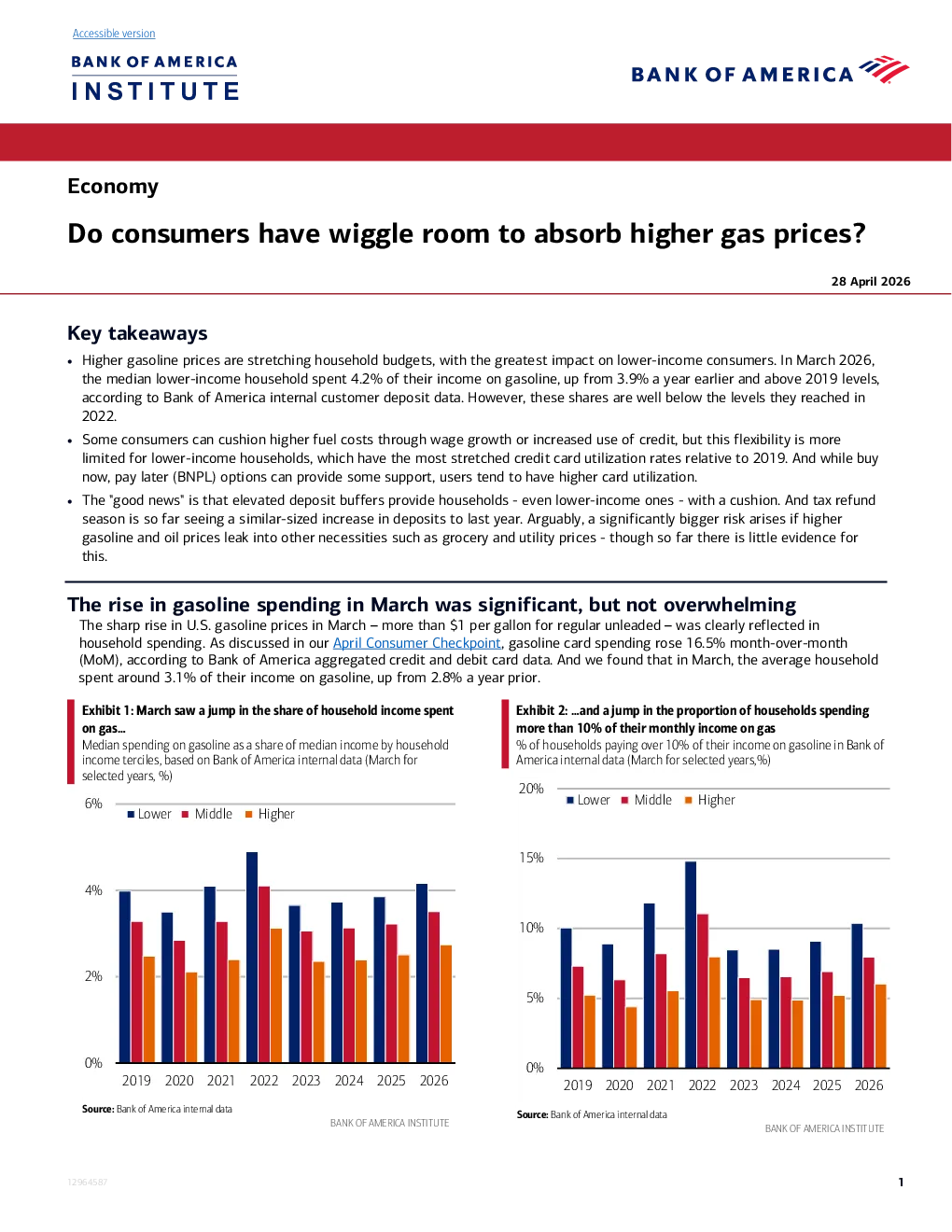
Do consumers have wiggle room to absorb higher gas prices? 28 April 2026 Key takeaways •Higher gasoline prices are stretching household budgets, with the greatest impact on lower-income consumers. In March 2026,the median lower-income household spent 4.2% of their income on gasoline, up from 3.9% a year earlier and above 2019 levels,according to Bank of America internal customer deposit data. However, these shares are well below the levels they reached in2022. •Some consumers can cushion higher fuel costs through wage growth or increased use of credit, but this flexibility is morelimited for lower-income households, which have the most stretched credit card utilization rates relative to 2019. And while buynow, pay later (BNPL) options can provide some support, users tend to have higher card utilization. •The "good news" is that elevated deposit buffers provide households - even lower-income ones - with a cushion. And tax refundseason is so far seeing a similar-sized increase in deposits to last year. Arguably, a significantly bigger risk arises if highergasoline and oil prices leak into other necessities such as grocery and utility prices - though so far there is little evidence forthis. The rise in gasoline spending in March was significant, but not overwhelmingThe sharp rise in U.S. gasoline prices in March–more than $1 per gallon for regular unleaded–was clearly reflected in household spending. As discussed in ourApril Consumer Checkpoint, gasoline card spending rose 16.5% month-over-month(MoM), according to Bank of America aggregated credit and debit card data. And we found that in March, the average householdspent around 3.1% of their income on gasoline, up from 2.8% a year prior. Exhibit1:March saw a jump in the share of householdincome spenton gas…Median spending on gasoline as a share of median income by household Exhibit2:…and a jump in the proportion of households spendingmore than 10% of their monthly income on gas% of households paying over 10% of their income on gasoline in Bank of income terciles, based on Bank of America internal data (March forselected years, %) America internal data (March for selected years,%) As would be expected, lower-income households are spending a higher share of their incomes on gas–with the medianhousehold in this cohort paying around 4.2% in March. For higher-income households, the figure is 2.7%. But we find that allincome cohorts saw a similar-sized increase compared to 2025. While the share of income spent on gasoline is higher than itwas in 2019, it remains well below its previous high in 2022 (Exhibit 1). Of course, some households spent more than the median (the middle of the distribution of households), and in Bank of Americadata we find that around 10% of lower-income households spent over 10% of their income on gasoline in March, compared toonly 6% of higher-income households who spent over 10% of their income on gasoline (Exhibit 2). Overall, then, it is householdsin the lowest income tercile who have generally been hit hardest by higher gasoline prices thus far, with some more exposedthan others–likely depending upon how much they drive and potentially if they use their car for work. It is, however, worth putting current spending on gasoline into a longer-term context. Using annual data from the Bureau ofLabor Statistics (BLS) Consumer Expenditure Survey,Exhibit 3shows the share of annual consumer expenditure on gasolinereached as high as 5% in 2008, 2011 and 2012. While this data runs only through 2024, looking at gasoline spending as a shareof income in Bank of America data for 2019-2026 indicates that it likely remains well off its historical highs (Exhibit 3). Exhibit3:The rise in spending on gasoline is relatively smallfrom a longer-run perspectiveShare of annual consumer expenditure on gasoline and other fuels according to the BLS Consumer Expenditure Survey (%, yearly) and the average share of gasoline as a percentage of average income in Bank of America customer deposit data (%, March for 2019-2026) What levers can households pull to support their spending?Faced with higher gasoline bills, some households may be inclined to trim their spending on other things. In the April Consumer Checkpoint (see:Consumer Checkpoint: The madness of March), we discussed how some areas of discretionary spending, suchas durable goods (e.g., furniture) and food services (e.g., restaurants), were candidates for a trim. Alongside this, previous sharprises in gas prices even appear to have led to a decline in the share of spending on groceries, perhaps as households trade down. But instead of making offsetting cuts elsewhere, could consumers simply spend more overall? Most obviously this would be a plausible response if, say, consumers thought the rise in gasoline prices was likely to betemporary. Additionally, if households were enjoying strong income growth, they might also find it easier to boost their totalspending and ride out the gas shock.