您的浏览器禁用了JavaScript(一种计算机语言,用以实现您与网页的交互),请解除该禁用,或者联系我们。 [ITIF]:美国科技公司应继续在中国运营 - 发现报告

美国科技公司应继续在中国运营

信息技术 2026-05-04 ITIF 张曼迪
报告封面

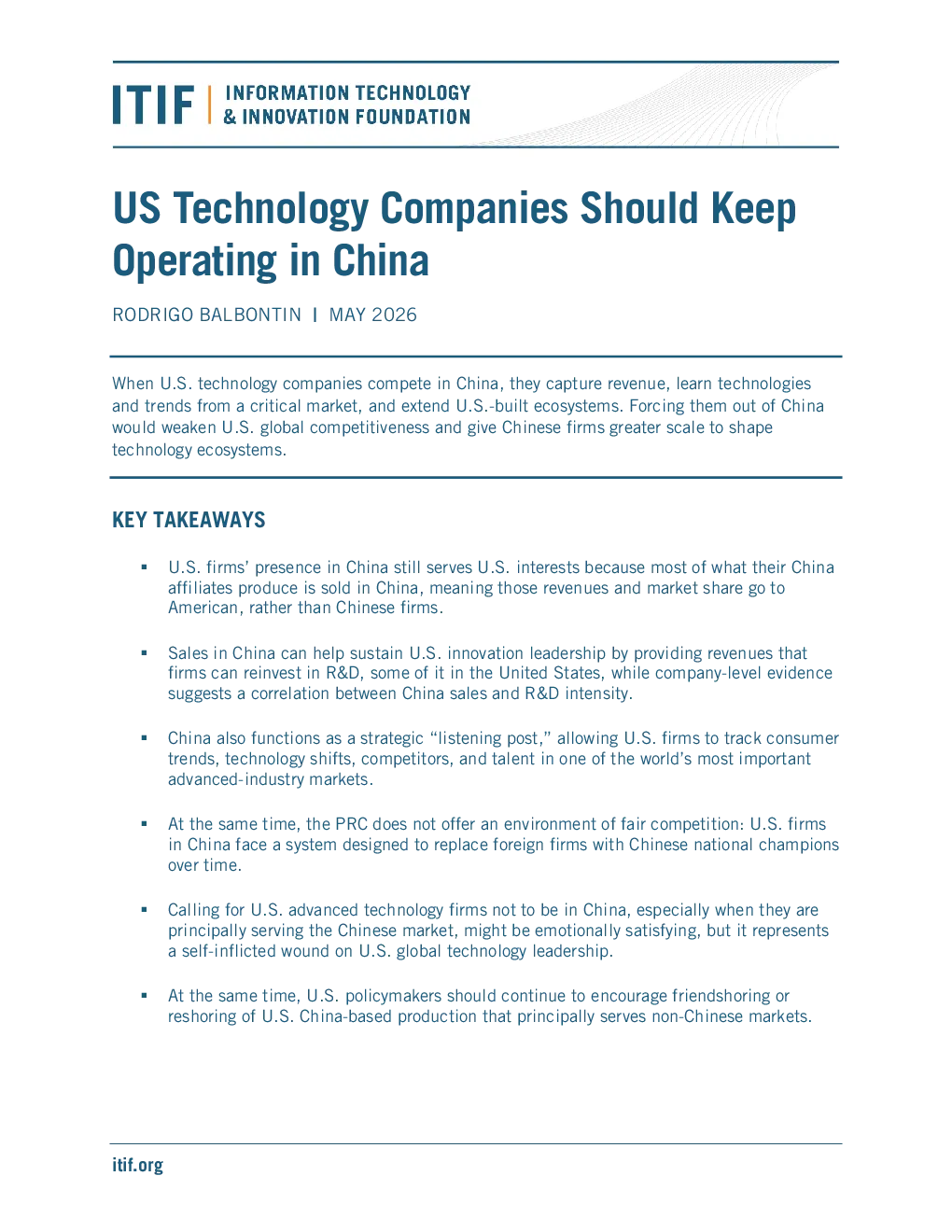
RODRIGO BALBONTIN|MAY 2026 When U.S. technology companies compete in China, they capture revenue, learn technologiesand trends from a critical market, and extend U.S.-built ecosystems. Forcing them out of Chinawould weaken U.S. global competitiveness and give Chinese firms greater scale to shape KEY TAKEAWAYS U.S. firms’ presence in China still serves U.S. interests because most of what their Chinaaffiliates produce is sold in China, meaning those revenues and market share go to Sales in China can help sustain U.S. innovation leadership by providing revenues thatfirms can reinvest in R&D, some of it in the United States, while company-level evidence China also functions as a strategic “listening post,” allowing U.S. firms to track consumertrends, technology shifts, competitors, and talent in one of the world’s most important At the same time, the PRC does not offer an environment of fair competition: U.S. firmsin China face a system designed to replace foreign firms with Chinese national champions Calling for U.S. advanced technology firms not to be in China, especially when they areprincipally serving the Chinese market, might be emotionally satisfying, but it represents At the same time, U.S. policymakers should continue to encourage friendshoring orreshoring of U.S. China-based production that principally serves non-Chinese markets. CONTENTS Key Takeaways................................................................................................................... 1Introduction....................................................................................................................... 2Mapping the Activities of U.S. Companies in China ............................................................... 3Sales of U.S. Companies in China..................................................................................... 4Capital Expenditure and R&D Investments in China............................................................ 7U.S. Companies’ Employees in China................................................................................ 9Profitability of U.S. Companies in China Has Declined in Recent Years .............................. 10Why It Matters: The Benefits of Having U.S. Companies in China.......................................... 12Access to Scarce STEM Talent ....................................................................................... 12 INTRODUCTION Many voices in Washington argue that U.S. companies should not be in China. This idea, whichwould represent a de facto decoupling from China, is not a consensus view, but it has supportfrom various constituencies. In 2022, Senator Rick Scott (R-FL) urged U.S. companies to “redirect supply chains and decouple their businesses from Communist China before its plannedinvasion of Taiwan.”1Furthermore, during his first administration, president Trump posted on social media that ‘ordered’ U.S. companies to “immediately start looking for an alternative toChina.”2Biden’s secretary of commerce, Gina Raimondo, stated in 2023 that U.S. companies complained that China was becoming “uninvestible.”3Others advocate incentives for companiesto exit China, arguing that keeping investments there “creates a dangerous business risk To be sure, some U.S. investments have helped build China’s manufacturing capacity and trainskilled engineers who now compete against American businesses, and U.S. companies should However, U.S. companies producing in China to serve the Chinese local market should not becontroversial. The Bureau of Economic Analysis (BEA) estimates that 70 percent, or $441billion, of what U.S. companies in China produced in 2023 was sold in the Chinese market. it is better to have American firms in China supplying that local market than Chinese firms This report argues that the discussion of forcing companies to exit the Chinese market is anoverreaction and fails to account for ways in which having American companies in China servesthe U.S. national interest. First, having a presence in the Chinese market is valuable because ithelps U.S. companies increase revenue and gain market share, which would otherwise accrue toChinese companies. The Chinese Communist Party (CCP) imposes unfair restrictions onaccessing the Chinese market, and producing in China for that market is one way U.S. firms cansell there. Second, there is a correlation between sales in China and global investment in The discussion of forcing companies to exit the Chinese market is an overreaction and fails to accountfor ways in which having American companies in China serves the U.S. national interest. The report begins with a summary of aggregated outcomes for U.S. companies in China,including revenues, capital expenditures, R&D investments, and other key indicators. It thenaddresses some of the boundaries of doing business in China, starting by outlining restrictions ondoing business with specific companies and how the People’s Republic of