您的浏览器禁用了JavaScript(一种计算机语言,用以实现您与网页的交互),请解除该禁用,或者联系我们。 [美股招股说明书]:摩根士丹利美股招股说明书(2026-05-04版) - 发现报告

摩根士丹利美股招股说明书(2026-05-04版)

2026-05-04 美股招股说明书 玉苑金山
报告封面

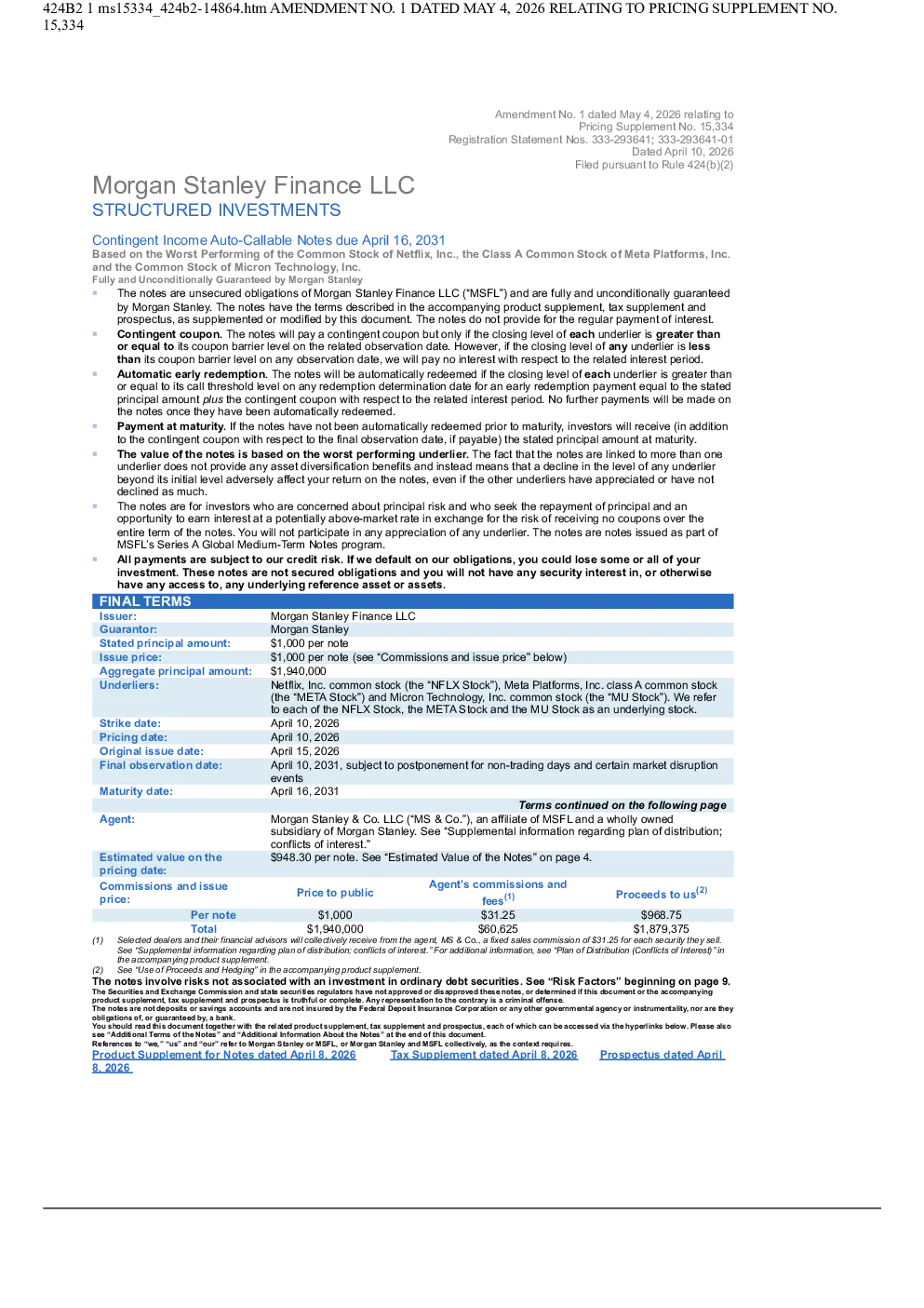
Contingent Income Auto-Callable Notes due April 16, 2031Based on the Worst Performing of the Common Stock of Netflix, Inc., the Class A Common Stock of Meta Platforms, Inc. and the Common Stock of Micron Technology, Inc.Fully and Unconditionally Guaranteed by Morgan Stanley■The notes are unsecured obligations of Morgan Stanley Finance LLC (“MSFL”) and are fully and unconditionally guaranteed by Morgan Stanley. The notes have the terms described in the accompanying product supplement, tax supplement andprospectus, as supplemented or modified by this document. The notes do not provide for the regular payment of interest. Contingent coupon.The notes will pay a contingent coupon but only if the closing level ofeachunderlier isgreater thanor equal toits coupon barrier level on the related observation date. However, if the closing level ofanyunderlier islessthanits coupon barrier level on any observation date, we will pay no interest with respect to the related interest period. ■Automatic early redemption. The notes will be automatically redeemed if the closing level ofeachunderlier is greater thanor equal to its call threshold level on any redemption determination date for an early redemption payment equal to the statedprincipal amountplusthe contingent coupon with respect to the related interest period. No further payments will be made onthe notes once they have been automatically redeemed. Payment at maturity.If the notes have not been automatically redeemed prior to maturity, investors will receive (in additionto the contingent coupon with respect to the final observation date, if payable) the stated principal amount at maturity. The value of the notes is based on the worst performing underlier.The fact that the notes are linked to more than one ■underlier does not provide any asset diversification benefits and instead means that a decline in the level of any underlierbeyond its initial level adversely affect your return on the notes, even if the other underliers have appreciated or have notdeclined as much. ■The notes are for investors who are concerned about principal risk and who seek the repayment of principal and anopportunity to earn interest at a potentially above-market rate in exchange for the risk of receiving no coupons over theentire term of the notes. You will not participate in any appreciation of any underlier. The notes are notes issued as part ofMSFL’s Series A Global Medium-Term Notes program. All payments are subject to our credit risk. If we default on our obligations, you could lose some or all of yourinvestment. These notes are not secured obligations and you will not have any security interest in, or otherwisehave any access to, any underlying reference asset or assets. Contingent Income Auto-Callable Notes Observation Dates and Coupon Payment Dates Contingent Income Auto-Callable Notes Contingent Income Auto-Callable Notes Estimated Value of the Notes The original issue price of each note is $1,000. This price includes costs associated with issuing, selling, structuring and hedgingthe notes, which are borne by you, and, consequently, the estimated value of the notes on the pricing date is less than $1,000.Our estimate of the value of the notes as determined on the pricing date is set forth on the cover of this document. What goes into the estimated value on the pricing date? In valuing the notes on the pricing date, we take into account that the notes comprise both a debt component and a performance-based component linked to the underliers. The estimated value of the notes is determined using our own pricing and valuationmodels, market inputs and assumptions relating to the underliers, instruments based on the underliers, volatility and other factorsincluding current and expected interest rates, as well as an interest rate related to our secondary market credit spread, which isthe implied interest rate at which our conventional fixed rate debt trades in the secondary market. What determines the economic terms of the notes? In determining the economic terms of the notes, we use an internal funding rate, which is likely to be lower than our secondarymarket credit spreads and therefore advantageous to us. If the issuing, selling, structuring and hedging costs borne by you werelower or if the internal funding rate were higher, one or more of the economic terms of the notes would be more favorable to you. What is the relationship between the estimated value on the pricing date and the secondary market price of the notes? The price at which MS & Co. purchases the notes in the secondary market, absent changes in market conditions, including thoserelated to the underliers, may vary from, and be lower than, the estimated value on the pricing date, because the secondarymarket price takes into account our secondary market credit spread as well as the bid-offer spread that MS & Co. would chargein a secondary market transaction of this type and other factors. However, because t