您的浏览器禁用了JavaScript(一种计算机语言,用以实现您与网页的交互),请解除该禁用,或者联系我们。 [美国银行]:Not exclusively mainstream: Consumer AI profiles - 发现报告

Not exclusively mainstream: Consumer AI profiles

信息技术 2026-03-01 美国银行 four_king
报告封面

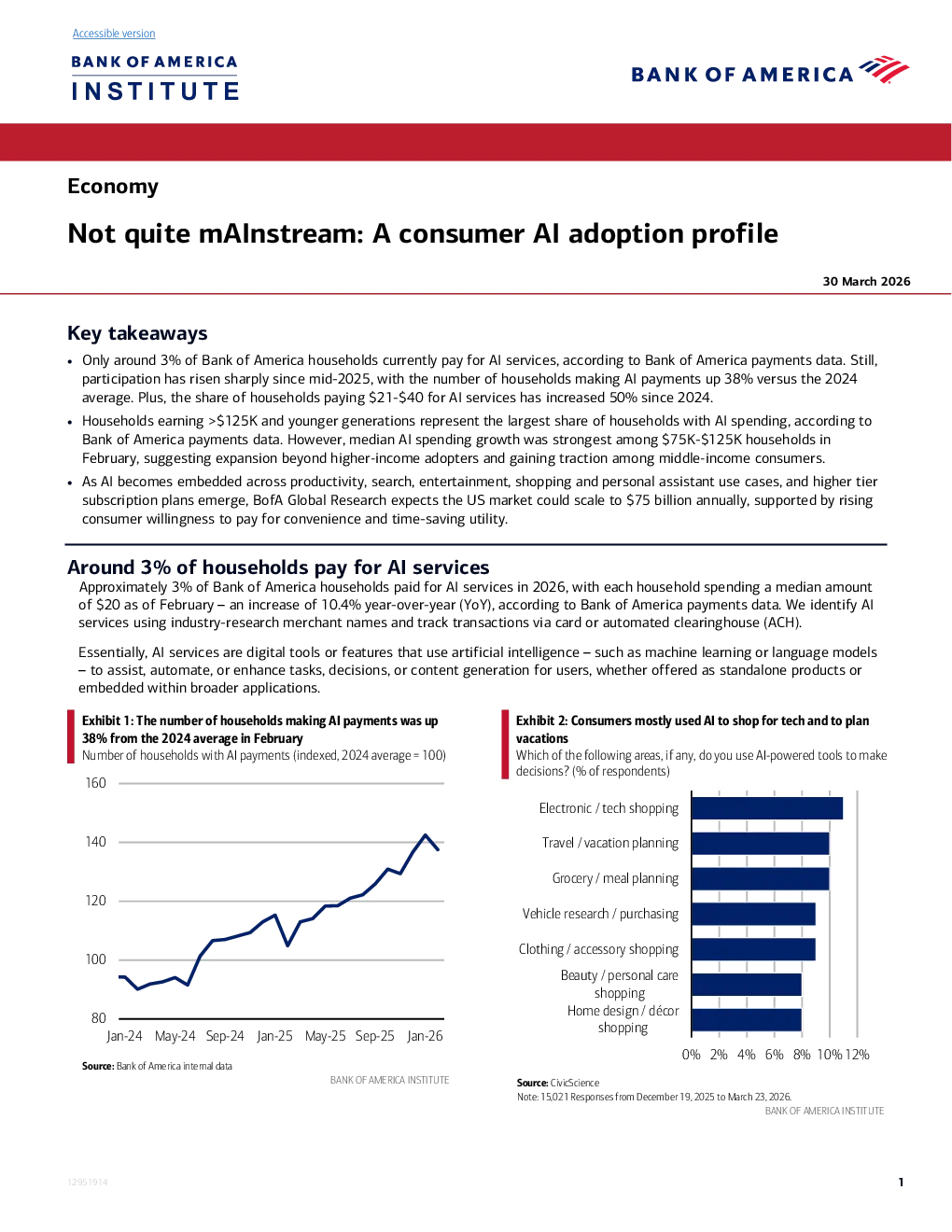
Not quite mAInstream: A consumer AI adoption profile Key takeaways Only around 3% of Bank of America households currently pay for AI services, according to Bank of America payments data. Still,participation has risen sharply since mid-2025, with the number of households making AI payments up 38% versus the 2024 •Households earning >$125K and younger generations represent the largest share of households with AI spending, according toBank of America payments data. However, median AI spending growth was strongest among $75K-$125K households in As AI becomes embedded across productivity, search, entertainment, shopping and personal assistant use cases, and higher tiersubscription plans emerge, BofA Global Research expects the US market could scale to $75 billion annually, supported by rising Around 3% of households pay for AI servicesApproximately 3% of Bank of America households paid for AI services in 2026, with each household spending a median amount of $20 as of February–an increase of 10.4% year-over-year (YoY), according to Bank of America payments data. We identify AI Essentially, AI services are digital tools or features that use artificial intelligence–such as machine learning or language models–to assist, automate, or enhance tasks, decisions, or content generation for users, whether offered as standalone products or Exhibit1:The number of householdsmakingAI payments was up38% from the 2024 average in February Which of the following areas, if any, do you use AI-powered tools to makedecisions? (% of respondents) Number of households with AI payments (indexed, 2024 average = 100) Increasingly, people are paying more to think lessAlthough many consumers may not pay for an AI subscription, they are more likely to do so when AI saves them time, bundles multiple tasks and reduces mental effort. According to Bank of America payments data, the number of households that pay for AIservices has surged 38% from the 2024 average (Exhibit 1). As AI becomes increasingly popular with consumers, more are expected to pay for“premium”versions versus free platforms,according to BofA Global Research. These premium features allow consumers to use AI tools for decision-making whenshopping, especially on tech or travel planning (Exhibit 2). Furthermore, of those households that do pay for AI services,approximately 60% of them pay $20 or less for AI services each month, according to Bank of America payments data (Exhibit 3). Who’s buying the AI hype?Looking at both income and generation, Bank of America data sheds light on who pays for AI. Currently, higher-income households (defined here as making >$125K) comprise the highest share of consumers with AIspending in the 12 months through February (Exhibit 4). Given discretionary pressures are most obvious for lower-incomehouseholds (read more on this in theMarch Consumer Checkpoint), it is unsurprising that higher-income households account for Interestingly, middle-income households’(defined here as those earning between $75K and $125K) median AI spending growthwas strongest in February on a three-month moving average basis, according to Bank of America payments data (Exhibit 5). Infact, this growth was more than double that of higher income, suggesting this cohort is increasingly supporting AI services Exhibit5:Middle-income households’($75K-$125K) median AIspending growth was strongest in February Exhibit4:The share of households with AI services spendingwasgreatest for the >$125K income cohort Median AI spending per household by income in February (3-monthmoving average, YoY%) Share of households with AI spend in the 12 months through February2026 (%) Younger generations are more likely to adopt AI Income isn’t the only differentiator when it comes to AI spending. There are generational differences, too. Bank of America datafound more Gen Z and younger Millennial households pay for AI services compared to older Millennials and Gen X, according toBank of America payments data (Exhibit 6). It’s also likely that some younger users may take advantage of free offerings or Still, Gen X and older Millennials’median spending growth per household on AI services has remained flat for the past year–uparound 42% and 28% from the 2024 average, respectively–whereas both Gen Z and younger Millennials’growth has increased Exhibit7:Gen Z and younger Millennials median AI spendinggrowthwas up around 54% from 2024 in February Median AI spending per household by generation (monthly, 3-monthmoving average, indexed, 2024 average =100) Most consumers have yet to start paying for AIAs AI increasingly becomes embedded in our daily lives, and higher-tier subscriptions emerge, BofA Global Research expects the US addressable market could scale to $75 billion annually, supported by rising consumer willingness to pay for convenience and Additionally, Agentic AI, according to BofA Global Research, marks the next structural transition, with tokens becoming a primarysource of val