印度尼西亚:油价与预算重新分配
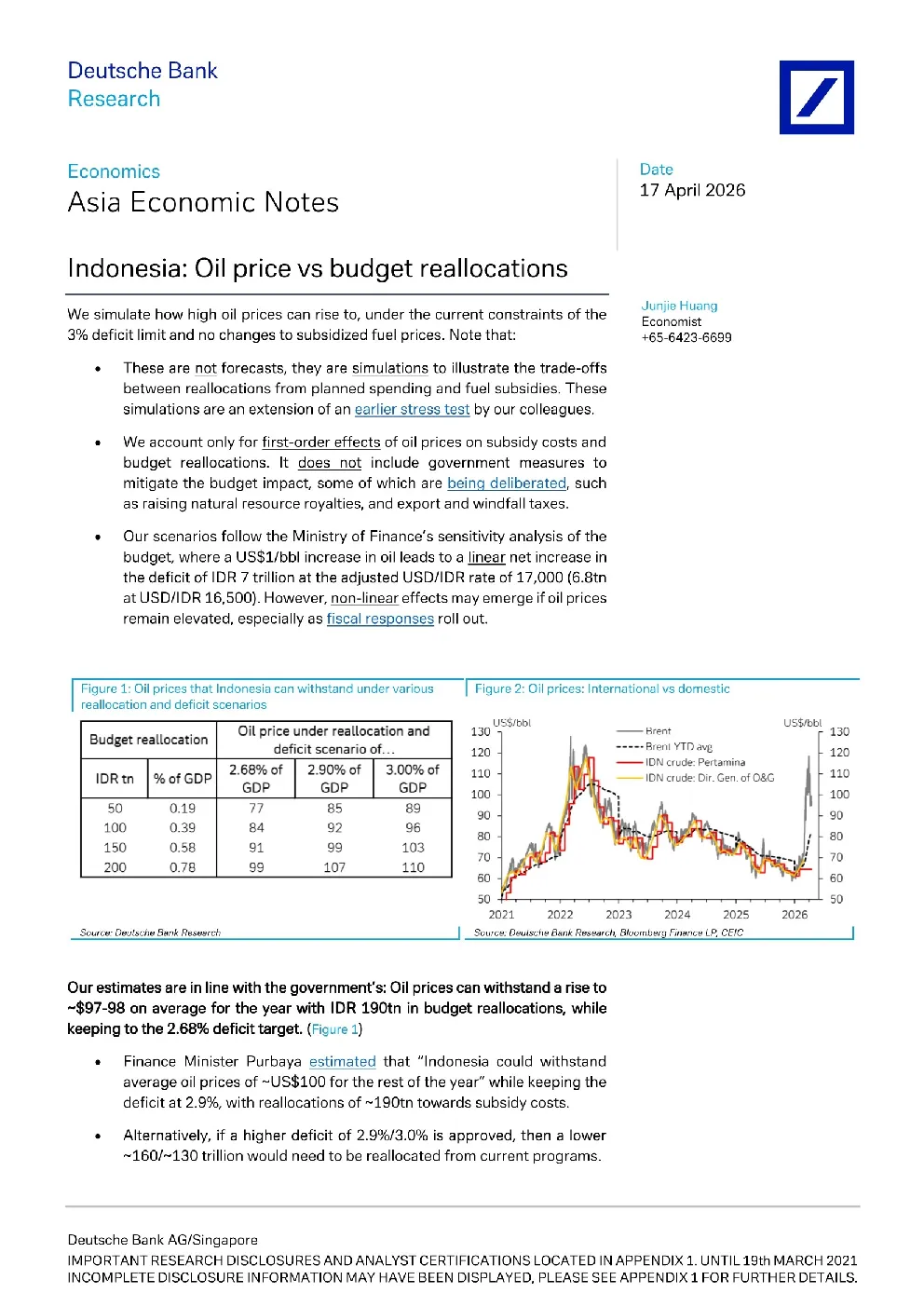
Indonesia: Oil price vs budget reallocations Economist+65-6423-6699 3% deficit limit and no changes to subsidized fuel prices. Note that: between reallocations from planned spending and fuel subsidies. Thesesimulationsareanextension of an earlierstresstest by our colleagues. budget reallocations. It does not include government measures tomitigate the budget impact, some of which are being deliberated, suchas raising natural resource royalties,and exportandwindfalltaxes. Our scenarios follow the Ministry of Finance's sensitivity analysis of thebudget, where a USs1/bbl increase in oil leads to a linear net increase inthedeficit of IDR7trillionattheadjusted USD/IDRrate of 17,000 (6.8tnatUSD/IDR16,500).However,non-lineareffects may emerge if oil pricesremain elevated, especially as fiscal responses roll out. Source: Deutsche Bank Research, Bloomberg Finance LP, CEIC Ourestimatesareinlinewiththegovernment's:Oilpricescanwithstandariseto~$97-98 on average for the year with IDR 190tn in budget reallocations, whilekeeping to the 2.68% deficit target. (Figure 1) Finance Minister Purbaya estimated that "Indonesia could withstandaverage oil prices of~Uss100forthe restoftheyear"whilekeeping thedeficit at 2.9%, with reallocations of ~190tn towards subsidy costs. Alternatively, if a higher deficit of 2.9%/3.0% is approved, then a lower~160/~130trillionwouldneedtobereallocatedfromcurrentprograms. Asia EconomicNotes the rest of the year to average ~100 for 2026. (Figure 2)Meanwhile, FM Purbaya has expressed reluctance to use the surplus budgetbalance(SAL)fornow,soreallocationsandamaximizationofthedeficit are likely actions to keep fuel prices at the subsidized levels. worries from sustaining fuel subsidies, in addition to global risk sentimentaffecting EM currencies more generally. IDR could range between 16,900-17,100for the next six months (prev: 16,850-16,900)—or until backlogs in the Straitclear—and end 2026 at ~16,950 (prev: 16,800).Beyond that, we forecast it togradually appreciate to ~16,750(prev:16,500)by end-2027.Our relativelysanguine forecast factors in (i) our view that Indonesia's medium-termfundamentals remain sound,despite the near-term uncertainty;and (i) DB'sviewthattheUSDfacesheadwinds Inflation.We revise 2026 and 2027inflation up to 3.0% (prev:2.8%)and 2.8%(prev:2.5%)respectively,to account for potential second-round effects fromhigher oil prices. We are not yet factoring in any raising of subsidized fuel prices,which the government has said could"stay in place until December".As a guide,we estimate a 25% rise in subsidized fuel prices could lead to headline inflationincreasing to 5-6% in the following 12months, froma baseline of 2-3%.(Figure 3) Growth.We downgrade 2026 growth slightlyto 4.9% (prev: 5%),as we think fiscalreallocations could lead to lowermultiplier effects on the economy,while higherimport bills could weigh on net exports. Bank Indonesia outlook.(see Bank Indonesia shifts to defense)We expect BI tostay in defense mode for the rest of this year by maintaining its policy rate at4.75% while guarding against rupiah volatility,amid the weak external outlookand heightened inflation expectations.There is risk of Bl hiking if (i)fuel subsidiesare lifted; (i) inflation is sustained above BI's 1.5-3.5% target with fuel subsidiesstill in place; (ii)IDR continues to weaken,adding to importedinflation pressures.(Figure 4) previously, vs the government's target of 2.68%. Higher fuel subsidy bills arelikely to make the initial target difficult to sustain.At the same time, excessivereallocations from existing operational budget risk negatively impacting theeconomy's productive capacity and overall societal well-being. We estimate acyclically neutral budget deficit of 2.2-2.4% of GDP. This suggests that there is awindow of IDR 70-120 trillion in reallocations before impacting essentialoperational needs,in ourview. Asia Economic Notes Appendix 1 The views expressed in this report accurately reflect the personal views of the undersigned lead analyst(s). In addition, the undersigned lead analyst(s) has not and will not receive any compensation for providing a specificrecommendation orview in this report. Junjie Huang. Prices are current as of the end of the previous trading session unless otherwise indicated and are sourced fromlocal exchanges via Reuters, Bloomberg and other vendors . Other information is sourced from Deutsche Bank, subjectcompanies, and other sources. For further information regarding disclosures relevant to Deutsche Bank Research,pleasevisitourglobal disclosurelook-uppage onourwebsite athttps://research.db.com/Research/Disclosures/FICCDisclosures. Aside from within this report, important risk and conflict disclosures canalsobefound athttps:/research.db.com/Research/Disclosures/Disclaimer.Investorsarestronglyencouragedtoreviewthisinformationbefore investing. AsiaEconomicNotes 'Deutsche Bank'). Though the information herein is believed to be reliable and has been ob