您的浏览器禁用了JavaScript(一种计算机语言,用以实现您与网页的交互),请解除该禁用,或者联系我们。 [奥雅纳(Arup)]:港口运营和海运工业用电 - 发现报告

港口运营和海运工业用电

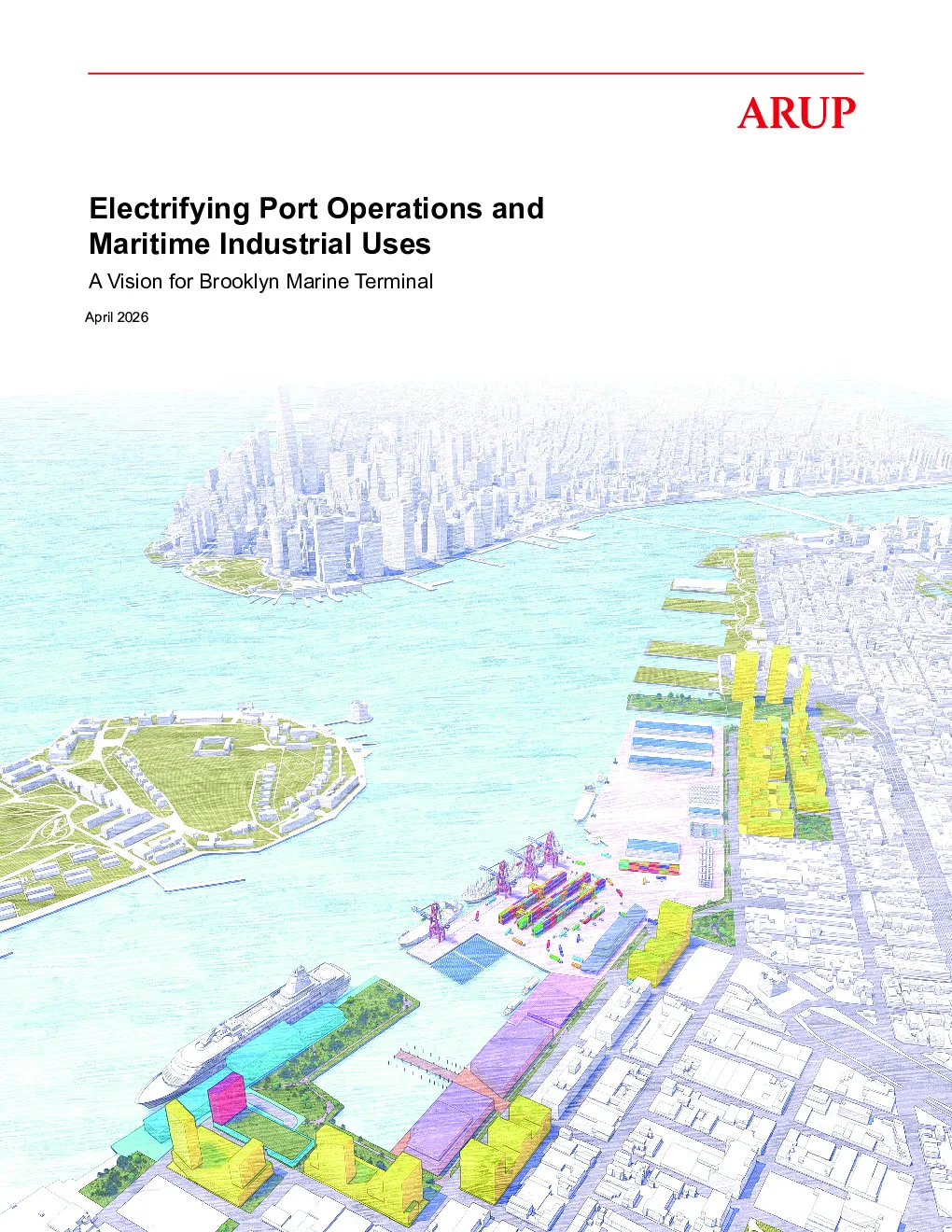
报告封面

A Vision for Brooklyn Marine Terminal April 2026 Executive Summary Achieving Full Electrification for Brooklyn Marine Terminal The maritime sector is beginning a shift toward low-carbon, resilient hubs to reduce local air pollution andgreenhouse gas emissions while improving efficiency.To accelerate this shift, ports, shipping lines, andoperators must update operations and assets and movefrom fossil fuels toward clean, electric systems. “With strategic preparation and expertadvice, ports can cut pollution whileincreasing energy resilience andoperational efficiencytoday.” The City of New York has a major opportunity to be atthe leading edge of this movement in North America.The City’sBrooklyn Marine Terminal (BMT) VisionPlan imagines transforming BMT into a modern,all-electric maritime port and mixed-use communityalong the Brooklyn waterfront. The Plan focuseson maintaining, modernizing, and electrifying theport to align with industry trends, remain financiallysustainable, and support efforts to move more freightby waterways under the Blue Highways initiative. Josh DeFlorioPrincipaljoshua.deflorio@arup.com The Vision: An All-Electric Brooklyn Marine Terminal Arup developed this concept paper to contributeto this Vision, drawing on our extensive globalport electrification work and strong New York Citypresence to assess the potential to fully electrifyBMT’s port elements. We apply real world insights,engineering knowledge, and grounded assumptions toconsider the following: Although BMT is currently constrained by electricalcapacity, our analysis indicates that full electrificationis likely feasible through a phased energy strategythat combines dynamic demand management withon-site renewable generation and energy storage.The Brooklyn Marine Terminal Vision offers acompelling pathway toward port electrification, moreefficient operations, and a cleaner environment for thecommunities it serves. •Components of an all-electric portWe identify the operations, assets, and systems of a future-state BMT, consistent with the City’s vision,and assess their potential for electrification. Weconsider both mature technologies and emergingstrategies that show promise for commercializationwithin the next 5-10 years.•Electrical demands and solutions About Arup As a global consultancy with over 500 staff based inNew York and New Jersey, Arup unites deep technicalexpertise and local understanding of New York’surban waterfront and energy challenges. We offercomprehensive experience in port electrification,shore power, cargo equipment, energy planning, portdecarbonization, and resilience. Demand management staggers concurrent power loads and shifts flexible loads to off-peak times.Starting with projected power requirements fora future BMT terminal, we evaluate practicaloperational and digital options to mitigate near-termelectrical capacity constraints.•Onsite energy generation and storage Further information on our maritime expertise can befound at:arup.com/markets/transport/maritime/ Even with demand management, BMT will likely need supply and storage strategies to accommodateheavy electrical loads. Onsite supply and storagecan meaningfully reduce reliance on grid imports,improve resilience, and support the transition toa low-carbon energy system. We assess on-siterenewables, such as solar PV, to supplement gridpower, and energy storage systems to capture surplusenergy off-peak and discharge it during spikes. The Opportunity: A Modern, All-Electric Urban Port Current Operations at BrooklynMarine Terminal Cruise •Brooklyn Cruise Terminal, currentlyreceives ~40 vessels per year.•By 2040, it is projected that the totalnumber of passengers per year will reachmore than 800,000.•Plans for a new cruise terminal includingintegrated public open space and anadjacent hotel in Atlantic Basin. The BMT is nestled amid a dense and diverseurban community in Brooklyn, New York. Theterminal currently serves smaller containervessels up to 4,000 TEU, handling around90,000 container moves annually, with regularweekly and bi-weekly services to the Caribbean,Central America, and West Africa, as well asbarge operations to New Jersey. Cruise activityis also significant, with the Brooklyn CruiseTerminal (BCT) accommodating regular callsfrom major cruise lines. BMT operates on a 60-acre site, five days a week. Container •The City aims to grow container operationsto around 135,000 moves per year byadding one additional regular shippingservice.•Expansion enabled by a new port layout,reconfigured pier, modern cargo handlingequipment, and updated infrastructure.•Potential to scale up to 170,000 movesannually by extending operations into theflex maritime zone.•Future terminal layout and equipmentchoices are yet to be finalized. Assumedterminal setup: RTG cranes and trucktrailer units, supporting densification andfreeing space for further development. New York City’s Vision for BMT In 2024, the City of New York acquired theproperty fro