美元的余震
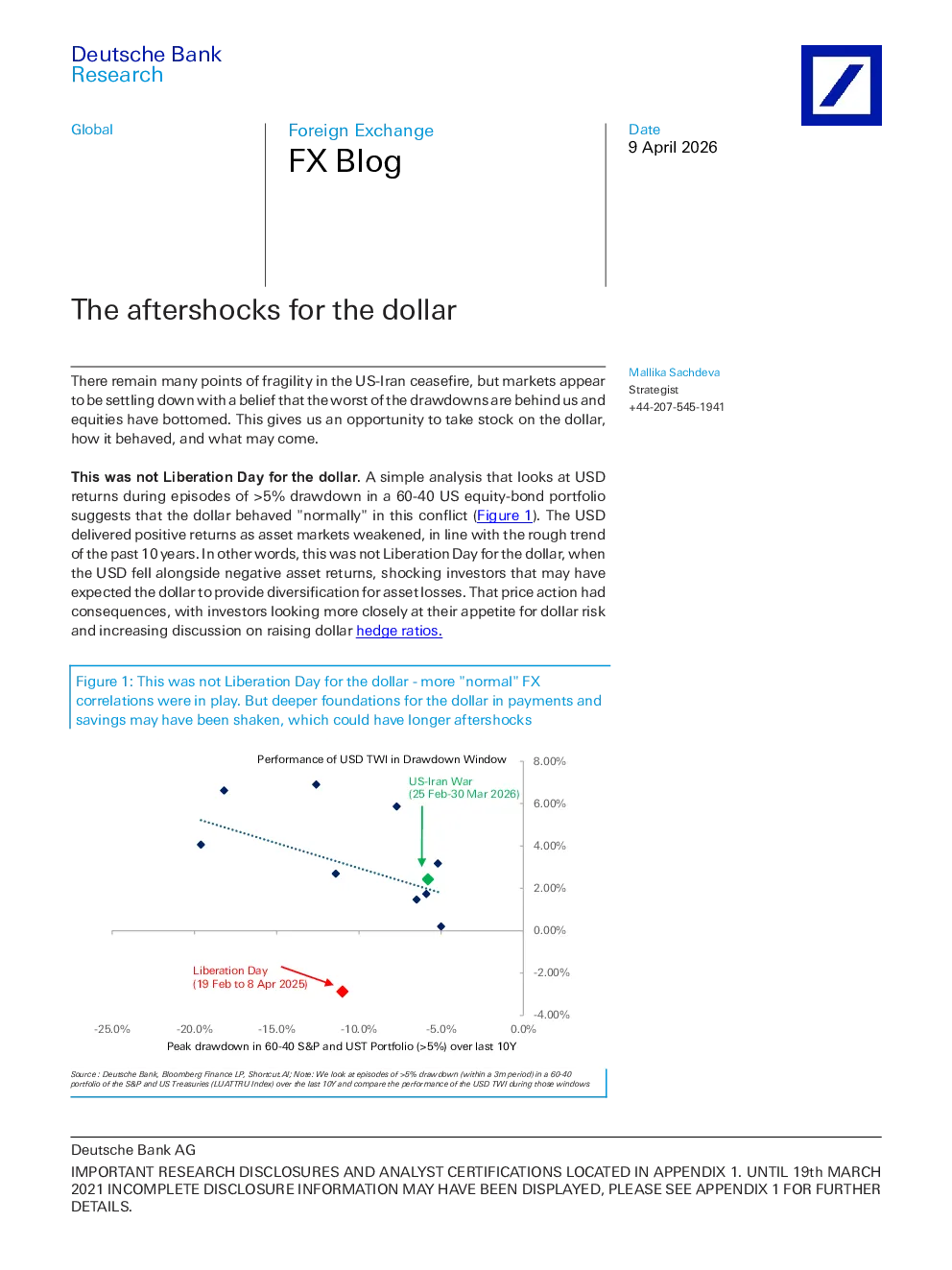
Mallika SachdevaStrategist There remain many points of fragility in the US-Iran ceasefire, but markets appearto be settling down with a belief that the worst of the drawdowns are behind us andequities have bottomed. This gives us an opportunity to take stock on the dollar, This was not Liberation Day for the dollar.A simple analysis that looks at USDreturns during episodes of >5% drawdown in a 60-40 US equity-bond portfoliosuggests that the dollar behaved "normally" in this conflict (Figure 1). The USDdelivered positive returns as asset markets weakened, in line with the rough trendof the past 10 years. In other words, this was not Liberation Day for the dollar, when Figure 1: This was not Liberation Day for the dollar - more "normal" FXcorrelations were in play. But deeper foundations for the dollar in payments and But the dollar's price action in the recent conflict is little source for relief.Whilecorrelationsmay have optically behaved better,we think some structuralfoundations of the dollar have been shaken over the past few weeks: namely the Last year, investors worried about the dollar's risk diversifying properties andsought to adjust exposure after the Liberation Day shock. Greater attention tohedge ratios meant that the dollar continued to weaken well after asset markets As the conflict settles, we share three key points of focus for the dollar long-term: 1. The foundations of the petrodollar have been shaken.We have written in depthabout how dollar dominance in payments and savings is built on the petrodollar,which in turn is a function of US security guarantees for the Gulf. In very simpleterms, the world saves in dollars because it pays for everything in dollars. Goods andservices are priced in dollars in large part because oil is priced in dollars. Oil is pricedin dollars because of an arrangement wherein the US provides security to theworld's biggest oil exporters. Our geopolitical experts now note that the "long-standing Middle East geopolitical equilibrium has been shattered" by this conflictwith the "Gulf paying the price". They see this as inevitably impacting theirrelationship with the US and driving more diversification in Gulf relations. While areshaping in the broader security relationship may take time, there are immediatesign posts for markets to heed. The Straits of Hormuz are crucial for global security 2. The world’s biggest savers may need to use their own savings.The two regionsin the world whose security risks have come to the fore in the last few weeks are theGulf and Asia – with defence and energy security respectively. Crucially, theseregions account for over 60% of central bank reserves and over 70% of sovereignwealth fund savings. Saudi Arabia had already committed under Vision 2030 to“localize over 50 percent of military equipment spending by 2030”. Theseambitions may well accelerate and be adopted more widely in the region (see here).For Asia, this conflict has laid bare the significant dependence on imported MiddleEast oil (see here). We would anticipate more investments in building domestic 3. Long-term trade flows in energy could shift to electro-states like China fromdollar-based petrostates.One potential silver lining for the US from this conflict may have been if the world began to redirect oil demand away from the Middle Easttowards the US. The US is after all the largest producer of crude oil in the world. Theproblem with this for now is that the US largely consumes what it produces, a pointwe explored in a recent piece. While the US appears to be looking to gain greaterleverage over Western Hemispheric oil, including Venezuela, this will take time todevelop. In the meantime, the country that may stand to supply energy into a globalmarket looking to diversify away from Middle East fossil fuels may be China, whichhas built significant excess capacity in electric vehicles and renewable energytechnology. Around half of China's green tech exports already go to emerging In conclusion, we would not take comfort in the dollar's recent performance duringthe US-Iran conflict. While the dollar did better as a diversifier for asset market riskin the short-term, we think deeper structural foundations for the dollar may have Appendix 1 Important Disclosures *Other information available upon request *Prices are current as of the end of the previous trading session unless otherwise indicated and are sourced from localexchanges via Reuters, Bloomberg and other vendors . Other information is sourced from Deutsche Bank, subject companies,and other sources. For further information regarding disclosures relevant to Deutsche Bank Research, please visit our globaldisclosure look-up page on our website at https://research.db.com/Research/Disclosures/FICCDisclosures. Aside from withinthis report, important risk and conflict disclosures can also be found at https://research.db.com/Research/Disclosures/ Analyst Certification The views expressed in this report accurately r