您的浏览器禁用了JavaScript(一种计算机语言,用以实现您与网页的交互),请解除该禁用,或者联系我们。 [联合国]:改革贸易规则以推动发展 - 发现报告

改革贸易规则以推动发展

商贸零售 2026-03-16 联合国 七个橙子一朵发🍊
报告封面

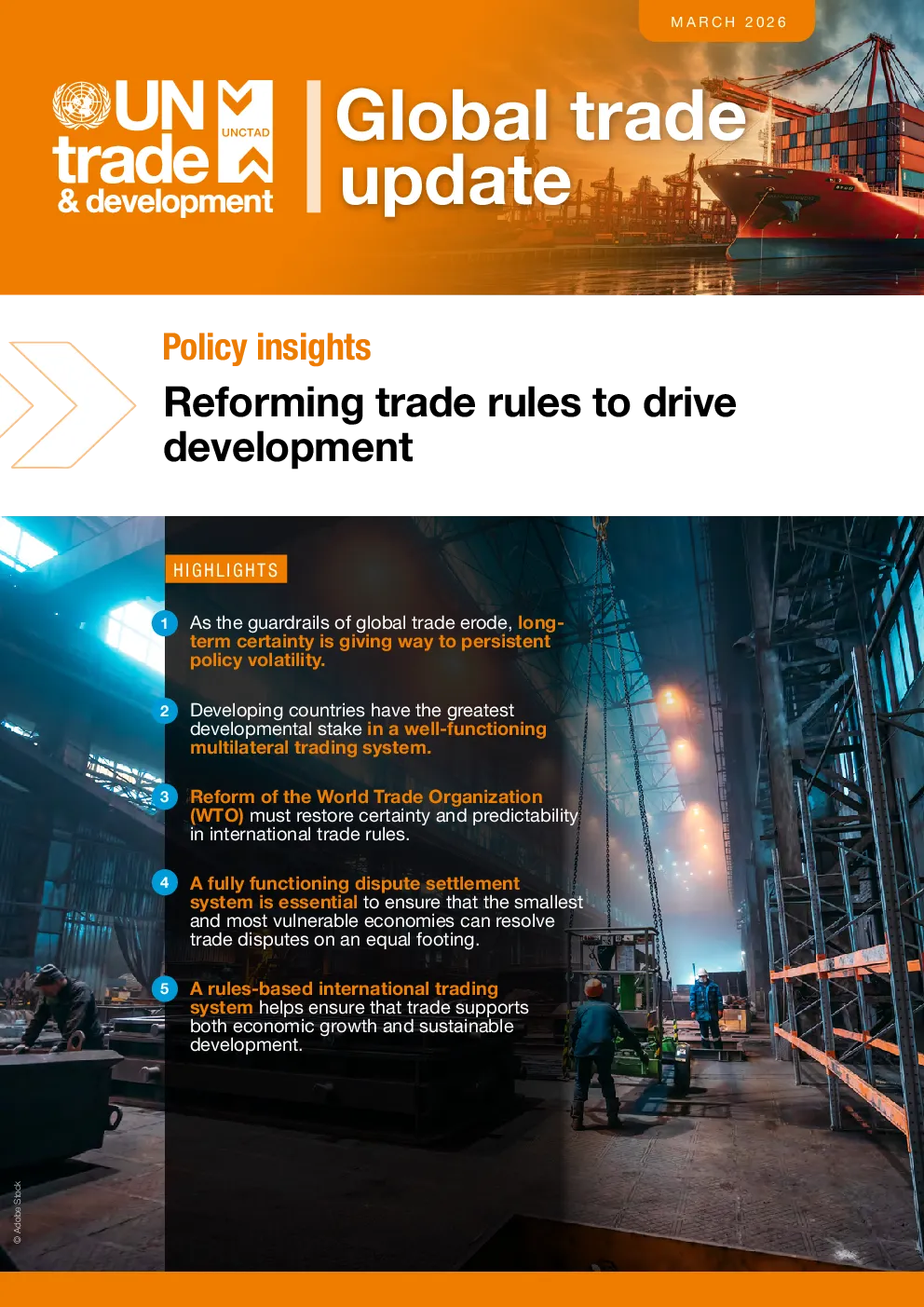
Policy insights Reforming trade rules to drive H I G H L I G H T S 1As the guardrails of global trade erode,long-term certainty is giving way to persistentpolicy volatility. 2Developing countries have the greatestdevelopmental stakein a well-functioningmultilateral trading system. 3Reform of the World Trade Organization(WTO)must restore certainty and predictabilityin international trade rules. 4A fully functioning dispute settlementsystem is essentialto ensure that the smallestand most vulnerable economies can resolvetrade disputes on an equal footing. A rules-based international tradingsystemhelps ensure that trade supportsboth economic growth and sustainable5 The multilateral trading system has played a fundamental role in shaping the global economyover the past several decades. Through a framework of negotiated rules and commitments, In recent years, however, the predictability of global trade rules has weakened. Some economieshave moved away from multilateral trade principles toward the use of trade measures to advanceindustrial policy objectives, national security priorities, and geopolitical competition. This shift Against this backdrop, discussion on reform of the World Trade Organization (WTO) has becomeincreasingly important. On March 26–29, 2026, the WTO’s 166 members will meet in Cameroonwith a shared mandate to advance reforms aimed at improving the organization’s functionality,strengthening its effectiveness, and facilitating the full participation of all members in its work. Acentral challenge is ensuring that WTO reform adequately reflects the priorities anddevelopment needs of developing economies. The key question is thereforewhat kind of WTOreform developing economies need to harness trade opportunities for development?Answering This issue of the Global Trade update examines several areas that are particularly relevantfrom a development perspective, including the role of the Most-Favoured Nation principle, theimportance of predictable market access for goods and services, the need for an effective Development must remaincentral to WTO reform efforts Developingcountries have high stakes in a well-functioning WTO because theorganization underpins the stable, predictable market access that these economiesrely on for growth.Over the past 20+ years, trade has been a central driver of economicexpansion for many developing countries. Integration into global markets facilitates investment,technology diffusion, job creation, and opportunities to move into higher-value activities. Exportearnings generate the foreign exchange needed to finance imports of capital goods, energy, and Yet despite decades of commitments within the multilateral trading system to supportdevelopment, the ability of many developing economies to participate fully and benefit For many developing countries, especially the small and vulnerable, development-oriented provisions have not generally resulted in actual market access or valueaddition,raising fundamental questions about the effectiveness of existing rules andreinforcing calls for more operational, impactful mechanisms to support a favourable integrationof least developed countries (LDCs) into global trade. In particular, the United Nations Doha Target and Actual Paths of LDC Export Share in World Merchandise Trade Without the WTO, many developing countries have no reliable legal frameworkto trade with one another.The multilateral trading system has been fundamental to theexpansion of South–South trade by providing a global forum where all developing countriescan trade under a shared, predictable, and non-discriminatory set of rules.Indeed, WTOrules have supported the rapid rise of South–South trade, which increased from about South-South trade outpaced developing countries’ exports to North andworld trade growth The role of services in the global economy has expanded rapidly in recent decades;however, many areas still lack significant multilateral commitments.Knowledge-intensiveand digitally deliverable services are increasingly central to economic growth, technologicalinnovation,and international competitiveness.For developing economies,participation inservices trade offers critical opportunities for structural transformation. Expanding serviceexports can help diversify economies beyond traditional goods sectors, generate higher value-added activities, and create new employment opportunities in modern sectors such as IT, Marginalization in services trade is particularly evident for LDCs.These countries havelargely remained outside of the opportunities offered by global services trade. Since 2010, LDCshave accounted for less than 1 per cent of global services exports (Figure 3), with their sharedeclining further during the pandemic to just 0.59 per cent in 2024, slightly below the 0.60 percent recorded in 2010. Between 2014 and 2024, LDC services exports grew at an average Services exports from LDCs remain a small part of global services exports2010