韩国:市场稳定措施
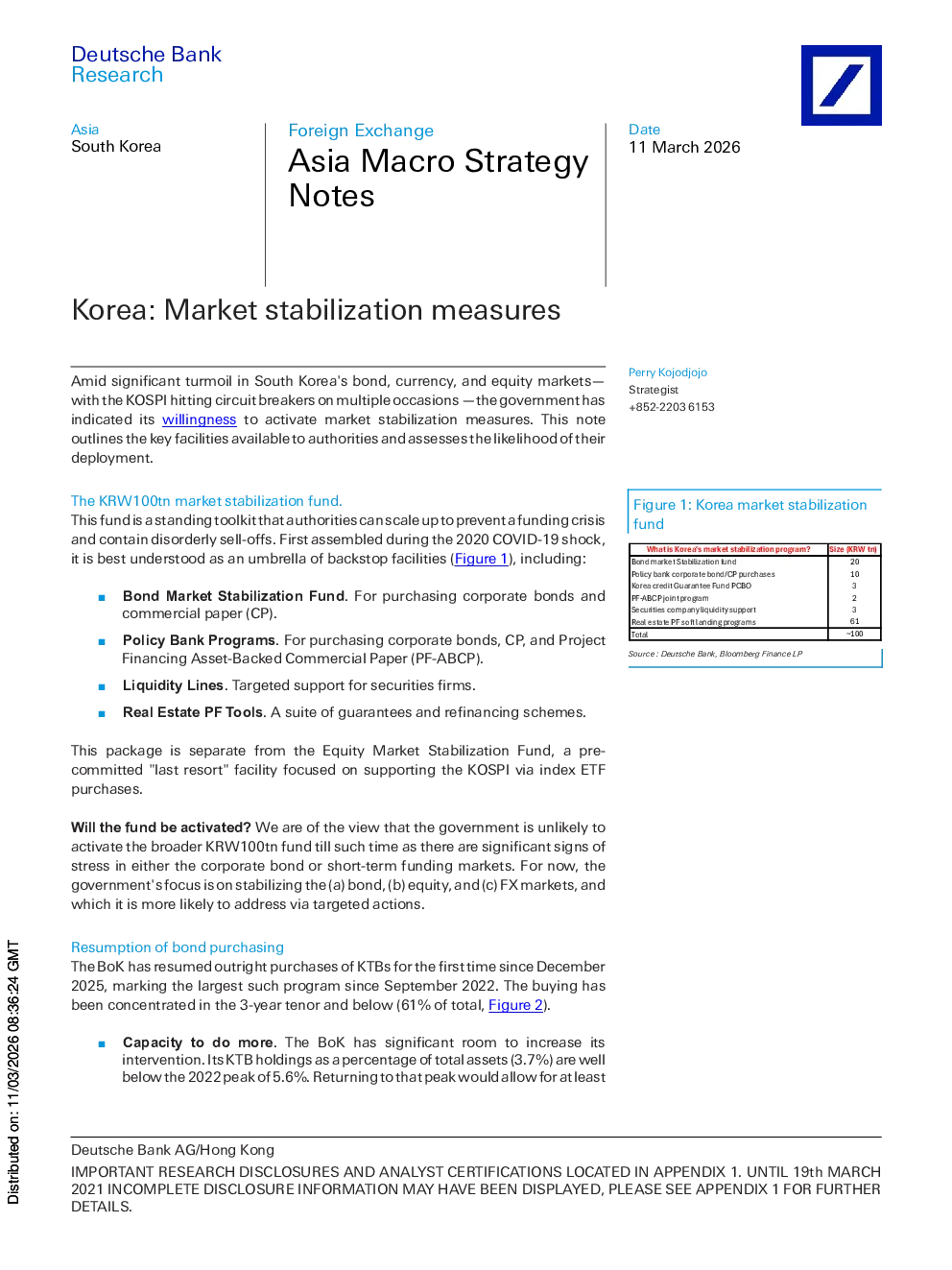
AsiaSouth Korea Asia Macro StrategyNotes Korea: Market stabilization measures Perry KojodjojoStrategist+852-2203 6153 Amid significant turmoil in South Korea's bond, currency, and equity markets—with the KOSPI hitting circuit breakers on multiple occasions —the government hasindicated its willingness to activate market stabilization measures. This noteoutlines the key facilities available to authorities and assesses the likelihood of theirdeployment. The KRW100tn market stabilization fund. This fund is a standing toolkit that authorities can scale up to prevent a funding crisisand contain disorderly sell-offs. First assembled during the 2020 COVID-19 shock,it is best understood as an umbrella of backstop facilities (Figure 1), including: nBond Market Stabilization Fund. For purchasing corporate bonds andcommercial paper (CP).nPolicy Bank Programs. For purchasing corporate bonds, CP, and ProjectFinancing Asset-Backed Commercial Paper (PF-ABCP).nLiquidity Lines. Targeted support for securities firms.nReal Estate PF Tools. A suite of guarantees and refinancing schemes. This package is separate from the Equity Market Stabilization Fund, a pre-committed "last resort" facility focused on supporting the KOSPI via index ETFpurchases. Will the fund be activated?We are of the view that the government is unlikely toactivate the broader KRW100tn fund till such time as there are significant signs ofstress in either the corporate bond or short-term funding markets. For now, thegovernment's focus is on stabilizing the (a) bond, (b) equity, and (c) FX markets, andwhich it is more likely to address via targeted actions. Resumption of bond purchasingThe BoK has resumed outright purchases of KTBs for the first time since December 2025, marking the largest such program since September 2022. The buying hasbeen concentrated in the 3-year tenor and below (61% of total, Figure 2). nCapacity to do more. The BoK has significant room to increase itsintervention. Its KTB holdings as a percentage of total assets (3.7%) are wellbelow the 2022 peak of 5.6%. Returning to that peak would allow for at least 11 March 2026Asia Macro Strategy Notes KRW10tn in purchases. During 2020, BoK had bought ~KRW11tn of KTBs(Figure 3). Further support could come from the Ministry of Economy andFinance's (MoEF) own buyback program. While these purchases are primarily intended to manage market volatility ratherthan fundamentally alter yield direction, we think the government will need to takemore active measures.This could include (a) a more regular bond purchasingprogram, which can also help loosen monetary conditions that have beentightening since February (Figure 4) and (b) a more aggressive program.Note thatKTBs make up 3.7% of BOK’s total assets now, vs ~10% in early 1990s, when it washelping support the government bond market and for liquidity managementpurposes. Activating the equity stabilization fundGiven sustained volatility, there is an increasing chance that the authorities may have to activate the Equity Stabilization Fund. This was first created in 1990, as ajoint public-private vehicle that has been expanded during periods of extremestress, including the 2008 GFC and the 2020 pandemic. It was last activated in 2008,deploying KRW515bn. The fund, which currently stands at around KRW10–11tn, isdesigned to buy KOSPI-linked index products (e.g., KOSPI 200 ETFs). Given the current size is small, less than 0.5% of the KOSPI's market capitalizationand foreign ownership in value terms, the government could "top it up" by invitingmore financial institutions to contribute or by increasing the committed capitalceiling. Alternatively they could adjust the NPS's investment allocation to increaseits domestic equity holdings. Absent that, the fund will unlikely be sufficient inmanaging KOSPI volatility particularly since foreign investors still own ~35% of theequity market as of February. How to Track:Monitor gross purchase data of KOSPI instruments by governmentand pension funds. The 2008 intervention was visible through notable purchases inlate December 2008 and early February 2009 (Figure 5). More active FX management To counter KRW weakness, we expect measures to limit capital outflows fromdomestic investors. nRetail investors.The government should introduce more tax incentives forrepatriatingoverseas earnings.We are looking for the ReshoringInvestment Account (RIA) to be approved during the special Parliamentarysession on March 19.nInstitutional investors. Authorities could encourage the NPS to be moreactive in FX hedging, potentially by adjusting its overseas investment limitsor lowering its hedging activation threshold (currently near USD/KRW1500, Figure 6). Implications. FX.The geopolitics of oil is likely to keep KRW vulnerable in the near term. However,the measures to slow domestic outflows, coupled with upcoming WGBI inclusion,a widening current account surplus, and a cheap FX valuation, support a moreconstructive medium-t