您的浏览器禁用了JavaScript(一种计算机语言,用以实现您与网页的交互),请解除该禁用,或者联系我们。[国际能源署]:国际能源署PVPS国家更新2025 - 发现报告

国际能源署PVPS国家更新2025

国际能源署PVPS国家更新2025

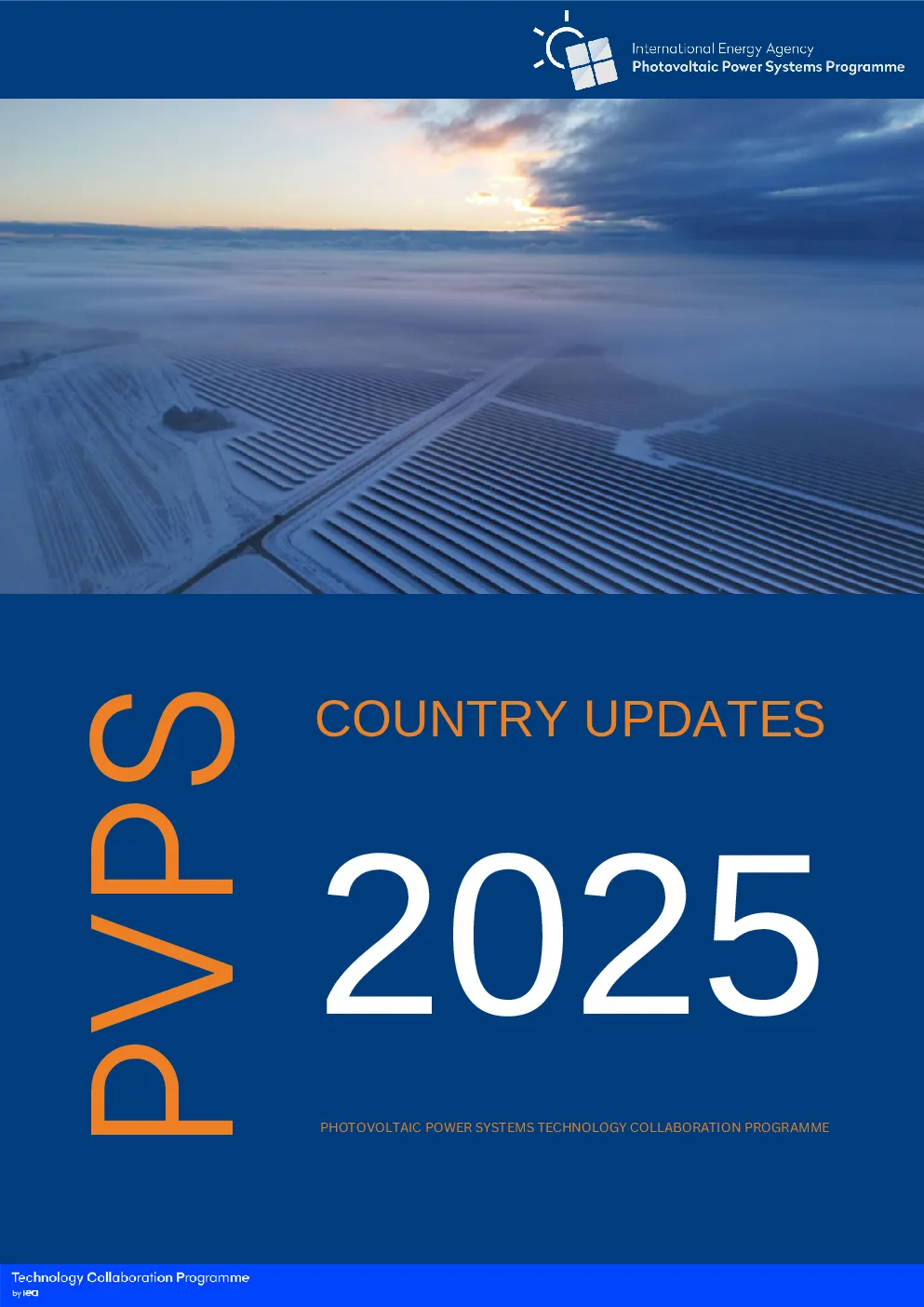
PVPS2025 PHOTOVOLTAIC POWER SYSTEMS TECHNOLOGY COLLABORATION PROGRAMME PHOTOVOLTAIC POWER SYSTEMS PROGRAMME Country Updates 2025 DISCLAIMER The IEAPVPS TCP is organised under the auspices of the International EnergyAgency (IEA) but is functionally and legallyautonomous. Views, findings and publications ofthe IEA PVPS TCP do not necessarily represent the views or policies of the IEA Secretariat or its individual member countries. COPYRIGHT STATEMENT This content may be freely used, copied and redistributed, provided appropriate credit is given (please refer to the ‘Suggested Citation’). The exception is that somelicensed images may not be copied, as specified in the individual image captions. COVER PICTURE MWp utility-scale project in Stourup, Denmark. The plant is owned by 3 local companies who also are the offtakes of the electricity produced. Owners engineer is Unison EnergyPartners. Photo credit Solar Polaris. ISBN 978-1-923734-02-9 TABLE OF CONTENTS PHOTOVOLTAIC POWER SYSTEMS PROGRAMME4 INTERNATIONAL ENERGY AGENCY4IEA PVPS MISSION AND OBJECTIVES5 PHOTOVOLTAIC POWERSYSTEMS PROGRAMME INTERNATIONAL ENERGY AGENCY IEA PVPS The International Energy Agency (IEA), founded in November 1974, is anautonomousbody within the framework of the Organisation forEconomic Cooperation and Development(OECD), which carries out acomprehensive programme of energy cooperation among its membercountries. The European Union also participates in the IEA’s work.Collaboration in research, development and demonstration (RD&D) ofenergytechnologies has been an important part of the IEA’sProgramme. The IEA Photovoltaic Power Systems Programme (PVPS) is one of theTechnology Collaboration Programmes (TCP) established within theIEA, and since its establishment in 1993, the PVPS participants havebeen conducting a variety of joint projects in the application ofphotovoltaic conversion of solar energy into electricity. Theoverall programme is headed by an Executive Committeecomposed of representatives from each participating country andorganisation, while the management of individual research projects(Tasks) is the responsibility of Task Managers. The IEA RD&D activities are headed by the Committee on Research andTechnology(CERT),supported by the IEA secretariat staff,withheadquarters in Paris. In addition, five Working Parties on IndustrialDecarbonization, Buildingand Transport, Fossil Energy and CarbonManagement, Renewable Energy Technologies and Fusion Power, arecharged with monitoring the various collaborative energy agreements,identifying new areas of cooperation and advising the CERT on policymatters. By the beginning of 2025, twenty Tasks were established within the PVPSprogramme, of which nine are currently operational. The thirty-onePVPS membersinclude twenty-eight countries:Australia, Austria,Belgium, Canada, China, Denmark, Finland, France, Germany, India,Israel,Italy,Japan,Korea,Lithuania,Malaysia,Morocco,theNetherlands,Norway,Portugal,South Africa,Spain,Sweden,Switzerland, Thailand, Türkiye, the United States of America, and theUnitedKingdom plus three sponsor members:the EuropeanCommission, Solar Power Europe and the Solar Energy ResearchInstitute of Singapore. The Renewable Energy Technologies Working Party (REWP) overseesthe work of twelve renewable energy agreements and is supported bythe RenewableEnergy Division, Directorate of Energy Market andSecurity at the IEA Secretariat in Paris, France. MISSION AND OBJECTIVES CURRENT TERM 2023-2028 In its 7th term from 2023 to 2028 IEA PVPS continues its commitment toadvancinginternational cooperation in the field of photovoltaictechnology. With many member countries contributing to its successover the past 29 years, PVPS outlines a strategic orientation aimed atsupporting the overarching goals of IEA in terms of energy security,climate change mitigation, and economic competitiveness. The focus ofthis strategic plan is to empower photovoltaic technology to not onlymeet but surpass the targets outlined in the IEA’s “Net Zero 2050Scenario.” The mission of the IEA PVPS programme is: Enhance the international collaborative efforts which facilitate therole of photovoltaic solar energy as a cornerstone in the transitionto sustainable energy systems. The IEA PVPS programme aims to realise its mission through thefollowing objectives related to reliable PV power system applications,contributing to sustainability in the energy system and a growingcontribution to CO2mitigation: The significance of photovoltaic technology has been steadily rising,with its emergence as one ofthe most cost-effective means ofelectricity production. Its attributes including rapid deployability, easeof installation, and minimal maintenance costs have positioned it as akey player in the global transition towards clean energy systems.Moreover, PV’s impact extends beyond the energy sector, infiltratingvarious domains such as buildings, transportation, agriculture, andindustrial processes. •PV