另辟蹊径锁定未来收益
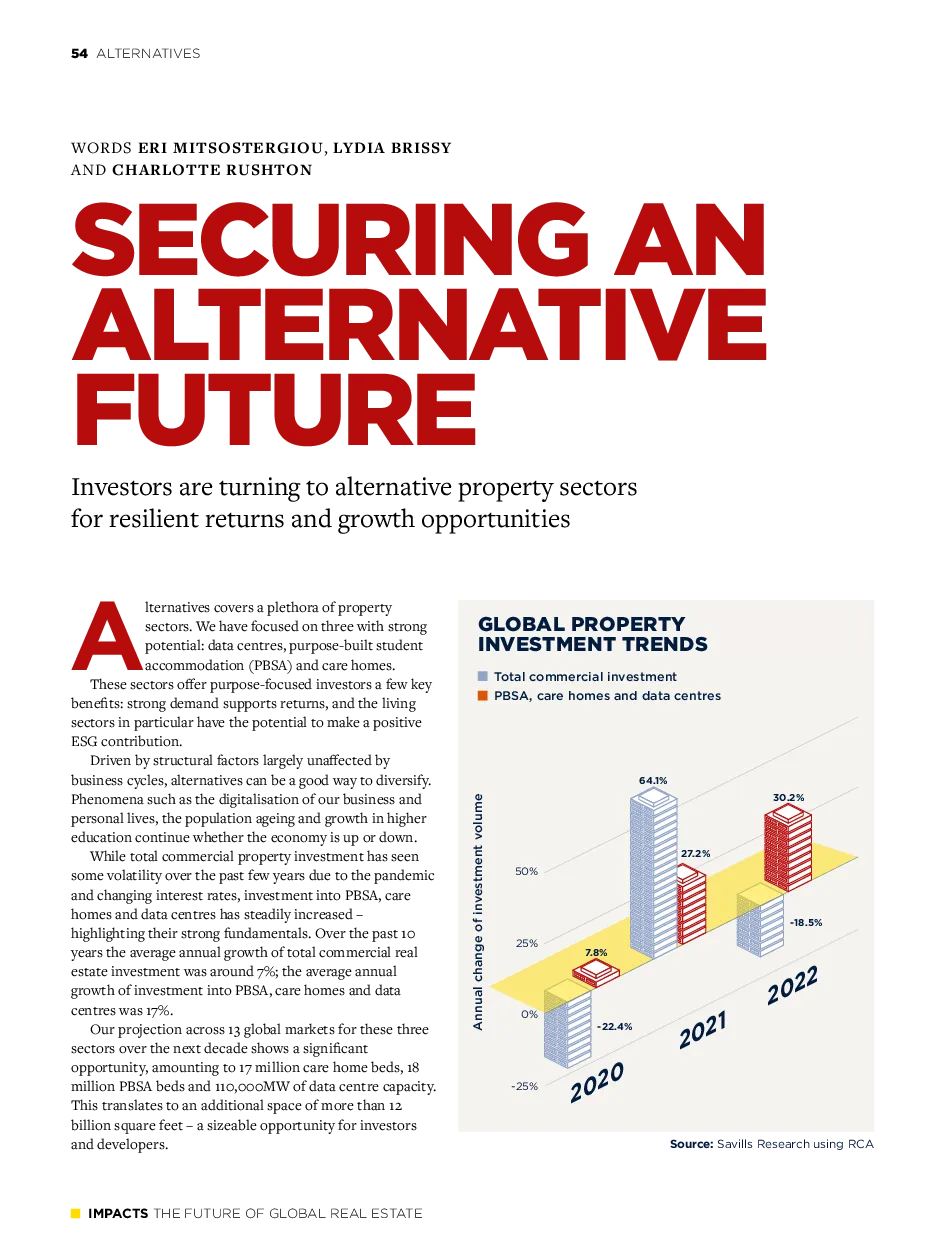
ALTERNATIVEFUTURE Investors are turning to alternative property sectorsfor resilient returns and growth opportunities Alternatives covers a plethora of propertysectors. We have focused on three with strongpotential: data centres, purpose-built studentaccommodation (PBSA) and care homes.These sectors offer purpose-focused investors a few keybenefits: strong demand supports returns, and the livingsectors in particular have the potential to make a positiveESG contribution. GLOBAL PROPERTYINVESTMENT TRENDS Driven by structural factors largely unaffected bybusiness cycles, alternatives can be a good way to diversify.Phenomena such as the digitalisation of our business andpersonal lives, the population ageing and growth in highereducation continue whether the economy is up or down.While total commercial property investment has seen some volatility over the past few years due to the pandemicand changing interest rates, investment into PBSA, carehomes and data centres has steadily increased –highlighting their strong fundamentals. Over the past 10years the average annual growth of total commercial realestate investment was around 7%; the average annualgrowth of investment into PBSA, care homes and datacentres was 17%.Our projection across 13 global markets for these three sectors over the next decade shows a significantopportunity, amounting to 17 million care home beds, 18million PBSA beds and 110,000MW of data centre capacity.This translates to an additional space of more than 12billion square feet – a sizeable opportunity for investorsand developers. ROY GIBBENSCHIEFREVENUEOFFICER,FORM8TION Over recent years, thedata centre sector hastaken giant leapsforward in improving power efficiency and reducingreliance on potable water. We havealso seen some interesting use ofwaste heat in providing communityheating projects and even theheating of swimming pools. I seethe next big target of our sector ascontinuing the development ofheat reuse strategies. ADDITIONAL SPACE NEEDED BY 2033GLOBALLY TO REACH IDEAL PROVISION More than 12 billion sq ft of additional space is required to satisfy thegrowing need for alternative uses in the next decade, creating an immensedevelopment and investment oportunity for real estate players. Heat reuse in data centres is astrategy to reduce energyconsumption and greenhouse gasemissions. Data centres generate alarge amount of heat, which can becaptured and reused for variouspurposes. Heat reuse will improvethe efficiency and reliability of datacentres by reducing the coolingload and mitigating overheatingchallenges. However, there aremany barriers to implementingheat reuse in data centres,including technical, economic,regulatory and social factors. Digitalisation rate over 70% – China has the world’ssecond-largest “unconnected”population, with almost 375 millionpeople not yet online.1Multiple new technological Generating power from heat israpidly becoming a viabletechnology. Most facilities currentlyeject most of their waste heat. Butwith the advances in thermoelectricgeneration, we could soon seesystems capable of reusing thiswaste heat at around 40%efficiency. If this approach can bedeveloped, we will also seesignificant savings in operationalcosts and, moreimportantly, oursector’s impact on theplanet will reduce. “Data centres are on the verge ofsignificant growth, driven by increasingdemand for cloud computing, big dataand the Internet of Things,” says ScottNewcombe, EMEA Head of DataCentres at Savills. “The emergence ofnew technologies, such as 5G and AI,has further accelerated this trend. Asbusinesses continue to move towardsdigital transformation, demand isexpected to rise, creating investmentopportunities.”Digital use around the world still innovations – including artificialintelligence (AI), machine learning(ML), the internet of things (IoT) andquantum computing – are expected tohave game-changing effects on howdata is being generated and used byindividuals and businesses. This willhave a notable effect on data centres.Access to data centre assets has varies enormously. At the top end ofthe scale, 55 countries enjoy internetadoption rates exceeding 90%. At thelowest end, 730 million people acrossIndia were still not using the internetat the start of 2023. Meanwhile –despite showing an internet adoption been somewhat limited for real estateinvestors. Much of the world’s space isowner-occupied, predominantly by afew specialised public REITs such asEquinix and Digital Realty. However, asdata centres are expensive to build andmanage, they need significant 1Source: Datareportal THERE IS A NEED FORSENIOR HOUSINGACROSS A SPECTRUMWHICH RUNS FROMINDEPENDENT LIVINGTOSPECIALISTNURSING HOMES FOREND-OF-LIFE CARE Ageing populationsPopulations are ageing worldwide, although approaches to later-life livingsetups vary across regions. OxfordEconomics says the proportion ofpeople aged 60 and above is currently14 per cent and is expected to be18 per cent by 2033 globally. Thenumbe