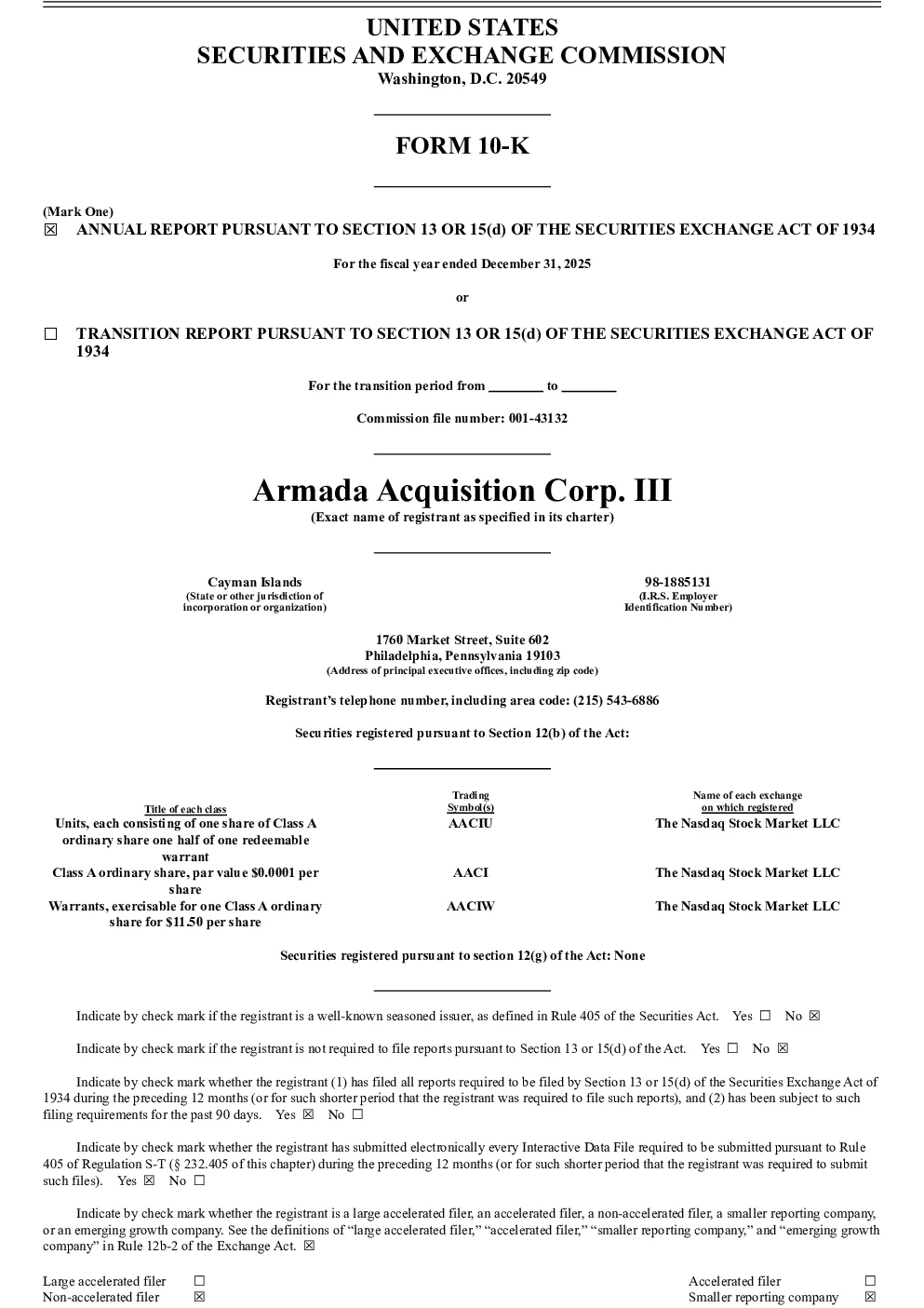
FORM 10-K Armada Acquisition Corp. III Indicate by check mark whether the registrant is a large accelerated filer, an accelerated filer, a non-accelerated filer, a smaller reporting company,or an emerging growth company. See the definitions of “large accelerated filer,” “accelerated filer,” “smaller reporting company,” and “emerging growthcompany” in Rule 12b-2 of the Exchange Act.☒ If an emerging growth company, indicate by check mark if the registrant has elected not to use the extended transition period for complying withany new or revised financial accounting standards provided pursuant to Section13(a) of the Exchange Act.☒ Indicate by check mark whether the registrant has filed a report on and attestation to its management’s assessment of the effectiveness of itsinternal control over financial reporting under Section404(b) of the Sarbanes-Oxley Act (15 U.S.C. 7262(b)) by the registered public accounting firm If securities are registered pursuant to Section12(b) of the Act, indicate by check mark whether the financial statements of the registrant includedin the filing reflect the correction of an error to previously issued financial statements.☐ Indicate by check mark whether any of those error corrections are restatements that required a recovery analysis of incentive-based compensationreceived by any of the registrant’s executive officers during the relevant recovery period pursuant to §240.10D-1(b).☐ As of June 30, 2025 (the last business day of the registrant’s most recently completed second fiscal quarter), there was no established publicmarket for the registrant’s shares. Accordingly, there was no market value for the registrant’s common stock on such date. As of March 20, 2026, there were 25,522,000 ClassA ordinary shares issued and outstanding, all of which are included in the Units, and8,507,834 ClassB ordinary shares issued and outstanding. DOCUMENTS INCORPORATED BY REFERENCE PART III PART IV CAUTIONARY NOTE REGARDING FORWARD LOOKING STATEMENTS This report includes forward-looking statements within the meaning of Section27A of the Securities Act of 1933, as amended (the “SecuritiesAct”), and Section21E of the Securities Exchange Act of 1934, as amended (the “Exchange Act”). We have based these forward-looking statements onour current expectations and projections about future events. These forward-looking statements are subject to known and unknown risks, uncertaintiesand assumptions about us that may cause our actual results, levels of activity, performance or achievements to be materially different from any futureresults, levels of activity, performance or achievements expressed or implied by such forward-looking statements. In some cases, you can identifyforward-looking statements by terminology such as “may”, “should”, “could”, “would”, “expect”, “plan”, “anticipate”, “believe”, “estimate”,“continue”, or the negative of such terms or other similar expressions. Such statements include, but are not limited to, possible business combinations •our ability to complete our initial business combination; •our success in retaining or recruiting, or changes required in, our officers, key employees or directors following our initial businesscombination;•our executive officers and directors allocating their time to other businesses and potentially having conflicts of interest with our businessor in approving our initial business combination, as a result of which they would then receive expense reimbursements;•our potential ability to obtain additional financing to complete our initial business combination;•our pool of prospective target businesses, including their industry and geographic location; The forward-looking statements contained in this report are based on our current expectations and beliefs concerning future developments andtheir potential effects on us. Future developments affecting us may not be those that we have anticipated. These forward-looking statements involve anumber of risks, uncertainties (some of which are beyond our control) or other assumptions that may cause actual results or performance to be materially •our being a company with no operating history and no revenues;•our ability to select an appropriate target business or businesses;•our ability to complete our initial business combination;•our expectations around the performance of a prospective target business or businesses;•our success in retaining or recruiting, or changes required in, our officers, key employees or directors following our initial business •target businesses, including the location and industry of such target businesses;•the ability of our officers and directors to generate a number of potential business combination opportunities;•our public securities’ potential liquidity and trading;•the lack of a market for our securities;•the use of proceeds not held in the trust account or available to us from interest income on the trust account balance;•the availability to us of funds from interes