您的浏览器禁用了JavaScript(一种计算机语言,用以实现您与网页的交互),请解除该禁用,或者联系我们。 [巴克莱银行]:United States credit theme: screening AI risks in the credit portfolio - 发现报告

United States credit theme: screening AI risks in the credit portfolio

2026-03-04 - 巴克莱银行 米软绵gogo
报告封面

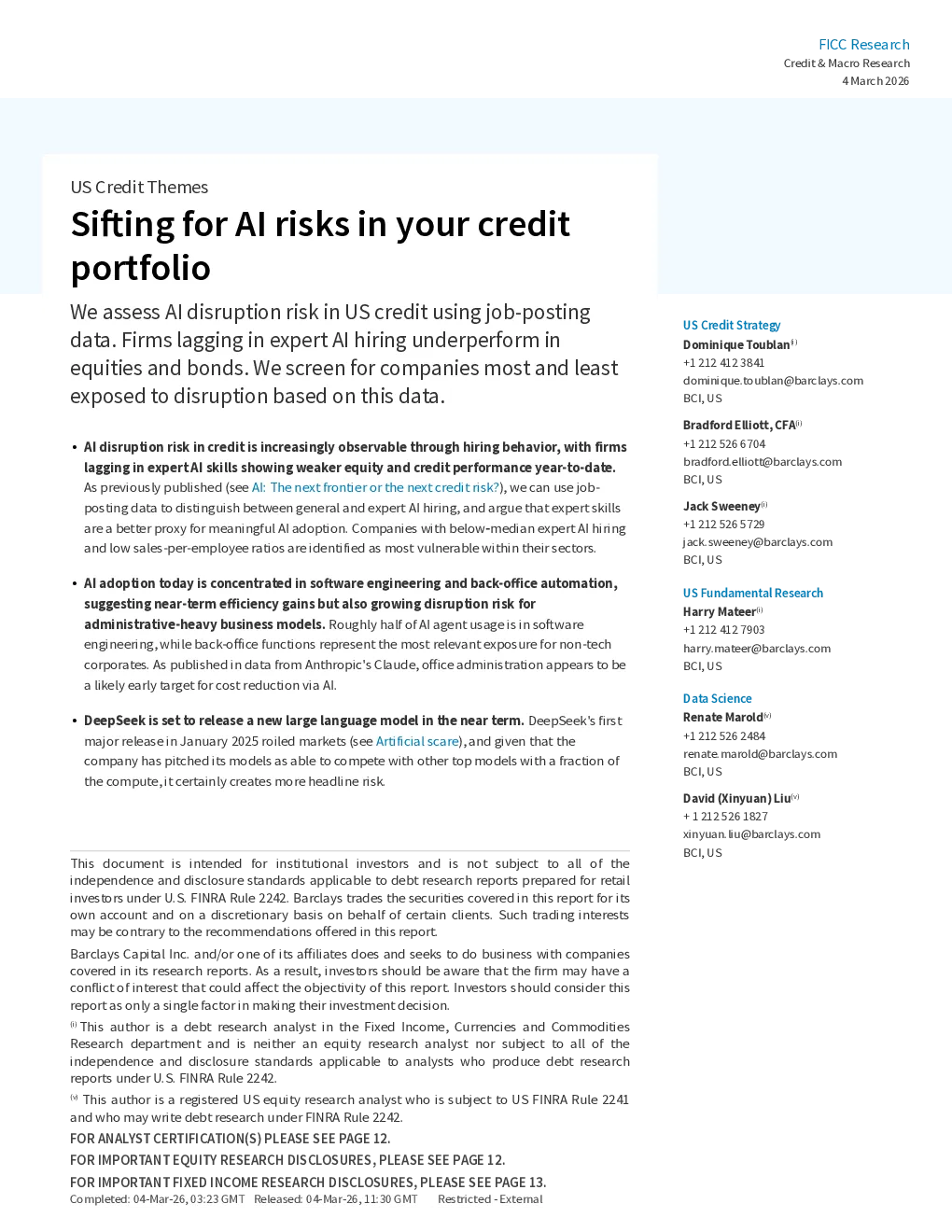
US Credit Themes Siftingfor AI risks in your credit We assess AI disruption risk in US credit using job-postingdata. Firms lagging in expert AI hiring underperform inequities and bonds. We screen for companies most and least US Credit Strategy Dominique Toublan(i)+1 212 412 3841dominique.toublan@barclays.com Bradford Elliott, CFA(i)+1 212 526 6704bradford.elliott@barclays.comBCI, US AI disruption risk in credit is increasingly observable through hiring behavior, with firmslagging in expert AI skills showing weaker equity and credit performance year-to-date. As previously published (see AI: The next frontier or the next credit risk?), we can use job-posting data to distinguish between general and expert AI hiring, and argue that expert skills Jack Sweeney(i)+1 212 526 5729jack.sweeney@barclays.com •AI adoption today is concentrated insoftwareengineering andback-officeautomation,suggesting near-termefficiencygains but also growing disruption risk foradministrative-heavy business models.Roughly half of AI agent usage is insoftware US Fundamental Research Harry Mateer(i)+1 212 412 7903harry.mateer@barclays.comBCI, US Data Science •DeepSeek is set to release a new large language model in the near term.DeepSeek's firstmajor release in January 2025 roiled markets (see Artificial scare), and given that thecompany has pitched its models as able to compete with other top models with a fraction of Renate Marold(v)+1 212 526 2484renate.marold@barclays.com David (Xinyuan) Liu(v)+ 1 212 526 1827xinyuan.liu@barclays.com Thisdocument is intended for institutional investors and is not subject to all of theindependence and disclosure standards applicable to debt research reports prepared for retailinvestors under U.S. FINRA Rule 2242. Barclays trades the securities covered in this report for its Barclays Capital Inc. and/or one of itsaffiliatesdoes and seeks to do business with companiescovered in its research reports. As a result, investors should be aware that the firm may have aconflict of interest that couldaffectthe objectivity of this report. Investors should consider this This author is a debt research analyst in the Fixed Income, Currencies and CommoditiesResearch department and is neither an equity research analyst nor subject to all of theindependence and disclosure standards applicable to analysts who produce debt research This author is a registered US equity research analyst who is subject to US FINRA Rule 2241and who may write debt research under FINRA Rule 2242.FOR ANALYST CERTIFICATION(S) PLEASE SEE PAGE 12.FOR IMPORTANT EQUITY RESEARCH DISCLOSURES, PLEASE SEE PAGE 12.FOR IMPORTANT FIXED INCOME RESEARCH DISCLOSURES, PLEASE SEE PAGE 13.Completed: 04-Mar-26, 03:23 GMTReleased: 04-Mar-26, 11:30 GMTRestricted - External We screen for companies most / least exposed to AI disruption based on the skillsneeded in job posting data.The most exposed companies are those with large negativedifferentialsversus sector-average expert AI hiring (Figure 7). Indeed these companies haveunderperformed in both equities and bonds year-to-date. Conversely, the least-exposed NCR Voyix, VeriSign, Workday, Crowdstrike, Dynatrace, ServiceNow, and IBM top the listin terms of most exposed companies based on hiring patterns. On Tuesday, February 23rd, market participants honed in on Anthropic's latest webinar, "TheBriefing: Enterprise Agents," where the company discussed new Claude developments and laidout its future use cases for its capabilities.Softwarestocks broadly reacted somewhat favorablyto what Barclays' USsoftwareresearch analyst, Raimo Lenschow described as "better-than- That said, Anthropic announced new plugins and capabilities that will likely stoke the flames ofthe AI disruption narrative. In particular, the company published data on which types ofcustomers are currently using Claude and that they are using the product in a fairly granularway. While not surprising, roughly 50% of today's agents are being deployed insoftware FIGURE 1. In what domains are agents being deployed? Note: Distribution of tool calls by domain.Softwareengineering accounts for nearly 50% of tool calls. Data reflects tool callsmade via our public API. 95% CI < 0.5% for all categories, n = 998,481Source: Anthropic When zooming in a bit further, a few more things stand out to us (Figure 3). Job functions areseemingly mostaffectedacross the education spectrum. We think this shouldn't be tooconcerning for most corporations outside of Edtech. However, the next job function on the list isofficeadministration, which companies may find an easy position in which to implement AI Screening for companies most / least exposed to AI- Previously, we published data on companies that might be at risk of falling behind in the AI raceby analyzing those that have either low or high hiring for "expert AI skills." In our view, acompany hiring for very specific AI-related skills might be able todifferentiatefaster. Wenormalize this data by calcula