2024年工业就业展望
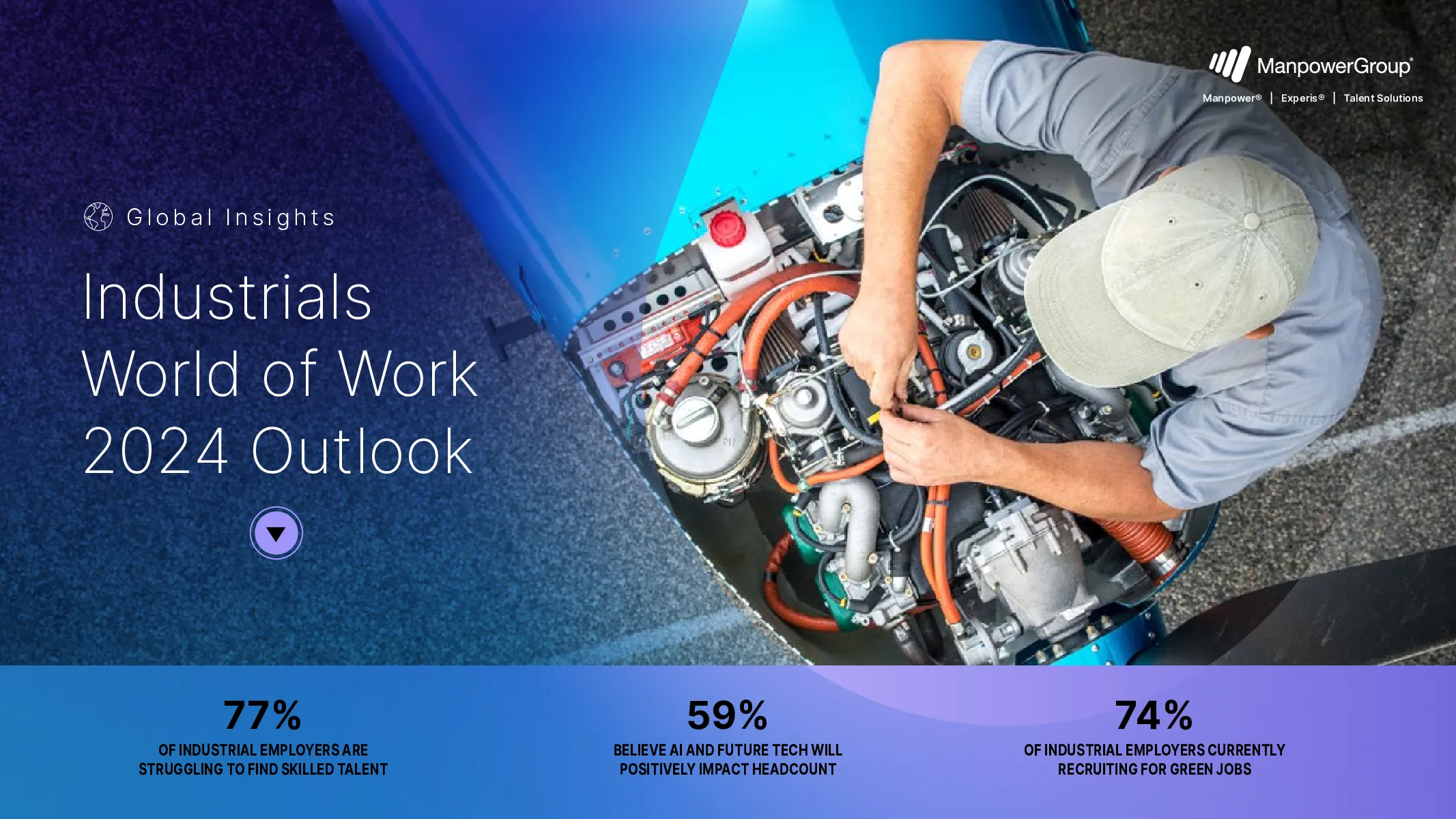
BELIEVE AI AND FUTURE TECH WILLPOSITIVELY IMPACT HEADCOUNT Contents Forward Looking Statements The global industrials sector* includes manufacturers and distributors of capital goods for aerospace & defense,building products, electrical equipment, machinery, as well as construction and engineering services. It is a Although this industry is accustomed to change, the pace has significantly accelerated since 2020. In recentyears, industrials sector leaders have already overcome a global pandemic, supply chain bottlenecks, historicinflation, the largest war in Europe since WWII, manufacturing localization pressures, growing demands to reduce Workforce Implications: •High demand for specializeddigital transformation talentwill continue and industrials Tooling Up Tech •Continuous upskilling andreskilling will be key to train The growing costs of raw material and labor around theworld are converging with rapid advancements in industrialtechnologies. This combination of necessity and invention •Sustained sector demand formanufacturing workers despitegrowing automation will make future will be more connected and automated, delivering greater efficiency, cost savings, and safer skilled •Robots Rock:Global cost pressures are accelerating the adoption of robotics including collaborativerobots (cobots) which work closely with facility team members, particularly for dangerous orphysically demanding tasks. Most manufacturing leaders (62%) say robotics and automation will •Meet Your Digital Twin:The use of digital twins—a virtual representation of an object or system—is rapidly growing in the industrials sector and the results are promising. Early implementers have •AI and VR on the Factory Floor:Will rapidly advancing technologies such as Artificial Intelligence(AI), Machine Learning (ML) and Virtual Reality (VR) have a negative impact on the future 59% OF INDUSTRIAL EMPLOYERSBELIEVEEMERGING TECHNOLOGIESWILL HAVE APOSITIVE IMPACT Industrial Business •Contingent workforce optimizationstrategy will be key for PaaS In response to the seismic changes in the global economy,business transformation is a key priority for senior leadersacross the industrials sector. This includes completely new •Upskilling and reskilling efforts mustkeep up with the rapidly evolving •Major players in the industrials sectorwill need to compete with otherindustries for in-demand customer •The New 2023 Models:The Production-as-a-Service (Paas) model has not yet proliferated inindustrial settings, although small-scale offerings related to the use of specific equipment haveappeared. PaaS expands this approach to the scope of an entire factory. More than two-thirds of •Now in 3D:Additive manufacturing and 3D printing using new advanced materials continue tobe at the forefront of Industry 4.0. There will be 2.8 million 3D printing devices globally by 2030 •A Prime Challenge:The high bar that B2C giants have set for personal and customizedcustomer experience increasingly extends to B2B industrial companies. Today, more than halfof B2B buyers (60%) say they would prefer to buy online instead of traditional sales channels. 85% OF MANUFACTURERSWOULD CONSIDERPRODUCTION-AS-A-SERVICE 70% OF US AND EU MANUFACTURERSAREPLANNING TO RESHOREOR NEARSHORE OPERATIONS Rolling Out Recent years of significant supply chain disruptionhave created increased urgency to build more true when critical elements of a supply chain could be exposed to increasing geopolitical tensions,wage inflation or raw material shortages. The need for supply chain transparency will also grow to •Vertical integration of functionspreviously handled by specializedsuppliers (in many cases on different •A Vertical Horizon of Integration:Vertical integration is becoming increasingly popular asmanufacturers seek to build resilience and replicate recently successful models such as Tesla’sgigafactories for battery production.1Industry analysts predict it will also gain traction within the •As manufacturers across sectorsattempt to reshore more of their •More and More Reshore:In response to growing geopolitical tensions, nearshoring and reshoringof supply chains is accelerating. In fact, 70% of manufacturers in the US and Europe say they •Getting Less Sly about Supply:Increasing supply chain transparency is a difficult challenge inthe industrials sector, particularly when an average aerospace company could have 12,000+Tier 2 suppliers.4Today, 70% of global business leaders describe their supply chains as “very” •The aging of workforce in the mostdeveloped markets will create The New Collar of The industrials sector will be among the most exciting and innovative asglobal green business transformations accelerate. As investment in greentech expands around the world, the race to find the skilled talent neededto sustain green innovation is heating up. Competition between industries 74% AREACTIVELYRECRUITINGORPLANNING TO RECRUIT •Green Help Wanted:The competition for green