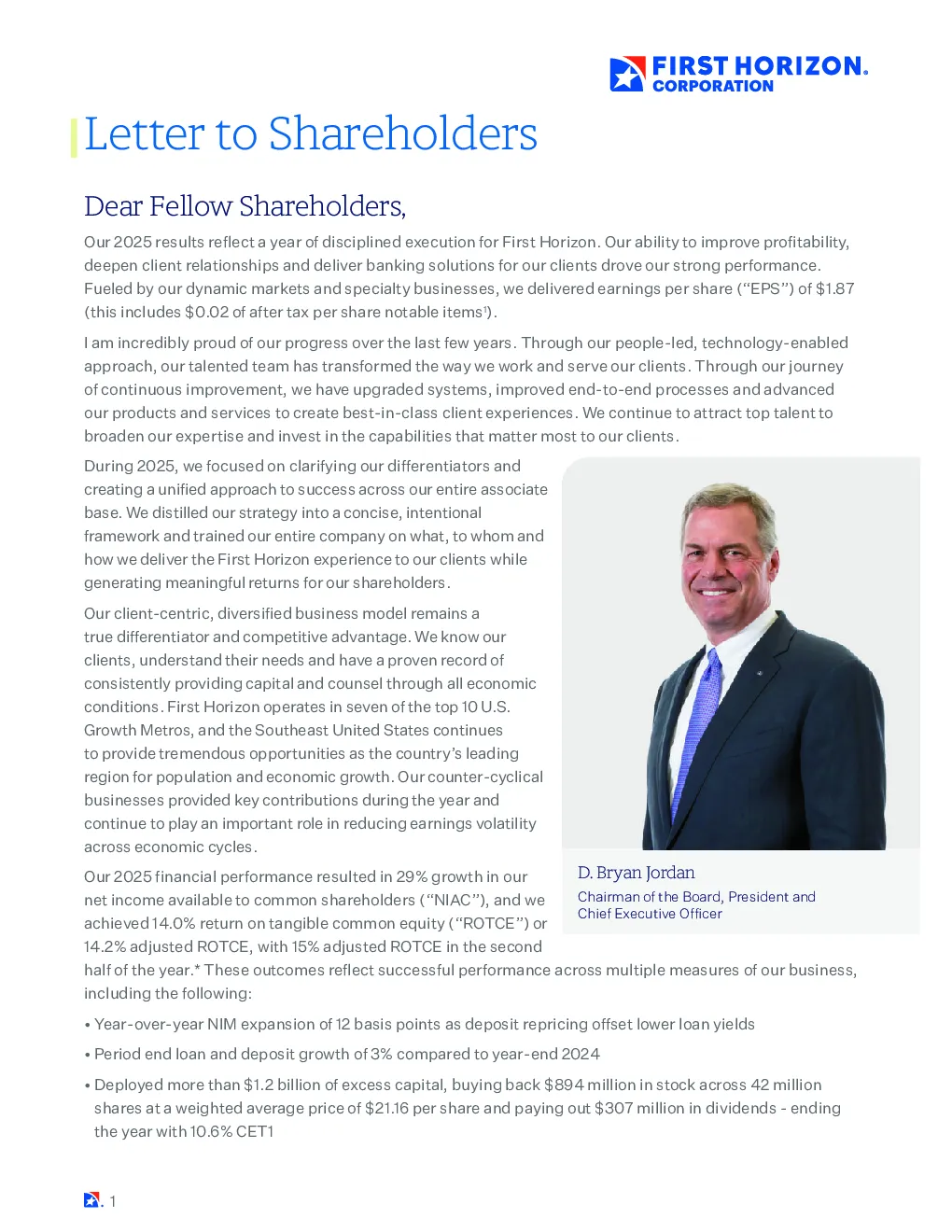
Dear Fellow Shareholders, Our 2025 results reflect a year of disciplined execution for First Horizon. Our ability to improve profitability,deepen client relationships and deliver banking solutions for our clients drove our strong performance.Fueled by our dynamic markets and specialty businesses, we delivered earnings per share (“EPS”) of $1.87(this includes $0.02 of after tax per share notable items1). I am incredibly proud of our progress over the last few years. Through our people-led, technology-enabledapproach, our talented team has transformed the way we work and serve our clients. Through our journeyof continuous improvement, we have upgraded systems, improved end-to-end processes and advancedour products and services to create best-in-class client experiences. We continue to attract top talent tobroaden our expertise and invest in the capabilities that matter most to our clients. During 2025, we focused on clarifying our differentiators andcreating a unified approach to success across our entire associatebase. We distilled our strategy into a concise, intentionalframework and trained our entire company on what, to whom andhow we deliver the First Horizon experience to our clients whilegenerating meaningful returns for our shareholders. Our client-centric, diversified business model remains atrue differentiator and competitive advantage. We know ourclients, understand their needs and have a proven record ofconsistently providing capital and counsel through all economicconditions. First Horizon operates in seven of the top 10 U.S.Growth Metros, and the Southeast United States continuesto provide tremendous opportunities as the country’s leadingregion for population and economic growth. Our counter-cyclicalbusinesses provided key contributions during the year andcontinue to play an important role in reducing earnings volatilityacross economic cycles. D. Bryan JordanChairman of the Board, President andChief Executive Officer Our 2025 financial performance resulted in 29% growth in ournet income available to common shareholders (“NIAC”), and weachieved 14.0% return on tangible common equity (“ROTCE”) or14.2% adjusted ROTCE, with 15% adjusted ROTCE in the second half of the year.* These outcomes reflect successful performance across multiple measures of our business,including the following: • Year-over-year NIM expansion of 12 basis points as deposit repricing offset lower loan yields • Period end loan and deposit growth of 3% compared to year-end 2024• Deployed more than $1.2 billion of excess capital, buying back $894 million in stock across 42 millionshares at a weighted average price of $21.16 per share and paying out $307 million in dividends - endingthe year with 10.6% CET1 1 Beyond our financial results, we measure success by the impact we make in the communities we serve.As of January 2026, the First Horizon Foundation has invested $200 million across our footprint sinceinception. But our giving is about more than funding; it’s a reflection of our values and the countless hoursour associates commit to be “Here for Good” for every single place we call home. We enter 2026 with clear objectives: delivering profitability, efficiency and operational excellence throughdisciplined execution of our strategic priorities. By leveraging our banker expertise to match clients withthe right solutions, aligning pricing with the value we deliver and maximizing the value of our footprint withour talent and distribution models, we believe we can unlock more than $100 million of revenue drivenincremental pre-provision net revenue (“PPNR”) over the next two to three years.* We will maintain prudent expense discipline while continuing to invest strategically in technology, talent andgrowth with a strong risk and credit culture that protects our clients and our shareholders and positions us todeliver sustainable long-term results. In an ever-changing world, we continuously evaluate the risks and unique opportunities across our industry. In 2025, private credit was a theme as both an indirect competitor and a potential risk to our industry.Since private credit operates outside of the bank regulatory framework, it is sometimes more flexible inpricing, terms and structure relative to bank lending. As such, we continued to see a subset of borrowersseeking more aggressive capital migrate to the more transactional private credit market last year. Wecontinue to assess the impact of private credit on both pricing and structure in our markets, but our focushas above all remained on disciplined relationship lending. We continue to achieve this by understandingthe risks associated with individual clients as well as the specific industries and geographies they operatein. Remaining focused on our relationship-first, long-term value proposition is critical to our strategy inresponding to this competition. Cryptocurrencies, stablecoins and blockchain-based money movement continue to emerge as capabilitiesneeded for th