制氢用电解槽的技术经济特性(英)2026
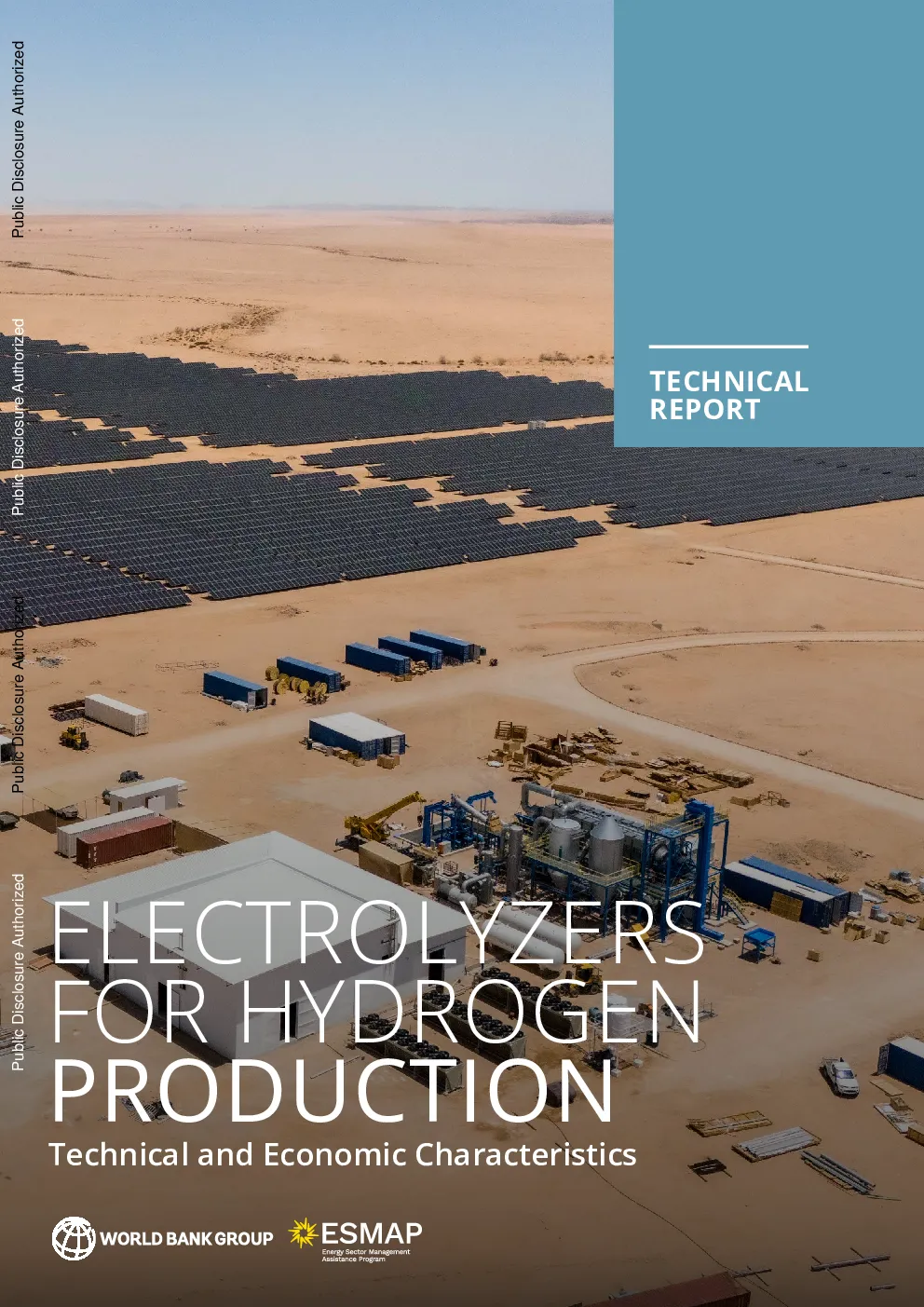
Technical and Economic Characteristics ELECTROLYZERSFOR HYDROGENPRODUCTION Technical and Economic Characteristics The findings, interpretations, and conclusions expressed in this work do not necessarily reflect the views of the WorldBank, its Board of Executive Directors, or the governments they represent. The World Bank does not guarantee theaccuracy of the data included in this work. The boundaries, colors, denominations, and other information shown onany map in this work do not imply any judgment on the part of the World Bank concerning the legal status of anyterritory or the endorsement or acceptance of such boundaries. Nothing herein shall constitute or be considered to bea limitation upon or waiver of the privileges and immunities of The World Bank, all of which are specifically reserved. © 2026 February|International Bank for Reconstruction and Development / The World Bank1818 H Street NW | Washington DC 20433202-473-1000 | www.worldbank.org Rights and Permissions This work is available under the Creative Commons Attribution 3.0 IGO license (CC BY 3.0 IGO)http://creativecommons.org/licenses/by/3.0/igo. Under the Creative Commons Attribution license, you are free to copy, distribute, transmit, andadapt this work, including for commercial purposes, under the following conditions: Attribution— Energy Sector Management Assistance Program (ESMAP). 2026.Electrolyzers for Hydrogen Production:Technical and Economic Characteristics. ESMAP Technical Report. Washington, DC Translations—If you create a translation of this work, please add the following disclaimer along with the attribution:This translation was not created by The World Bank and should not be considered an official World Bank translation.The World Bank shall not be liable for any content or error in this translation. Adaptations—If you create an adaptation of this work, please add the following disclaimer along with the attribution:This is an adaptation of an original work by The World Bank. Views and opinions expressed in the adaptation are thesole responsibility of the author or authors of the adaptation and are not endorsed by The World Bank. Third-party content—The World Bank does not necessarily own each component of the content contained within thework. The World Bank therefore does not warrant that the use of any third party-owned individual component or partcontained in the work will not infringe on the rights of those third parties. The risk of claims resulting from suchinfringement rests solely with you. If you wish to re-use a component of the work, it is your responsibility to determinewhether permission is needed for that re-use and to obtain permission from the copyright owner. Examples ofcomponents can include, but are not limited to, tables, figures, or images. All queries on rights and licenses should be addressed to World Bank Publications, The World Bank, 1818 H Street NW,Washington, DC 20433, USA; e-mail: pubrights@worldbank.org. PRODUCTION CREDITS Cover photo:Electrolyzer installation in Namibia, ©HyIron.Design:Jehison Aaron Hernandez Mujica, World Bank GroupEditor:Steven B. Kennedy PHOTO CREDITS p. xiv ©HyIronp. xvii ©HyIrop.xxx ©Siemens Energyp. xxxi ©HyIronp . xxxvii ©HyIronp. 12 ©HyIronp. 14 Alkaline electrolyzer sketchp. 18 PEM electrolyzer sketchp. 24 SOEC electrolyzer sketchp. 27 AEM electrolyzer sketchp. 47 ©Siemens Energy p. 48 ©HyIronp. 91 ©Siemens Energyp. 103 ©Iwatani-Cosmo Hydrogen Stationp. 104 ©HyIronp. 117 ©Walmart Chilep. 118 ©Siemens Energyp. 130 ©HyIron Table of Contents AbbreviationsviiiForewordxAcknowledgmentsxiiKey Take AwaysxvExecutive SummaryxviiiElectrolyzer Market DynamicsxviiiElectrolyzer Manufacturing Capacity and Supply ChainsxixElectrolyzer Costs and the Impact on Hydrogen EconomicsxxiiiRecommendations for Equipment Selection and Due DiligencexxviiCaveats and Future ResearchxxxAbout this ReportxxxiiContext of the ReportxxxiiRationale and Objective of the ReportxxxiiI. Market and Technology Status1Key Points1Hydrogen Demand2Electrolyzer Demand3Electrolyzer Supply as of mid-20256Electrolyzer Technologies and Technology/Commercial Readiness Levels12Alkaline (ALK) Electrolyzers14Proton Exchange Membrane (PEM) Electrolyzers20Solid Oxide Electrolyzer Cells (SOECs)24Anion Exchange Membrane (AEM) Electrolyzers27Electrolyzer System Components33Integration of Variable Renewable Energy and Electrolyzer systems39Approaches for Electrolyzer System Flexibility42II. The Cost of Electrolysis49Key Points49Overview of Expenditures52Direct Capital Expenditures57Indirect Capital Expenditure68Operational Expenditure74The Levelized Cost of Hydrogen86Costs of Electrolyzer Systems, by Region of Manufacture96 III. Pathways to Reducing Costs105 Key Points105Securing Low-cost Electricity106Refining the Scope of Engineering, Procurement, Construction, and Optimizing Balanceof Stack andbalance of Plant108Accelerating Stack Innovation109Digitalizing Across the Project Life Cycle113Reducing Financing Costs11