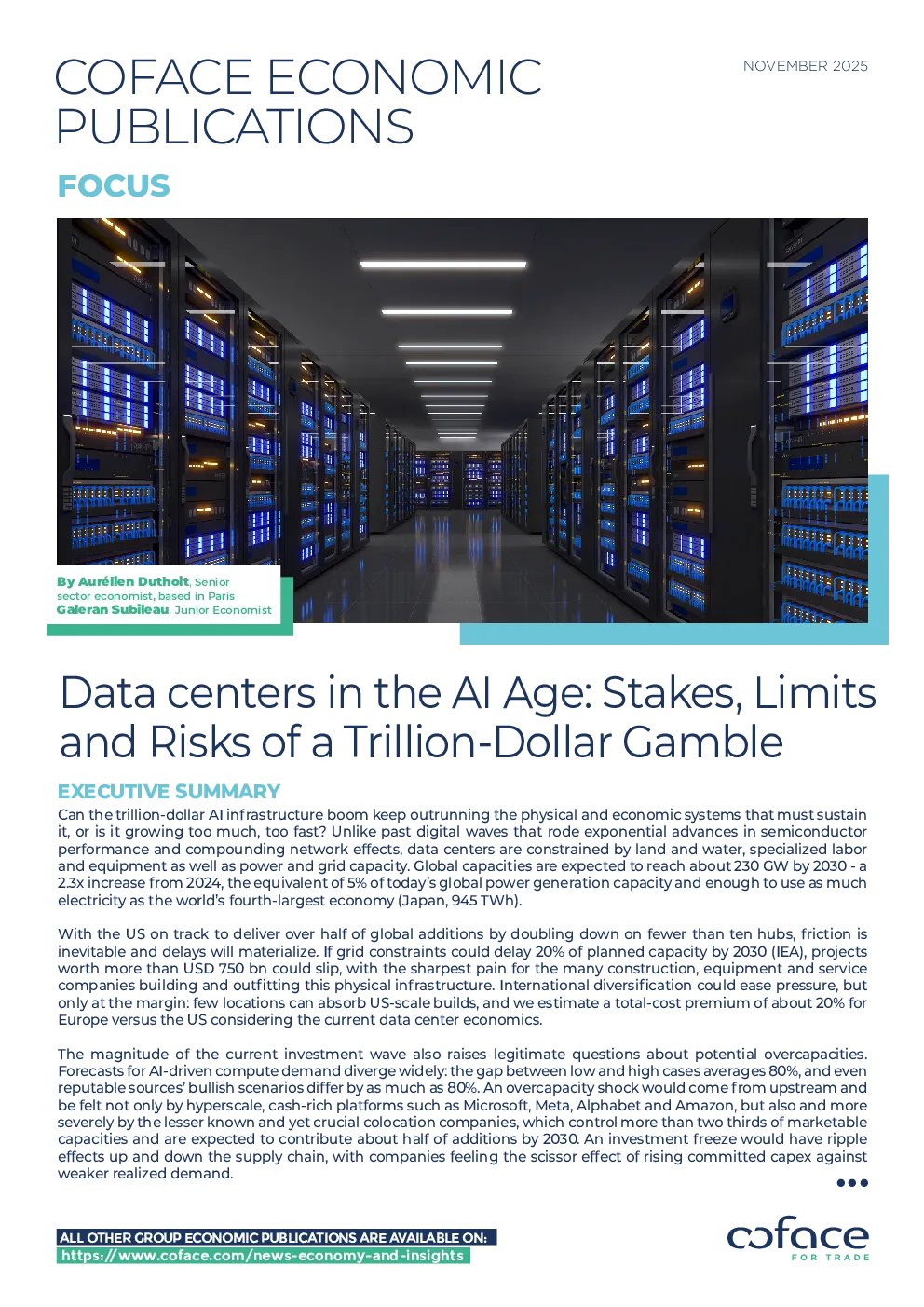
FOCUS Data centers in the AI Age: Stakes, Limitsand Risks of a Trillion-Dollar Gamble EXECUTIVE SUMMARY Can the trillion-dollar AI infrastructure boom keep outrunning the physical and economic systems that must sustainit, or is it growing too much, too fast? Unlike past digital waves that rode exponential advances in semiconductorperformance and compounding network effects, data centers are constrained by land and water, specialized laborand equipment as well as power and grid capacity. Global capacities are expected to reach about 230 GW by 2030 - a2.3x increase from 2024, the equivalent of 5% of today’s global power generation capacity and enough to use as muchelectricity as the world’s fourth-largest economy (Japan, 945TWh). With the US on track to deliver over half of global additions by doubling down on fewer than ten hubs, friction isinevitable and delays will materialize. If grid constraints could delay 20% of planned capacity by 2030 (IEA), projectsworth more than USD 750 bn could slip, with the sharpest pain for the many construction, equipment and servicecompanies building and outfitting this physical infrastructure. International diversification could ease pressure, butonly at the margin: few locations can absorb US-scale builds, and we estimate a total-cost premium of about 20% forEurope versus the US considering the current data center economics. The magnitude of the current investment wave also raises legitimate questions about potential overcapacities.Forecasts for AI-driven compute demand diverge widely: the gap between low and high cases averages 80%, and evenreputable sources’ bullish scenarios differ by as much as 80%. An overcapacity shock would come from upstream andbe felt not only by hyperscale, cash-rich platforms such as Microsoft, Meta, Alphabet and Amazon, but also and moreseverely by the lesser known and yet crucial colocation companies, which control more than two thirds of marketablecapacities and are expected to contribute about half of additions by 2030. An investment freeze would have rippleeffects up and down the supply chain, with companies feeling the scissor effect of rising committed capex againstweaker realized demand.l l l l l l For now, the boom is already macro-relevant but not transformative. Using a bottom-up attribution focused on data-center construction and IT hardware, we estimate AI-related spending accounted for 17–23% of US GDP growth inQ2-2025. For the boom to have broader and more durable impact, it must evolve from an investment cycle into aproductivity cycle, one that not only raises efficiency but also generates new goods and services at scale. Behindthis spectacular surge in equity valuationslies a massive and already tangible investment cycle.Hundreds of billions of dollars are being deployed tobuild the physical and digital infrastructure needed totrain and operate large-scale AI models. While Nvidia,whosedominance in advanced graphic processingunits (GPUs) has captured most of the headlines, sitsat the visible end of this transformation, its successdepends on investment further down the value chainin the lesser-known but highly strategic infrastructureof data centers, the facilities where thousands of serversequippedwith these chips are installed,powered,cooled and interconnected. Since 2022, global annualspending on data centers did more than double, risingfrom 221 billion USD in 2022 to an estimated 475 billionUSD in 2025. Booming investment in data centers didnot start from a low point: over the past decade already,the migration from locally owned servers to remote,shared infrastructure managed by specialized providersknown as cloud computing made data centers one ofthe fastest-growing components of global IT spending,second only to software(Chart 2). The global boom in artificialintelligence investment bringsdata centers to center stage The public release of ChatGPT 3.5 in November 2022markeda turning point in the global technologylandscape,moving artificial intelligence(AI)fromresearchlabs to a mainstream service adopted byhundreds of millions of users within weeks. Growingbusiness and consumer interest in AI has since triggereda surge in corporate spending and investor enthusiasmunmatched since the early days of the internet. In lessthan three years, the combined market capitalization ofthe world’s largest AI-exposed firms (Nvidia, Microsoft,Alphabet, Amazon and Meta) has increased by morethan 12 trillion dollars, accounting for much of the rise inmajor US equity indices(Chart 1). While dollar figures highlight the magnitude of theinvestment opportunity created by the hardware sideof the AI boom, the data center industry tends to trackitsprogress in terms of power demand capacitiesrather than currency. Capacities can however meanvery different things whether data center developmentis seen through the lens of the power, informationtechnology or real estate industries.Chart 3provides asnapshot of current global capacities from those