您的浏览器禁用了JavaScript(一种计算机语言,用以实现您与网页的交互),请解除该禁用,或者联系我们。 [巴克莱银行]:美国一级信贷市场竞争达到历史新高:基于2017年以来超百万条初始投资者记录,投资级竞争上升15%,高收益级上升30%,并蔓延至二级市场,尤其是大型交易,推动首10天换手率上升 - 发现报告

美国一级信贷市场竞争达到历史新高:基于2017年以来超百万条初始投资者记录,投资级竞争上升15%,高收益级上升30%,并蔓延至二级市场,尤其是大型交易,推动首10天换手率上升

2026-02-26 - 巴克莱银行 匡露
报告封面

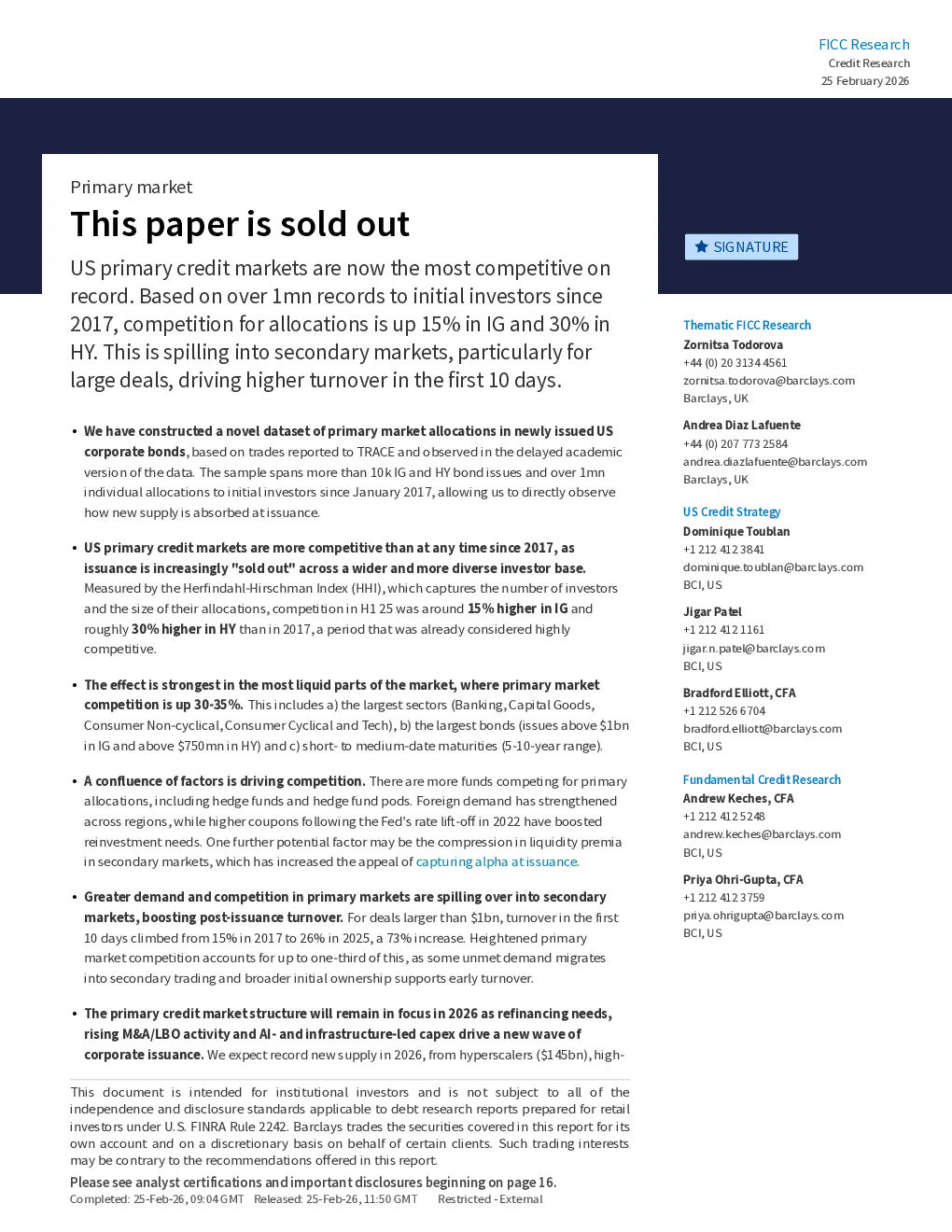
This paper is sold out SIGNATURE US primary credit markets are now the most competitive onrecord. Based on over 1mn records to initial investors since2017, competition for allocations is up 15% in IG and 30% inHY. This is spilling into secondary markets, particularly forlarge deals, driving higher turnover in the first 10 days. Thematic FICC ResearchZornitsa Todorova+44 (0) 20 3134 4561zornitsa.todorova@barclays.com Andrea Diaz Lafuente+44 (0) 207 773 2584andrea.diazlafuente@barclays.comBarclays, UK •We have constructed a novel dataset of primary market allocations in newly issued UScorporate bonds, based on trades reported to TRACE and observed in the delayed academicversion of the data. The sample spans more than 10k IG and HY bond issues and over 1mn US Credit Strategy Dominique Toublan+1 212 412 3841dominique.toublan@barclays.com US primary credit markets are more competitive than at any time since 2017,asissuance is increasingly "sold out" across a wider and more diverse investor base. Measured by the Herfindahl-Hirschman Index (HHI), which captures the number of investorsand the size of their allocations, competition in H1 25 was around15% higher in IGand Jigar Patel+1 212 412 1161jigar.n.patel@barclays.com Theeffectis strongest in the most liquid parts of the market, where primary marketcompetition is up 30-35%.This includes a) the largest sectors (Banking, Capital Goods,Consumer Non-cyclical, Consumer Cyclical and Tech), b) the largest bonds (issues above $1bn Bradford Elliott, CFA+1 212 526 6704bradford.elliott@barclays.comBCI, US •A confluence of factors is driving competition.There are more funds competing for primaryallocations, including hedge funds and hedge fund pods. Foreign demand has strengthenedacross regions, while higher coupons following the Fed's ratelift-offin 2022 have boosted Fundamental Credit Research Andrew Keches, CFA+1 212 412 5248andrew.keches@barclays.com Priya Ohri-Gupta, CFA+1 212 412 3759priya.ohrigupta@barclays.com •Greater demand and competition in primary markets are spilling over into secondarymarkets, boosting post-issuance turnover.For deals larger than $1bn, turnover in the first10 days climbed from 15% in 2017 to 26% in 2025, a 73% increase. Heightened primary The primary credit market structure will remain in focus in 2026 as refinancing needs,rising M&A/LBO activity and AI- and infrastructure-led capex drive a new wave ofcorporate issuance.We expect record new supply in 2026, from hyperscalers ($145bn), high- Thisdocument is intended for institutional investors and is not subject to all of theindependence and disclosure standards applicable to debt research reports prepared for retailinvestors under U.S. FINRA Rule 2242. Barclays trades the securities covered in this report for its grade utilities ($140bn) and corporate hybrids ($65bn). Beyond 2026, emerging capex-heavyfrontiers such as physical AI and robotics are set to furtherliftfunding needs. A new database of primary market allocations The key innovation of this report is the construction of a comprehensive dataset ofprimary market allocations in newly issued corporate bonds to initial investors.Oursample comprises more than 10k HY and IG bondofferings(including 144A deals) issuedbetween 1 January 2017 and 30 June 2025, togetherwith the full record of over 1mn These primary market trades come from the academic version of TRACE, which requiresmembers of underwriting syndicates to report all primary market transactions using the “P1” indicator – a requirement in place since March 2010.1In addition to primary market trades, theacademic TRACE dataset includes true (ie, uncapped) secondary market transactions – used In the academic TRACE dataset, primary market trades appear as P1 transactions executed ontheofferdate at theofferprice, reflecting dealer-to-client (D2C) sales rather than dealer-to-dealer (D2D) activity. Our sample covers USD-denominated bonds with a fixed non-zero coupon, As an illustration, Figure 1 provides details of a bond with the CUSIP 760759BM1, issued on 17March 2025 at price of 99.325%. In TRACE (the blue shaded area), the individual allocationsappear as separate P1-marked trades, all executed on the issue date, all at theofferprice and allreported as D2C transactions (Reporting Party = “Dealer (D)”, Counterparty = “Client (C)”). In this TRACE reporting and robustness Our dataset captures primary market trades at the individual fund level, implying that theallocations we observe are not aggregated at the asset-manager or fund-family level. While thiscannot be verified directly using TRACE – since the dataset does not disclose the identities of either reporting dealers or clients – we are nevertheless confident that this interpretation is First, each trade settles independently and therefore must be reported individually for TRACEpurposes. Second, the small average allocation size ($9mn in IG and $7.5mn in HY) stronglysuggests individual fund-level allocation