您的浏览器禁用了JavaScript(一种计算机语言,用以实现您与网页的交互),请解除该禁用,或者联系我们。 [美国银行]:抑制住便宜货 - 发现报告

抑制住便宜货

商贸零售 2025-07-01 美国银行 Joken Hu
报告封面

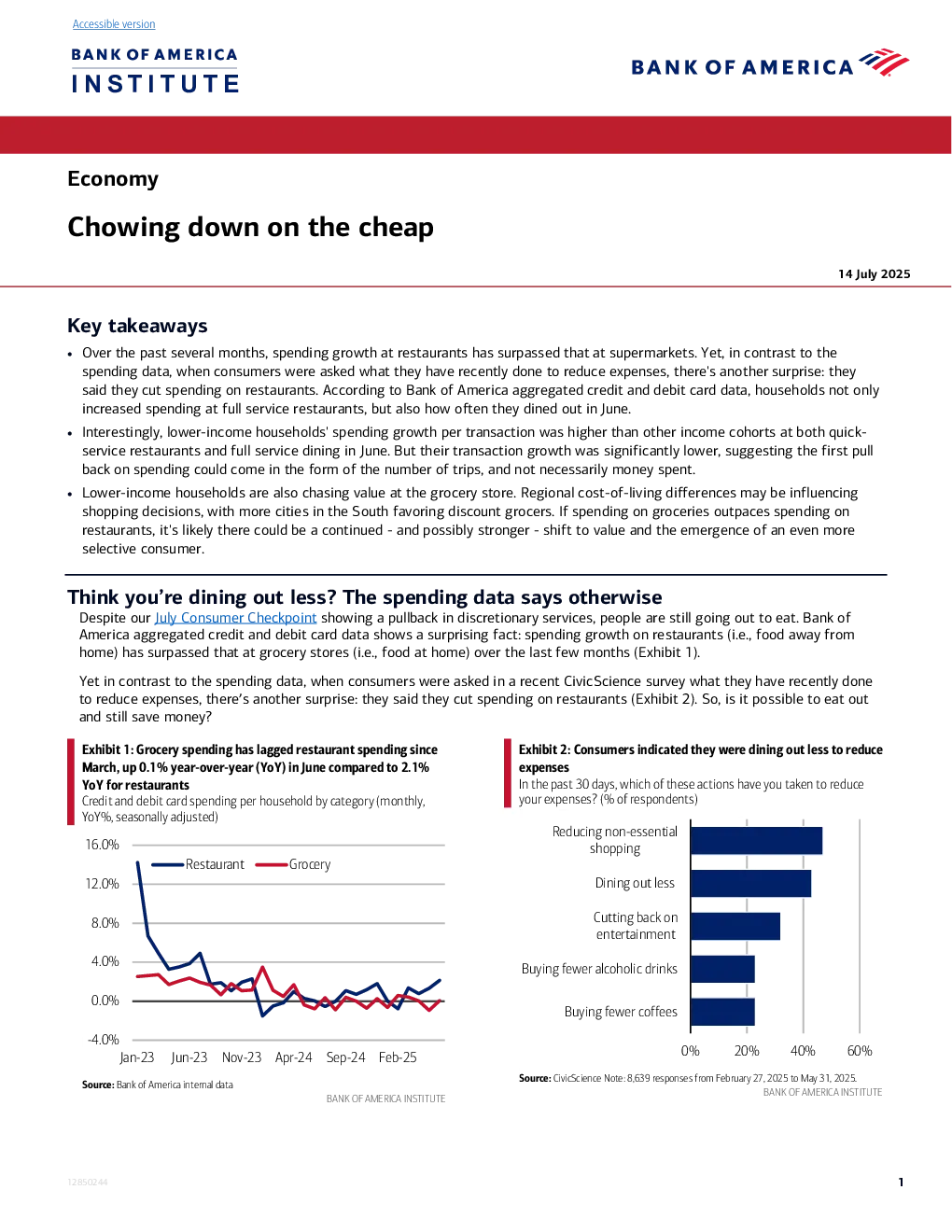
Chowing down on the cheap Key takeaways •Over the past several months, spending growth at restaurants has surpassed that at supermarkets. Yet, in contrast to thespending data, when consumers were asked what they have recently done to reduce expenses, there's another surprise: theysaid they cut spending on restaurants. According to Bank of America aggregated credit and debit card data, households not onlyincreased spending at full service restaurants, but also how often they dined out in June. •Interestingly, lower-income households' spending growth per transaction was higher than other income cohorts at both quick-service restaurants and full service dining in June. But their transaction growth was significantly lower, suggesting the first pullback on spending could come in the form of the number of trips, and not necessarily money spent. •Lower-income households are also chasing value at the grocery store. Regional cost-of-living differences may be influencingshopping decisions, with more cities in the South favoring discount grocers. If spending on groceries outpaces spending onrestaurants, it's likely there could be a continued - and possibly stronger - shift to value and the emergence of an even moreselective consumer. Think you’re dining out less? The spending data says otherwiseDespite ourJuly Consumer Checkpointshowing a pullback in discretionary services, people are still going out to eat. Bank of America aggregated credit and debit card data shows a surprising fact: spending growth on restaurants (i.e., food away fromhome) has surpassed that at grocery stores (i.e., food at home) over the last few months (Exhibit 1). Yet in contrast to the spending data, when consumers were asked in a recent CivicScience survey what they have recently doneto reduce expenses, there’s another surprise: they said they cut spending on restaurants (Exhibit 2). So, is it possible to eat outand still save money? Exhibit1:Grocery spending has lagged restaurant spending sinceMarch, up 0.1% year-over-year (YoY) in June compared to 2.1%YoY for restaurantsCredit and debit card spending per household by category (monthly, Exhibit2: Consumers indicated they were dining out less to reduceexpensesIn the past 30 days, which of these actions have you taken to reduce your expenses? (% of respondents) YoY%, seasonally adjusted) Is the economy producing picky eaters?Interestingly, the wallet share for food away from home increased during two out of the six past recessions, according to Bureau of Economic Analysis data (Exhibit 3). One possible explanation for this could be that consumers don’t actually shift from diningout during economic slowdowns, they just switch to less expensive options. For now, looking across Bank of America card data, we see households made fewer visits to quick-service restaurants (QSRs) andincreased the number of transactions at full-service, casual dining spots in June on a YoY growth basis. Share of totalpersonal consumption expenditureon food at home and food away from home prior to and during recessions (%) Lower-income households are dining out less, but spending moreAccording to BofA Global Research, we are seeing a continuation of the consumer selectivity that typically characterizes times of economic uncertainty. Specifically, some consumers appear to be seeking out perhaps fewer, but more meaningful experiences. This is particularly the case for lower-income households. Their spending growth per transaction was greater than other incomecohorts at both limited and full-service dining (Exhibit 4andExhibit 5). Yet, the growth in the number of transactions was muchlower in June, suggesting the first pull back in spending could come in the number of trips, but not necessarily money spent. Exhibit5:Across cohorts, lower-income households had theweakest growth in transactions at casual dining, but increasedspending the most in JuneSpending per card transaction, card transaction per month on casual Exhibit4:Compared to other cohorts, lower-income householdsmade far fewer transactions and increased spending growth onfast food in June dining in June by income category (3-month moving average, YoY%) Spending per card transaction, card transaction per month on QSRs inJune by income category (3-month moving average, YoY%) Clipping coupons at the grocery storeDoes spending more but going less often also apply to grocery shopping? As discussed in ourJuly Consumer Checkpoint, there has been a continued migration towards“value”when grocery shopping. According to Bank of America card data, consumersacross all income groups are transacting more frequently (Exhibit 6) and–with the exception of middle-income households–spending less per transaction YoY, meaning it’s likely people are shopping more selectively to get the best bargains. After all, shoppers this year have been hit by high prices for products ranging from eggs to meat, so searching for discounts is ofparticular importance (read more