您的浏览器禁用了JavaScript(一种计算机语言,用以实现您与网页的交互),请解除该禁用,或者联系我们。 [美国银行]:25年的五个主题 - 发现报告

25年的五个主题

信息技术 2025-12-01 美国银行 光影
报告封面

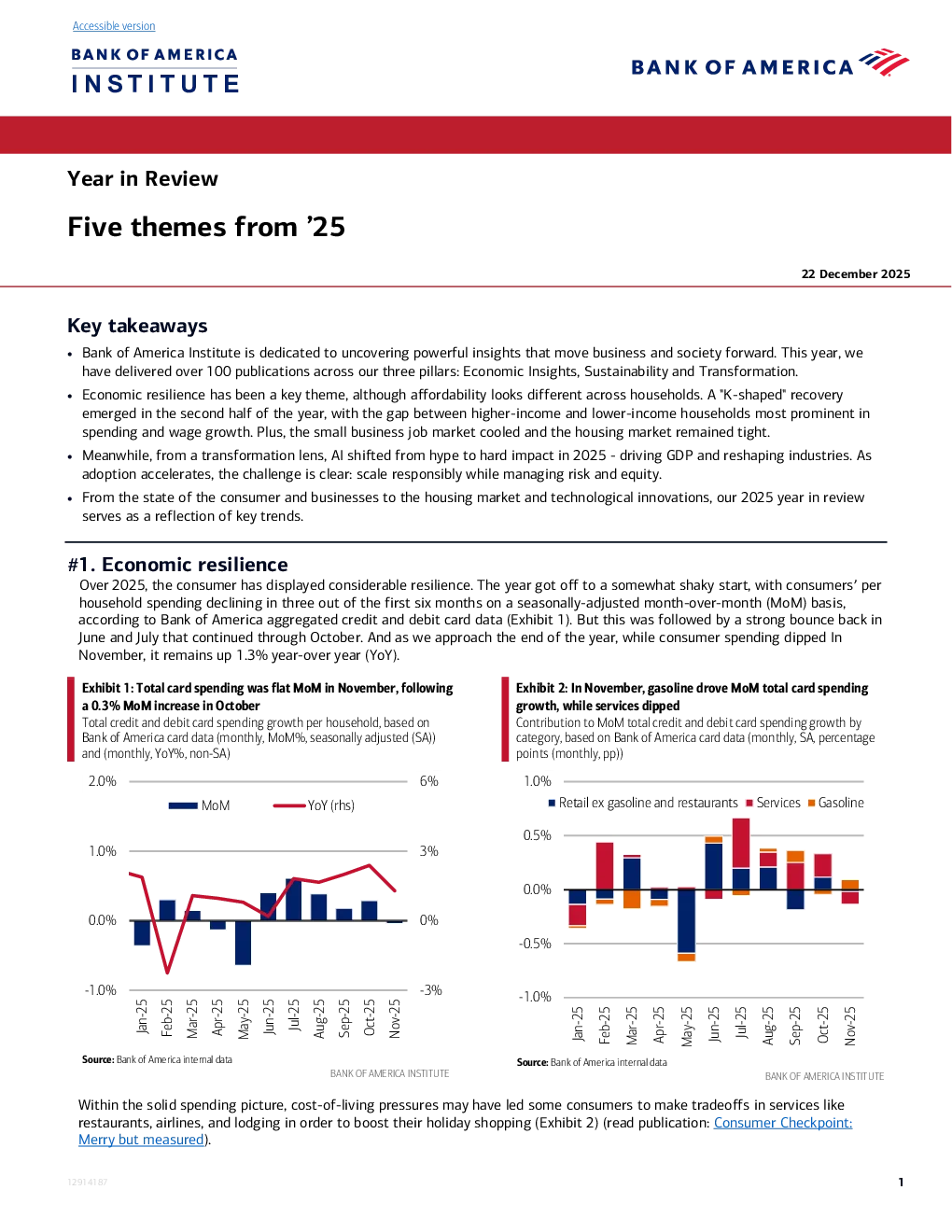
Five themes from ’25 Key takeaways •Bank of America Institute is dedicated to uncovering powerful insights that move business and society forward. This year, wehave delivered over 100 publications across our three pillars: Economic Insights, Sustainability and Transformation. •Economic resilience has been a key theme, although affordability looks different across households. A "K-shaped" recoveryemerged in the second half of the year, with the gap between higher-income and lower-income households most prominent inspending and wage growth. Plus, the small business job market cooled and the housing market remained tight. •Meanwhile, from a transformation lens, AI shifted from hype to hard impact in 2025 - driving GDP and reshaping industries. Asadoption accelerates, the challenge is clear: scale responsibly while managing risk and equity. •From the state of the consumer and businesses to the housing market and technological innovations, our 2025 year in reviewserves as a reflection of key trends. #1. Economic resilienceOver 2025, the consumer has displayed considerable resilience. The year got off to a somewhat shaky start, with consumers’per household spending declining in three out of the first six months on a seasonally-adjusted month-over-month (MoM) basis,according to Bank of America aggregated credit and debit card data (Exhibit 1). But this was followed by a strong bounce back inJune and July that continued through October. And as we approach the end of the year, while consumer spending dipped InNovember, it remains up 1.3% year-over year (YoY). Exhibit1:Total card spendingwas flat MoM inNovember, followinga 0.3% MoM increase in OctoberTotal credit and debit card spending growth per household, based on Exhibit2:In November, gasolinedrove MoMtotalcard spendinggrowth, while services dippedContribution to MoM total credit and debit card spending growth by category, based on Bank of America card data (monthly, SA, percentagepoints (monthly, pp)) Bank of America card data (monthly, MoM%, seasonally adjusted (SA))and (monthly, YoY%, non-SA) Within the solid spending picture, cost-of-living pressures may have led some consumers to make tradeoffs in services likerestaurants, airlines, and lodging in order to boost their holiday shopping (Exhibit 2) (read publication:Consumer Checkpoint:Merry but measured). And all of this is occurring against the backdrop of a labor market that is cooling–or in a“low-hire, low-fire”mode–as opposedto an outright deterioration. According to BofA Global Research, slowing labor supply is one reason behind cooling jobs growth,rather than it being largely driven by significant decreases in labor demand. This is likely why consumers continue to be resilient. Consistent with this cooling,Exhibit 3suggests that the YoY growth in our payrolls measure slowed to 0.2% in November, adeceleration in the growth rate of around 0.5% YoY seen in October and September. AndExhibit 4shows that in November thegrowth in unemployment payments into Bank of America customer accounts remained around 10% YoY, a similar rate of growthto the prior two months. Exhibit3:An estimate of payrolls from Bank of America internaldata suggests November saw some deceleration in YoY jobs growthPayroll estimates from Bank of America internal data (three-month Exhibit4:Unemployment payments into Bank of America customeraccounts rose around 10% YoY in November, similar to Septemberand October moving average, % YoY), the Bureau of Labor Statistics (BLS) andAutomatic Data Processing (ADP) (monthly, YoY) Number of households receiving unemployment payments (three-monthmoving average, YoY%, NSA) and Continuing claims (three-monthmoving average, YoY%, SA) #2. “K-shaped” consumer recoveryHow might the cooling labor market be affecting consumers? In our view, it appears to be disproportionately affecting lower- income households. AsExhibit 5illustrates, starting around the spring of 2025, higher-income households’spending growthaccelerated, while lower-income households’spending growth weakened–leading to a pronounced“K”shape. A key reason behind this“K-shaped”spending pattern is the labor market. In Bank of America deposit data, after-tax wage andsalary growth has risen for higher-income households over the year, culminating with a 4.0% YoY growth rate in November–equal to the highest level of growth since 2021. The same is not true for lower-income households (Exhibit 6), though wagegrowth for this cohort appears to have stabilized since the summer. Exhibit5:Aroundthespring of 2025,the gap between higher-andlower-income households’ spending growth got progressively widerTotal credit and debit card spending per household, according to Bank of America card data, by household income terciles (3-month movingaverage, YoY%, SA) Exhibit6:A similar story of widening gaps between higher-andlower-income households has played out in wage growthAfter-tax wage and salary growth by household income terciles, based on