您的浏览器禁用了JavaScript(一种计算机语言,用以实现您与网页的交互),请解除该禁用,或者联系我们。 [美国银行]:时钟观察 - 发现报告

时钟观察

电子设备 2026-01-01 美国银行 江边的鸟
报告封面

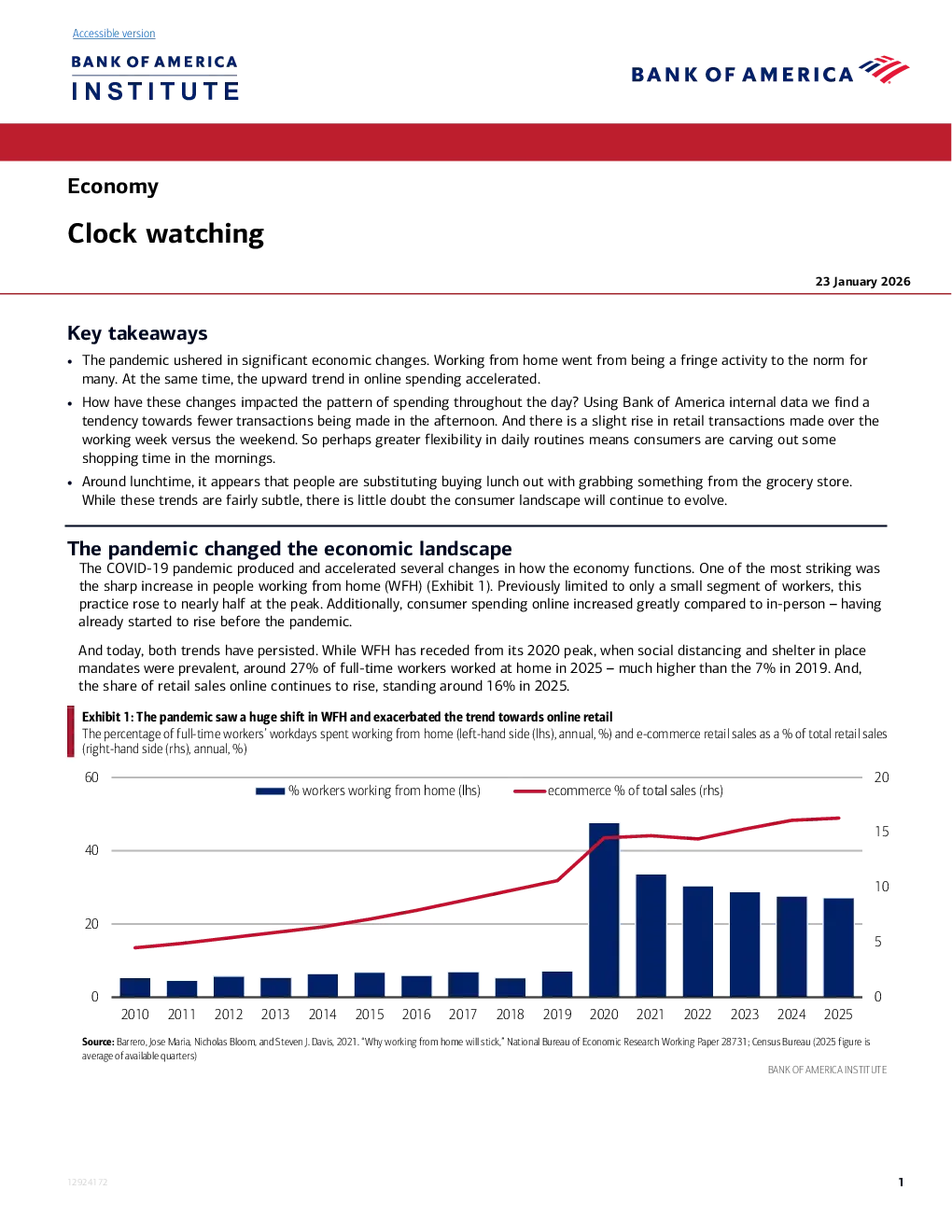
Clock watching Key takeaways •The pandemic ushered in significant economic changes. Working from home went from being a fringe activity to the norm formany. At the same time, the upward trend in online spending accelerated. •How have these changes impacted the pattern of spending throughout the day? Using Bank of America internal data we find atendency towards fewer transactions being made in the afternoon. And there is a slight rise in retail transactions made over theworking week versus the weekend. So perhaps greater flexibility in daily routines means consumers are carving out someshopping time in the mornings. •Around lunchtime, it appears that people are substituting buying lunch out with grabbing something from the grocery store.While these trends are fairly subtle, there is little doubt the consumer landscape will continue to evolve. The pandemic changed the economic landscapeThe COVID-19 pandemic produced and accelerated several changes in how the economy functions. One of the most striking was the sharp increase in people working from home (WFH) (Exhibit 1). Previously limited to only a small segment of workers, thispractice rose to nearly half at the peak. Additionally, consumer spending online increased greatly compared to in-person–havingalready started to rise before the pandemic. And today, both trends have persisted. While WFH has receded from its 2020 peak, when social distancing and shelter in placemandates were prevalent, around 27% of full-time workers worked at home in 2025–much higher than the 7% in 2019. And,the share of retail sales online continues to rise, standing around 16% in 2025. Exhibit1:The pandemic saw a huge shift inWFHand exacerbated the trend towards online retailThe percentage of full-time workers’ workdays spent working from home (left-hand side (lhs), annual, %) and e-commerce retail sales as a % of total retail sales (right-hand side (rhs), annual, %) When are people doing their shopping?Given the shift to more remote work and an uptick in online spending, an interesting question is whether there have been changes to when people do their in-person shopping during the day. For example, has WFH facilitated a more even distributionof in-person spending given the greater ease for people to run to the store? Here we look at in-person debit card transactions using“time-stamped”Bank of America internal data to identify changes in thetimes of day that people shop. More overall spending was done in the morning in 2025 than in 2019First, looking at debit card transactions across all categories of in-person spending, most spending is done during daytime hours, particularly from 8am to 7pm (Exhibit 2). During the peak pandemic years (2020/21) the share of these transactions made in theafternoon (12pm to 7pm) was higher than in 2019. However, by 2025, this trend had reversed and the share of transactionsbetween 12pm and 7pm was lower than in 2019. Conversely, more transactions were made in the morning (4am to 11am) in2025 than in 2019 and the pandemic years. Exhibit3:Around30%of retail transactions weremadein themorning in 2025 during weekdays….The share of in-person debit card transactions on non-food retail Exhibit4:…anda similar30% of retail transactions weremadeinthe morning in 2025 during weekendsThe share of in-person debit card transactions on non-food retail categories (excluding groceries and food services and drink) by time ofday during weekdays (%, annual average of weekdays) categories (excluding groceries and food services and drink) by time ofday during weekdays (%, annual average of weekends) When we examine non-food retail transactions (excluding groceries and food services/drink), we see fairly similar behavioralchanges across weekdays and weekends (Exhibit 3andExhibit 4). Notably, on both weekdays and weekends, a slightly larger share of retail transactions took place in the morning in 2025 compared with 2019-2021. This suggests that shifts in spendingtime are not limited to food purchases. Instead, greater flexibility in daily routines–and perhaps not being restricted to on-sitework–may be allowing consumers to fit in some occasional morning shopping, while school runs and deadlines may make thisharder later in the day. Is the grocery store becoming a substitute for restaurants at lunchtimes?When we look at transactions for groceries, it seems people may still be making the most of WFH flexibility to shop for food over the lunchtime (12pm to 3pm) hours–as the share of transactions here is above 2019 levels (Exhibit 5). Exhibit5:For groceries,the share of transactionsmadeduring thetime period 12pm to 3pm was up in 2025 from 2019…The share of in-person debit card transactions on groceries by time of day Exhibit6:…while for food services, the share of transactions madeduring the lunchtime period in 2025 was notably lowerThe share of in-person debit card transactions on food services and drink during weekdays (%, annual average of weekdays)