您的浏览器禁用了JavaScript(一种计算机语言,用以实现您与网页的交互),请解除该禁用,或者联系我们。 [美国银行]:区域综述:制定可负担性 - 发现报告

区域综述:制定可负担性

房地产 2026-01-01 美国银行 还是郁闷闷啊
报告封面

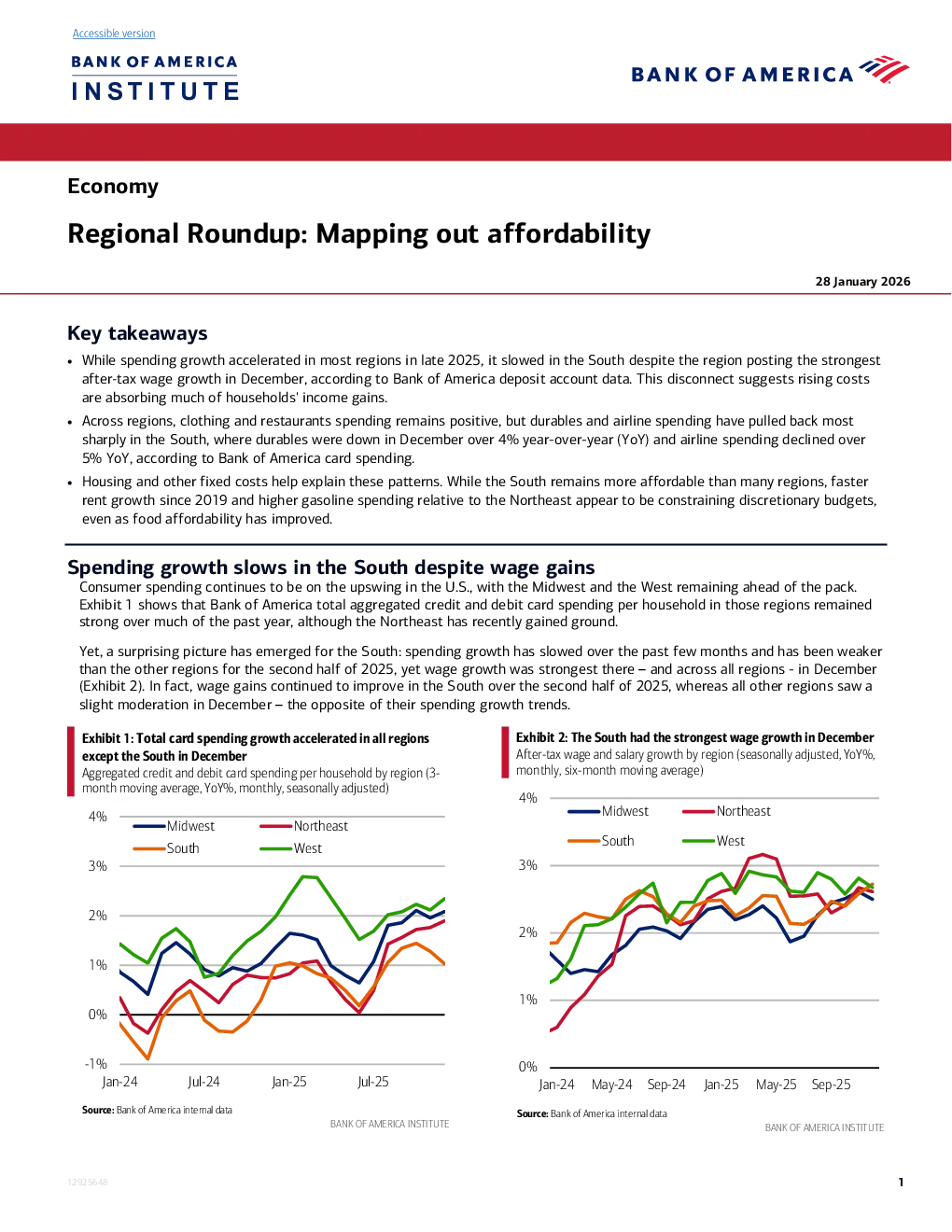
Regional Roundup: Mapping out affordability 28 January 2026 Key takeaways •While spending growth accelerated in most regions in late 2025, it slowed in the South despite the region posting the strongestafter‑tax wage growth in December, according to Bank of America deposit account data. This disconnect suggests rising costsare absorbing much of households' income gains. •Across regions, clothing and restaurants spending remains positive, but durables and airline spending have pulled back mostsharply in the South, where durables were down in December over 4% year-over-year (YoY) and airline spending declined over5% YoY, according to Bank of America card spending. •Housing and other fixed costs help explain these patterns. While the South remains more affordable than many regions, fasterrent growth since 2019 and higher gasoline spending relative to the Northeast appear to be constraining discretionary budgets,even as food affordability has improved. Spending growth slows in the South despite wage gainsConsumer spending continues to be on the upswing in the U.S., with the Midwest and the West remaining ahead of the pack. Exhibit 1 shows that Bank of America total aggregated credit and debit card spending per household in those regions remainedstrong over much of the past year, although the Northeast has recently gained ground. Yet, a surprising picture has emerged for the South: spending growth has slowed over the past few months and has been weakerthan the other regions for the second half of 2025, yet wage growth was strongest there–and across all regions - in December(Exhibit 2). In fact, wage gains continued to improve in the South over the second half of 2025, whereas all other regions saw aslight moderation in December–the opposite of their spending growth trends. Exhibit 1:Total card spending growth accelerated in all regionsexcept the South in DecemberAggregated credit and debit card spending per household by region (3- After-tax wage and salary growth by region (seasonally adjusted, YoY%,monthly, six-month moving average) month moving average, YoY%, monthly, seasonally adjusted) The culprit across the board: changes in affordabilityWhat’s behind this? Some of this might be due to waning labor supply, from increased immigration restrictions, putting pressure on wages. Another part of the equation–affordability challenges might be driving some changes in spending behavior. In ourview, southern households are pulling back more sharply on bigger ticket discretionary items like durables and travel in order tokeep up with expenses (Exhibit 3) (read more on this inSeptember’s Regional Roundup). In the West, consumers exhibited comparatively more resilient spending in bigger ticket discretionary categories, consistent withhigher average incomes and continued travel demand. The Northeast is between these two extremes, with relatively modestdeclines in durables but a sharper pullback in travel. By contrast, spending on smaller ticket categories like clothing andrestaurants increased at a similar pace across all regions. Aggregated credit and debit card spending, based on Bank of America data, per household by region for select discretionary categories (3-month movingaverage to December 2025, YoY%, monthly, non-seasonally adjusted) Rents race ahead of paychecks across the SouthHousing costs remain one of the most significant affordability challenges. In fact, over the past few years, after‑tax wage growth in the South has failed to keep up with rent growth by a wider margin than in most other regions (Exhibit 4). Growth in median rent payments compared to growth in average after-tax wage and salary, both based on Bank of America data (yearly, difference in index Renters–who tend to be younger and have lowerincomes than homeowners–are particularly sensitive to these pressures,especially as housing is often the largest expense of any household. And while we do not directly observe rent as a share ofincome, the gap between rents and wages suggests that housing has claimed a larger portion of a typical renter’s householdbudget in the South. This dynamic likely reflects a strong increase in people moving to the region, especially from the Northeast, which bolstereddemand for rental housing faster than supply (read more on this inOn the move: U.S. migration patterns). However, the goodnews is–supply has caught up. We recently found that rent payments in certain parts of the South have been flat or even decreasing (read more inOn themove: Renters catch a break). This has likely eased some of the burden that rents have put on some Southern households in thepast few years. However, while cooling rent payments likely boosted smaller ticket discretionary spending (like clothing andrestaurants), these improvements have likely not extended to bigger ticket items like durables and travel yet, in our view. Median rents per region compared to national median, based onBank of America payments data (yearly,