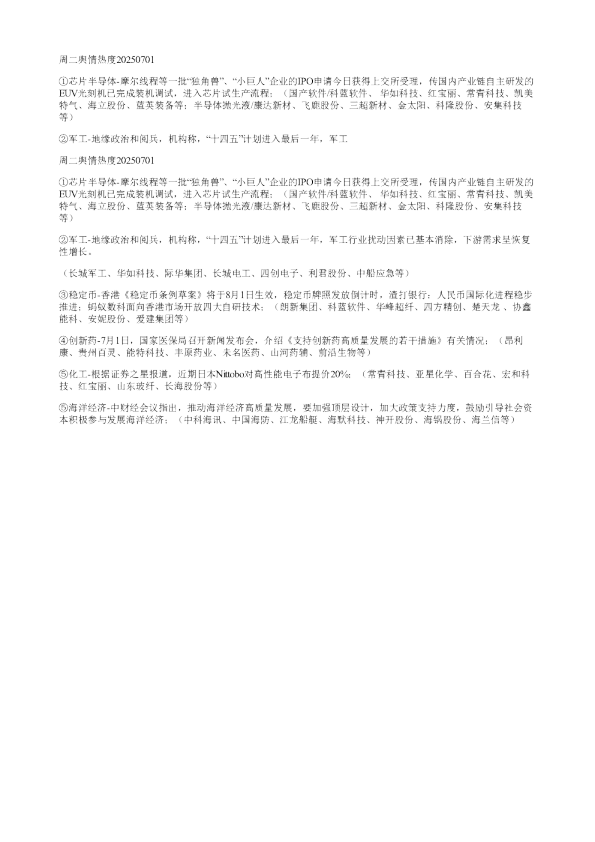
美国独角兽群规模
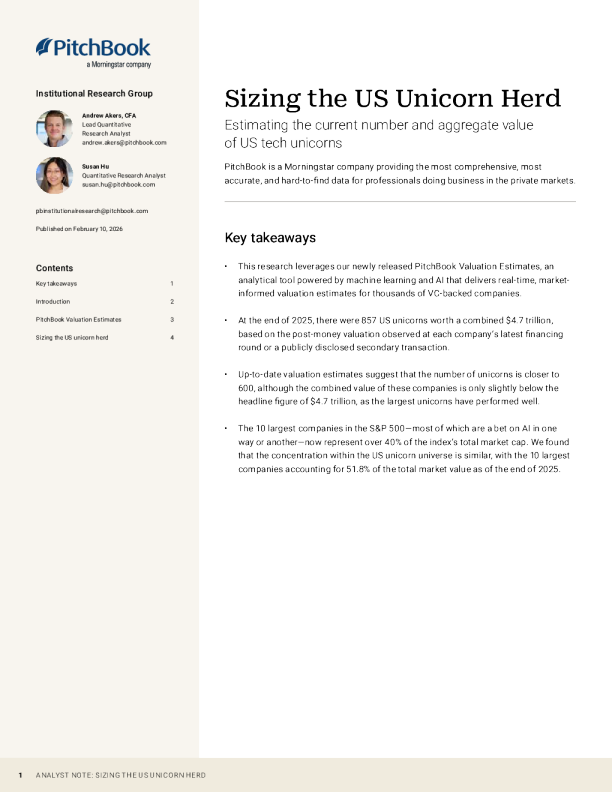
Sizing the US Unicorn Herd Institutional Research Group Estimating the current number and aggregate value PitchBook is a Morningstar company providing the most comprehensive, mostaccurate, and hard-to-find data for professionals doing business in the private markets. Susan HuQuantitative Research Analystsusan.hu@pitchbook.com pbinstitutionalresearch@pitchbook.com Published on February 10, 2026 Key takeaways •This research leverages our newly released PitchBook Valuation Estimates, ananalytical tool powered by machine learning and AI that delivers real-time, market- Contents Key takeawaysIntroduction •At the end of 2025, there were 857 US unicorns worth a combined $4.7 trillion,based on the post-money valuation observed at each company’s latest financing •Up-to-date valuation estimates suggest that the number of unicorns is closer to600, although the combined value of these companies is only slightly below the •The 10 largest companies in the S&P 500—most of which are a bet on AI in oneway or another—now represent over 40% of the index’s total market cap. We foundthat the concentration within the US unicorn universe is similar, with the 10 largest Introduction Since Aileen Lee, founder of Cowboy Ventures, coined the term “unicorn” in 2013 todescribe a tech startup that reached a billion-dollar valuation, the term has becomeubiquitous in the venture community. While the VC market has grown dramaticallyover the past 12 years, the billion-dollar valuation mark and the associated unicornstatus remain coveted by investors and founders. The number of US unicorns surgedfrom 114 at the end of 2016 to 857 at the end of 2025, totaling more than $4 trillion This lack of recent pricing complicates any attempt to analyze the current state ofunicorns in aggregate. Private company valuations are often treated as static markers,but in practice, they are point-in-time assessments that can quickly become outdatedas market conditions, company performance, and investor risk tolerance evolve. To address this challenge, this research utilizes PitchBook Valuation Estimates, anew analytical tool that provides real-time, mark-to-market valuation estimates forVC-backed companies. By incorporating observed public and private market data,company-specific signals, and valuation trends across comparable peers, PitchBook PitchBook Valuation Estimates PitchBook’s recently launched VC-backed company valuation estimates—the expectedpre-money valuations companies would be priced at under current market conditions—are derived from a regression model that predicts a company’s expected annualized growth rate from its last known post-money valuation. Valuation estimates are updateddaily on the PitchBook Platform for companies that have reached a Series A or laterround and have been valued in a transaction tracked by PitchBook in the past three Market- and comp-growth data is taken from two primary sources: public companyequity performance and VC-backed company valuations observed in primary VCfunding rounds, respectively. In addition to examining overall market performancefrom both sources, we generate a set of comps for each company being valued using Sizing the US unicorn herd At the end of 2025, there were 857 US unicorns worth a combined $4.7 trillion, basedon the post-money valuation observed at each company’s latest financing round ora publicly disclosed secondary transaction. However, on average, these valuationswere struck over 2.5 years ago. Up-to-date valuation estimates show that the current The estimated number of unicorns tells a different story, one at the core of the currentdynamics in the broader VC market. Our analysis indicates that the actual numberof unicorns, based on current valuation estimates, is just 635. Over a quarter ofcompanies previously dubbed as unicorns are likely no longer worth more than $1 Much of the fallout from the unicorn universe had run its course by the end of 2023.The past two years have looked more like a rebalancing as new unicorns easilyoutpaced fallen unicorns. A slower pace of exits has also contributed to the netincrease in unicorns over the past two years, though the 27 exits in 2025 were themost in a calendar year since 2020. While exits typically do not move the needle much One of the key themes and potential risks across US equity markets today isconcentration. This theme is relevant to both public and private markets. The 10largest companies in the S&P 500—most of which are a bet on AI in one way oranother—now represent over 40% of the index’s total market cap. We found that theconcentration within the US unicorn universe is similar, with the 10 largest companiesaccounting for 51.8% of the total market value as of the end of 2025. However, the risks Taken together, these dynamics suggest that the unicorn market has not simplyrebounded to its prior peak but has meaningfully reset. While aggregate value haslargely held up—supported by a small group of exceptionally la