2026年1月进出口价格指数与贸易指数(初步数据)
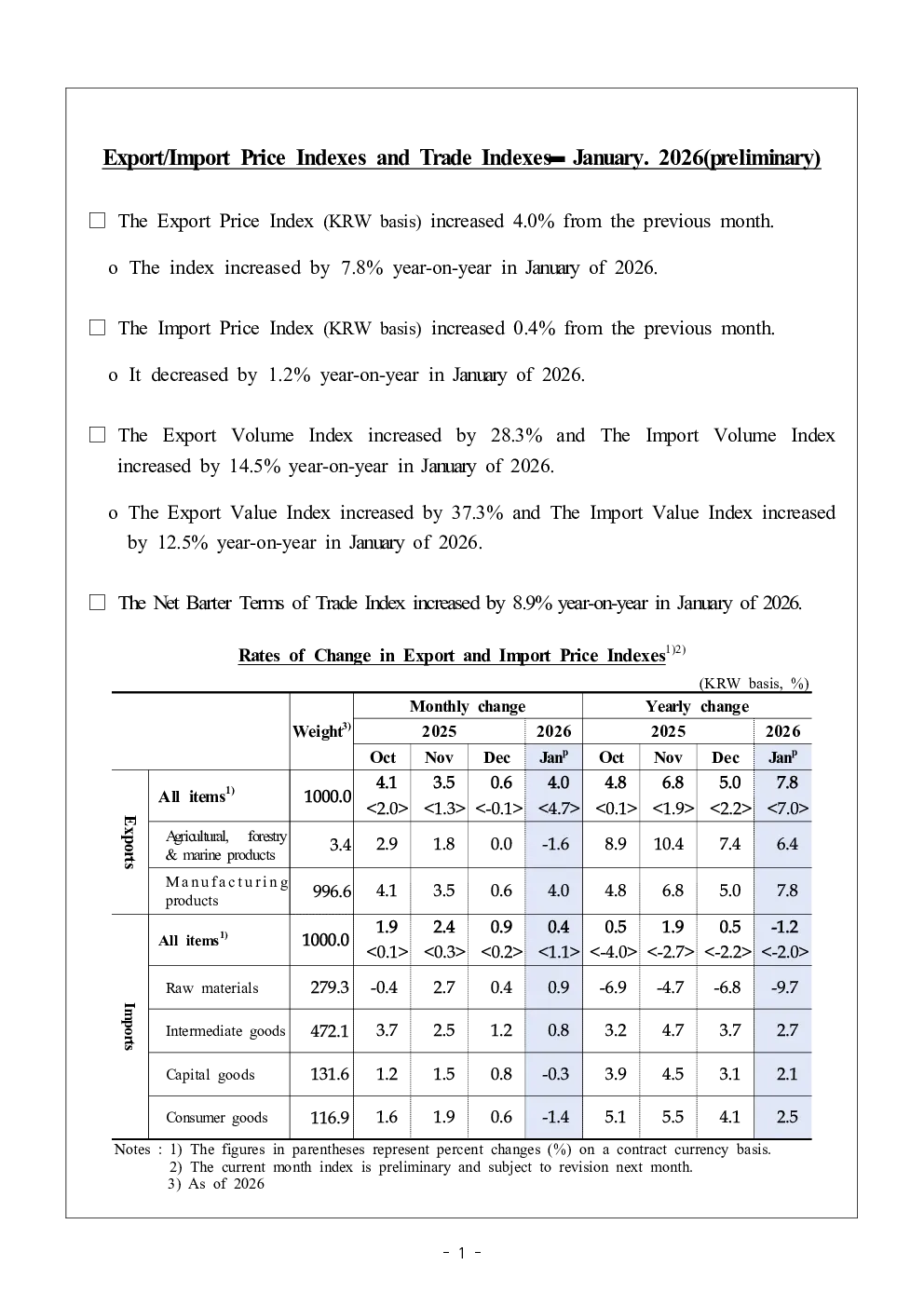
o The index increased by 7.8% year-on-year inJanuaryof 2026. □The Import Price Index(KRW basis)increased 0.4% from the previous month. o It decreased by 1.2% year-on-year inJanuaryof 2026. □The Export Volume Index increased by 28.3%and The Import Volume Index o The Export Value Index increased by 37.3% and The Import Value Index increased □The Net Barter Terms of Trade Index increased by 8.9% year-on-year in January of 2026. ※Further statistics can be found at the Bank of Korea's Economic Statistics System website(http://ecos.bok.or.kr). ( Chart ) Export/Import Price Indexes and Trade Indexes 1. Export Prices A. Index B. Changes 2. Import Prices B. Changes ( Appendix 1 ) How the Export and Import Price Indexes are compiled 1. Definition and use ―The Export and Import Price Indexes measure fluctuations in the prices of goodsexportedand imported.The indexes are used to gauge the effects of price 2. Frequency ―At the beginning of each month, prices for the previous month are surveyed. 3. Prices surveyed ―Average monthly prices are surveyed in principle,based upon the points atwhichthe export/import contracts are entered into,so that they may serve as ―Export prices are surveyed on an FOB basis,and import prices on CIF.Forsome items, however, trade practices are applied. 4. Items subject to survey ―Only items whose export/import amounts account for more than 1/2,000 of thecountry's trading volume;that are representative of the price movements of itemsgrouped within similar industries; whose quality standards are uniformly maintained; ―Items marked without comparable price quotations for considerable period(e.g. 5. Method of compilation ―Classification ㅇBasic classification: The industrial classification set out in the Korea StandardIndustrialClassification(KSIC)is applied with necessary modifications as thebasicclassification.This is further broken down into two sub-categories forexports - agricultural, forestry & marine products and manufacturing products andthreefor imports-agricultural,forestry&marine products,mining products ㅇSpecialized classification:For user convenience,the indexes are alsoclassifiedinto foods/non-foods;energy/items other than energy;informationtechnology/items other than IT; and foods & energy/items other than foods &energy; as well as groupings by use(for MPI only), trade and industry type. ―Weights ㅇThe weights of individual items are expressed in permillage in accordance ―Compilation ㅇThe headline indexes are compiled from Korean won-based indexes, which areproducedby converting the contract prices of exports/imports so that their ㅇThe formula used to aggregate the indexes is a Lowe Chain weightedformula. The price reference and weighting period are changed every years, soas to increase the extent to which the Export and Import Price Indexes reflect 6. Notes on statistical use ―The purpose of the index is to measure the changes in the price, not to present ―The Export and Import Price Indexes are compiled on three different bases: theKorean won, the contract currencies, and the US dollar. Users are hence advised ―The Export and Import Price Indexes for current month is preliminary and ―The Trade indexes for current month is preliminary and may be revised uponthe release of the index for the following month. Additionally, the index for the