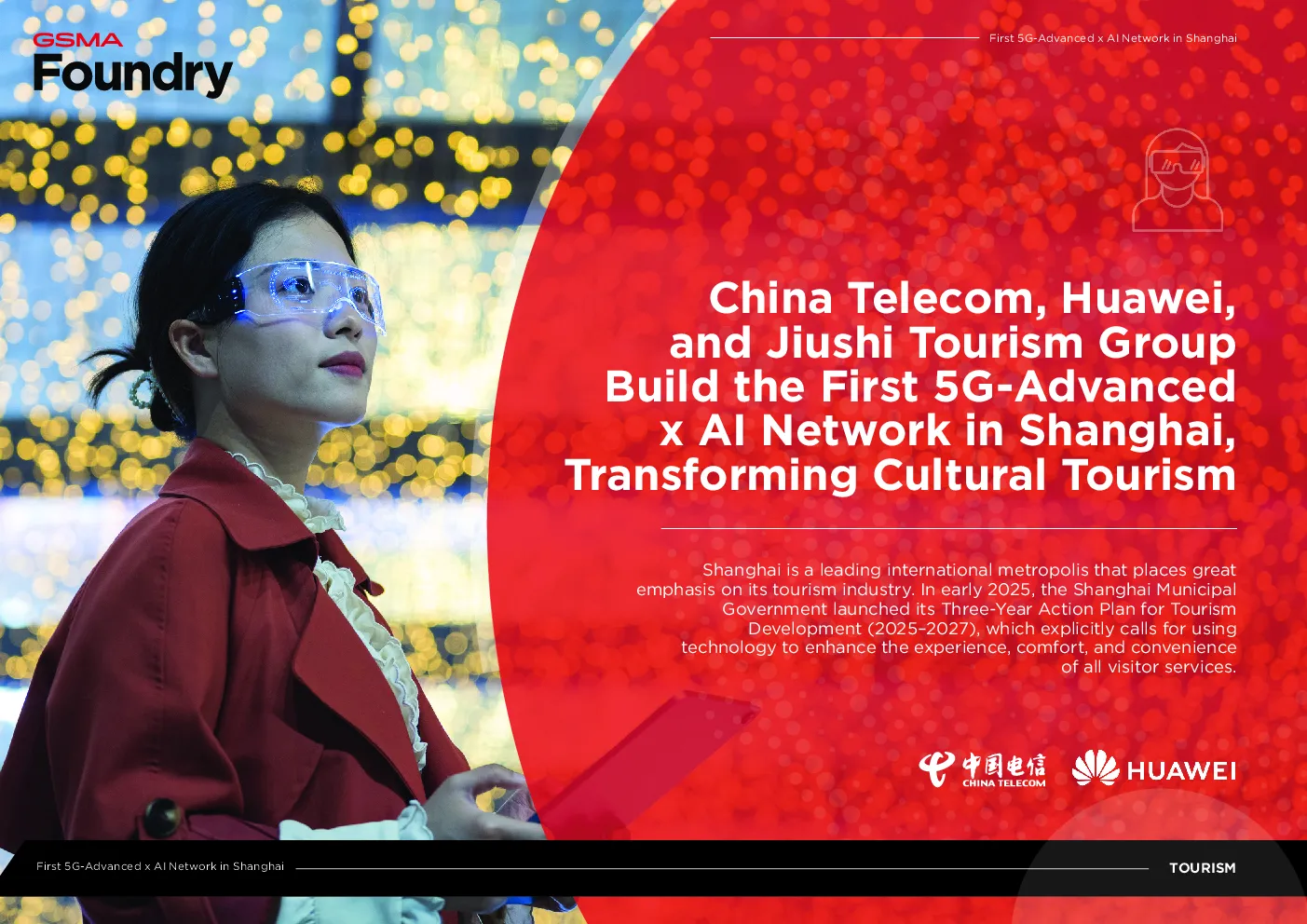
Shanghai is a leading international metropolis that places greatemphasis on its tourism industry. In early 2025, the Shanghai MunicipalGovernment launched its Three-Year Action Plan for TourismDevelopment (2025–2027), which explicitly calls for usingtechnology to enhance the experience, comfort, and convenienceof all visitor services. China Telecom, Huawei, and Jiushi Tourism GroupBuild the First 5G-Advanced x AI Network in Shanghai,Transforming Cultural Tourism that works over both land andwater. Along the river, mmWavestations were deployed. Onboardthe “Junzilan” cruise ships,they installed special compactindoor devices (LampSite X) andmmWave receivers (CPEs) toguarantee strong coverage insidethe cabins. For the service, theyused AI glasses from Rokid, whichoffer real-time translation andnavigation. The AI model wasspecially trained using tour guidedata from Jiushi Tourism Groupto ensure accurate, multilingualservice. AI tour guide for every tourist.The AI glasses rental service hasproven profitable, generating anannual revenue of CNY X0million for Jiushi Tourism Group,setting Shanghai as a benchmarkfor cultural innovation. CASE STUDY LEAD:CHINA TELECOM, HUAWEI,AND JIUSHI TOURISM GROUP CHALLENGES Shanghai, as a global city,needs world-class tourismexperiences. Touristson the popular Huangpu Rivercruises faced two main issues:poor service due to a lack ofmultilingual guides, and unreliablemobile coverage caused by signalreflection off the water and signalloss inside metal/thick-walledcruise cabins. This prevented thesmooth, always-on AI interactionsthat visitors expected. RESULTS: Since launching, the5G-A x AI network hasdramatically improvedthe user experience across landand river. On cruise ships, mobilephone peak download speeds nowreach 3.1 Gbit/s and uplink speedshit 260 Mbit/s. This robustnetwork now powers the personal SOLUTION China Telecom Shanghaipartnered with Huaweito create a seamless5G-Advanced (5G-A) x AI network ProjectBackground Shanghai is a leading international metropolis that places greatemphasis on its tourism industry. In early 2025, the ShanghaiMunicipal Government launched its Three-Year Action Plan forTourism Development (2025–2027), which explicitly calls for usingtechnology to enhance the experience, comfort, and convenienceof all visitor services. The deployment of mature, scalableAI glasses technology presents a timelyopportunity to upgrade the cruiseexperience and drive businesstransformation The city offers a wealth ofattractions, including historicsites, cultural landmarks,natural scenery, and modernarchitecture. Popular locationssuch as the Huangpu River, theBund, and Shanghai Disneylanddraw millions of touristsannually. Shanghai is also seeingrapid growth in its cruiseeconomy. However, traditionalcruise services often fail to meetmodern consumer expectationsfor personalised and intelligent experiences. The deployment ofmature, scalable AI glassestechnology presents a timelyopportunity to upgrade the cruiseexperience and drive businesstransformation. Challenge Business challenges: 2.Cabin Penetration:Cruise ship hulls are made of thick metal, causing significantsignal loss and preventingexternal signals from reachingpassengers inside. Due to the complexsignal reflection onthe Huangpu Riverand cabin barriers,the traditionalapproach of directcoverage fromriverbank stationsresults in poor signalquality onboard 1.Poor OnboardExperience:The internet experience on Huangpu Rivercruises negatively affects theoverall sightseeing enjoyment. 3.Bandwidth Limits:Traditionalsolutions lack the bandwidth tosupport hundreds of passengersneeding high-speed datasimultaneously. 2.Service Gaps:A shortageof translation resources hindersservice for foreign languagegroup tours. 4.Signal Blocking:High-frequency signals rely on a 3.Revenue Bottleneck:The sector urgently needsinnovative services to boostrevenue and maintain marketcompetitiveness. direct line of sight. When cruiseships turn, this line of sight isoften blocked, leading tosudden coverage loss. 4.Safety Risks:The inabilityto monitor the surroundingenvironment in real-time duringnavigation poses safety risks. Lu Heng- Senior Expert of ChinaTelecom Shanghai Technical challenges: 1.Signal Interference:The complex reflections off theriver surface risk interferencewith the wideband spectrumused by current networks. Solution cameras, microphones, andearphones to provide multilingualguidance and sightseeinginformation. Crucially, thenavigation overlay is presenteddirectly in the wearer’s view,avoiding the distraction andinconvenience of constantlylooking down at a phone ormap, which enhances both theimmersion and safety of the tour. At MWC Shanghai, the GSMA hosted a launch event for mobileAI, bringing together China Telecom Shanghai, Jiushi Group, andHuawei. During discussions on the industry’s future, the partnersunveiled the commercial use of AI glasses for guided tours. 2.Enhanced Safety Monitoring:RedCap