您的浏览器禁用了JavaScript(一种计算机语言,用以实现您与网页的交互),请解除该禁用,或者联系我们。[GSMA]:私有5G机载网络为法国电视台和RAI改造外部广播 - 发现报告

私有5G机载网络为法国电视台和RAI改造外部广播

信息技术2026-02-23GSMAB***
AI智能总结
查看更多
私有5G机载网络为法国电视台和RAI改造外部广播

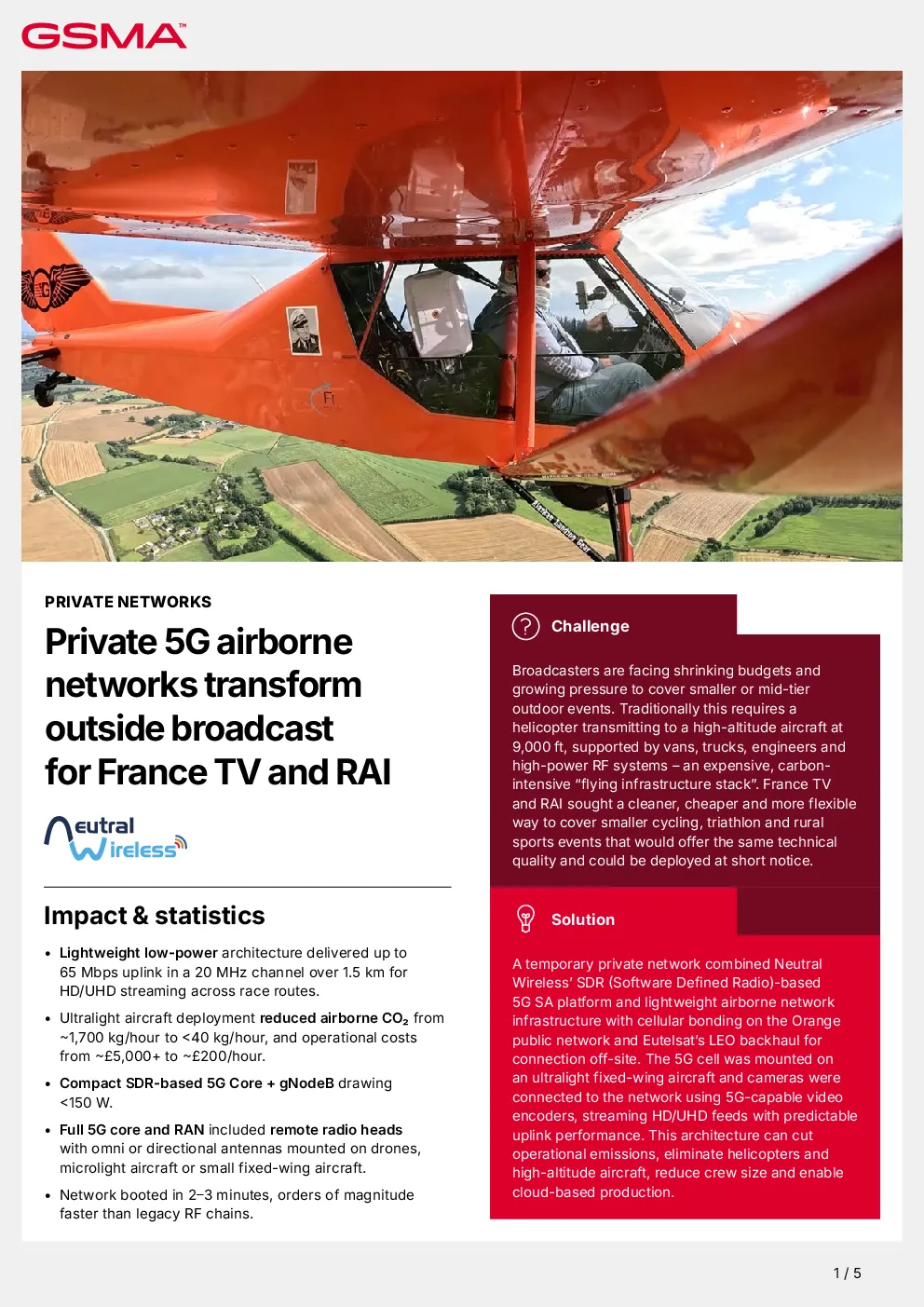
PRIVATE NETWORKS Challenge Private 5G airbornenetworks transformoutside broadcastfor France TV and RAI Broadcasters are facing shrinking budgets andgrowing pressure to cover smaller or mid-tieroutdoor events. Traditionally this requires ahelicopter transmitting to a high-altitude aircraft at9,000 ft, supported by vans, trucks, engineers andhigh-power RF systems – an expensive, carbon-intensive “flying infrastructure stack”. France TVand RAI sought a cleaner, cheaper and more flexibleway to cover smaller cycling, triathlon and ruralsports events that would offer the same technicalquality and could be deployed at short notice. Impact & statistics Solution •Lightweight low-powerarchitecture delivered up to65 Mbps uplink in a 20 MHz channel over 1.5 km forHD/UHD streaming across race routes. A temporary private network combined NeutralWireless’ SDR (Software Defined Radio)-based5G SA platform and lightweight airborne networkinfrastructure with cellular bonding on the Orangepublic network and Eutelsat’s LEO backhaul forconnection off-site. The 5G cell was mounted onan ultralight fixed-wing aircraft and cameras wereconnected to the network using 5G-capable videoencoders, streaming HD/UHD feeds with predictableuplink performance. This architecture can cutoperational emissions, eliminate helicopters andhigh-altitude aircraft, reduce crew size and enablecloud-based production. •Ultralight aircraft deploymentreduced airborne CO₂from~1,700 kg/hour to <40 kg/hour, and operational costsfrom ~£5,000+ to ~£200/hour. •Compact SDR-based 5G Core + gNodeBdrawing<150 W. •Full 5G core and RANincludedremote radio headswith omni or directional antennas mounted on drones,microlight aircraft or small fixed-wing aircraft. •Network booted in 2–3 minutes, orders of magnitudefaster than legacy RF chains. Revolutionary wireless connectivityfor outside broadcast coverage A temporary private 5G SA network, developed by Neutral Wirelessand broadcast partners as part of the IBC Accelerator Media InnovationProgramme, was deployed on an ultralight aircraft using Orangebonded-cellular and Eutelsat satellite connections to cloud and remoteproduction, to explore more affordable and sustainable alternatives tolegacy aircraft-based RF architectures. Introduction Challenges —Background:Outside broadcast operations have longdepended on airborne radio frequency (RF) relaychains to cover dynamic, fast-moving sports such ascycling, triathlon and open-road racing. While suitableand affordable for premium events such as the Tourde France, helicopters and high-altitude aircraftare too expensive and carbon-intensive for smallerregional races and less prestigious events. —Operational issues:Airborne broadcast coverage hastraditionally used helicopters to capture images andreceive feeds from chase motorbikes, and forwardthem to high-altitude aircraft that relay the signals toground receivers. This creates a heavy infrastructurestack: specialist RF equipment, high-power COFDMlinks, flight engineers, trucks, generators and complexcoordination between air and ground teams. —Use case context:Private airborne 5G networksenable broadcasters to cover smaller sportingevents more cost effectively with professional-grade production value, and provide connectivity foradditional content and IP-based workflows. —Environmental and logistical constraints:Helicopterand high-altitude aircraft systems take hours to prepare,require fair weather conditions, create significant noisepollution and consume large amounts of fuel. —Technology rationale: Units are small, lightweight anddraw very little power. They can also boot up in twoto three minutes. This flexibility allowed the team tomount the 5G cell onto an ultralight fixed-wing aircraft. —Objectives:This project sought to prove thattemporary private 5G networks, combined withlightweight airborne deployment, could deliverthe same editorial value at a fraction of the cost,emissions and complexity, while offering increasedflexibility through the use of off-the-shelf devices andsmartphones. Solution —Spectrum:Licensed by the French Ministry of ArmedForces to use a 20 MHz channel (2310–2330 MHz) inits n40 spectrum at 25 dBm (316 mW) Neutral Wireless’ SDR-based 5G platform is abreakthrough in outside broadcast coverage, fusing the5G Core and gNodeB in a compact, ultra-portable unit. —Technology overview:With private 5G, the ultralightbecomes a flying 5G cell, creating a broad, stable,IP-native coverage bubble below. Ground cameras,motorbike units, commentary positions and roamingjournalists simply attach to the airborne cell usingcommercial encoders such as the Haivision Pro460or Sony PDT-FP1, or off-the-shelf smartphones.Because the network can be uplink-optimised touse a 1:3 resource ratio (a public network is typically3:1 downlinked optimised), the airborne cell cansustain hundreds of megabits per second of HD orUHD video traffic depending on channel size. LEOsatellite backhaul via Eutelsat OneWeb provid