China's Direct Foreign Investment (ODI): Steadily Advancing, Redefining the Landscape
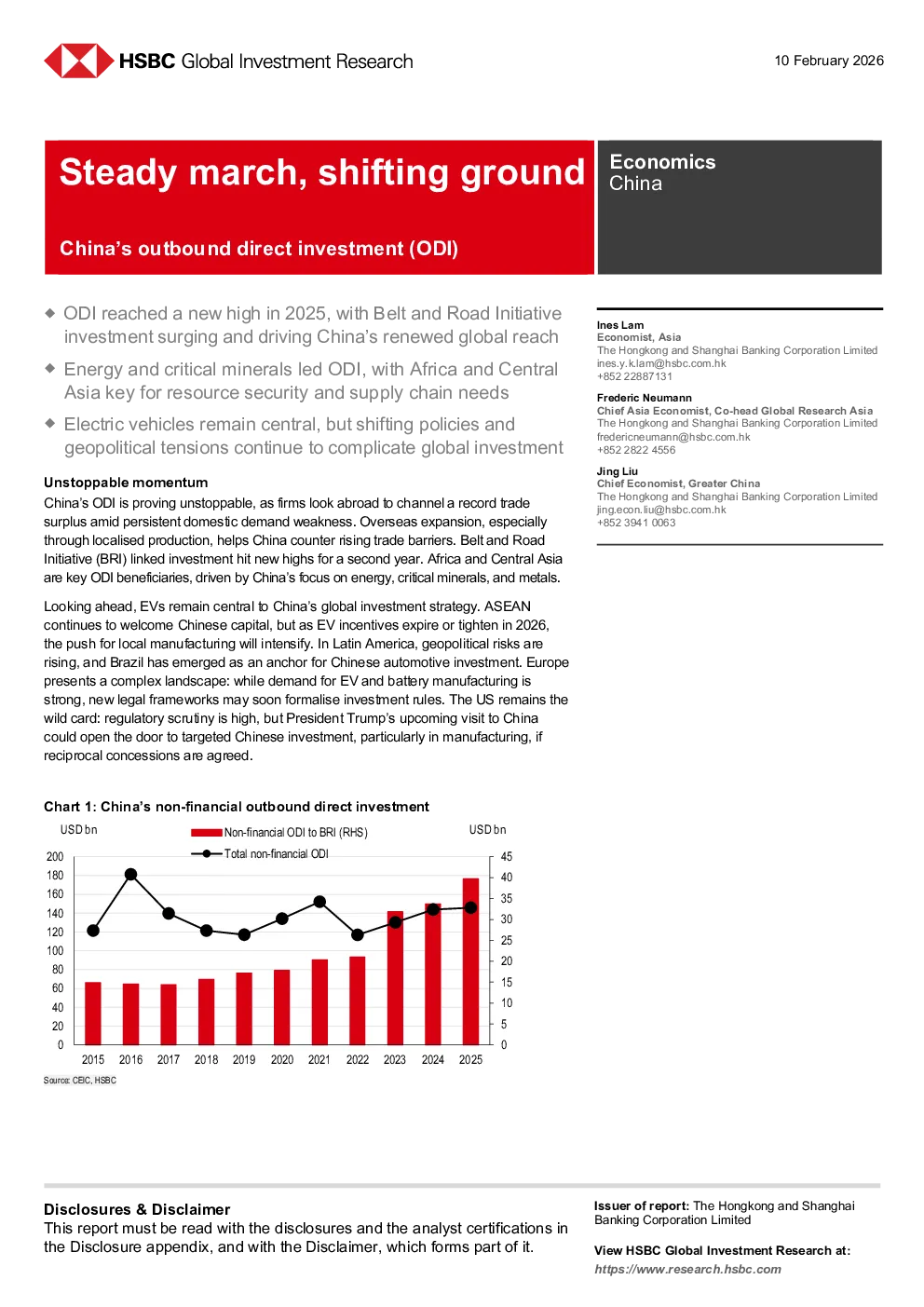
Steady march, shifting ground China’s outbound direct investment(ODI) ◆ODI reached a new high in 2025, with Belt and Road Initiativeinvestmentsurging anddriving China’s renewed globalreach Ines LamEconomist, AsiaThe Hongkong and Shanghai Banking Corporation Limitedines.y.k.lam@hsbc.com.hk+852 22887131 ◆Energy and critical minerals ledODI, with Africa and CentralAsia key for resource security and supply chain needs Frederic NeumannChief Asia Economist, Co-head Global Research AsiaThe Hongkong and Shanghai Banking Corporation Limitedfredericneumann@hsbc.com.hk ◆Electric vehicles remain central, but shifting policies andgeopolitical tensions continue tocomplicateglobal investment Jing LiuChief Economist, Greater China Unstoppablemomentum TheHongkong and Shanghai Banking Corporation Limitedjing.econ.liu@hsbc.com.hk +852 3941 0063 China’sODIis proving unstoppable, as firms look abroad to channel a record tradesurplus amid persistent domestic demand weakness. Overseasexpansion, especiallythrough localised production, helps China counter rising trade barriers.Belt and RoadInitiative (BRI)linked investment hit new highs for a second year. Africa and Central Asia Looking ahead, EVs remain central to China’s global investment strategy. ASEANcontinues to welcome Chinese capital, but as EV incentives expire or tighten in 2026,the push for local manufacturing will intensify. In Latin America, geopolitical risks arerising, and Brazil has emerged asananchor for Chinese automotive investment. Europepresents a complex landscape: while demand for EV and battery manufacturing is Issuer of report:The Hongkong and ShanghaiBanking Corporation Limited Disclosures & Disclaimer Thisreport must be read with the disclosures and the analyst certifications inthe Disclosure appendix, and with the Disclaimer, which forms part of it. Belt and Road Initiativepowers ahead BRI is back in a big way In 2025, China’s outbound direct investment (ODI) surged, with Ministry of Commerce data showinga 7.4% year-on-year increase to USD174.38bn (RMB1,245.6bn), underscoring the country’saccelerating role as a global investor.While totalODI remainedbelowthe peak in2016, investmentlinked to the Belt and Road Initiative (BRI) reached its highest level on record. The BRI continued todrive China’s ODI, with BRI-related investment up 18.4% year-on-year,more than twice the overall China’s investment in BRIcountries reached a record In contrast,inbound foreign direct investment (FDI) declined by 9.5% to RMB747bn(USD116.2bn)in 2025. This marksthe third consecutive year of falling FDI and the second yearODI has exceeded FDI,highlightingChina’s continued transition from an FDI-led economy to akeyinternational investor(Chart 3);still, to some extent, MOFCOM data on FDI may understate Another year of net outbound For international comparisons, we look atOECD data(Chart 4). For the first half of 2025,China’s ODI totalled approximately USD60bn, positioning it as the world’s second-largestsource of ODI after Japan, which recorded USD100bn.Chart 5 demonstrates that China’s total China ranked second globallyin ODI flows in 2H25 The United States, historically the leading FDI provider, fell to third place with USD50.4bnin1H25, as increased policy uncertainty under the new Trump administration appears to have As highlighted in our previous reports on ODI, China’s overseas investment has becomeincreasingly private sector led, reflecting the dominance of EVs, batteries, and advancedtechnology. These are sectors where private enterprises are at the forefront. This patternremained evident in 2025, as subdued domestic demand continued to push Chinese companies to Private companies flourish inoverseas expansion under Cross-border lending rebounds There is another noteworthy change in China’s overseasactivity. China’s non-financial ODIgrew by a mere 1.3%, compared with the 7% in total ODI, implying much stronger expansion infinancial investment. This pickup coincided with amarkedre-accelerationin overseas lending,following a period of broadly flat activity between 2020 and 2023(Chart6).Datafrom the Bank China’scross-borderlending Inaddition to a resurgence, the currency composition of Chinese banks’ overseas lending isshifting. Evidence points to a growing use of renminbi and a reduced reliance on US dollarfunding, particularly in emerging markets.TheOctober 2024 BIS statistical release summary RMB’s quiet rise incross- border lending As highlightedin “Chinese Banks’ Dollar Lending Decline”(Federal Reserve Board, 16 May 2025),higher US and euro-area interest rates have left Chinese institutions with one of the lowest-costhome currencies among major international lenders in past few years. At the same time, Beijing’slong-standingobjective to reduce dependence on thedollar-based financial system, intensified by RMB lending a risingalternative for EM economies Greenfield dominates, M&A recovers Greenfield projects have come to dominate China’s OD