您的浏览器禁用了JavaScript(一种计算机语言,用以实现您与网页的交互),请解除该禁用,或者联系我们。 [英国文化协会]:2025-26年苏格兰语言趋势 - 发现报告

2025-26年苏格兰语言趋势

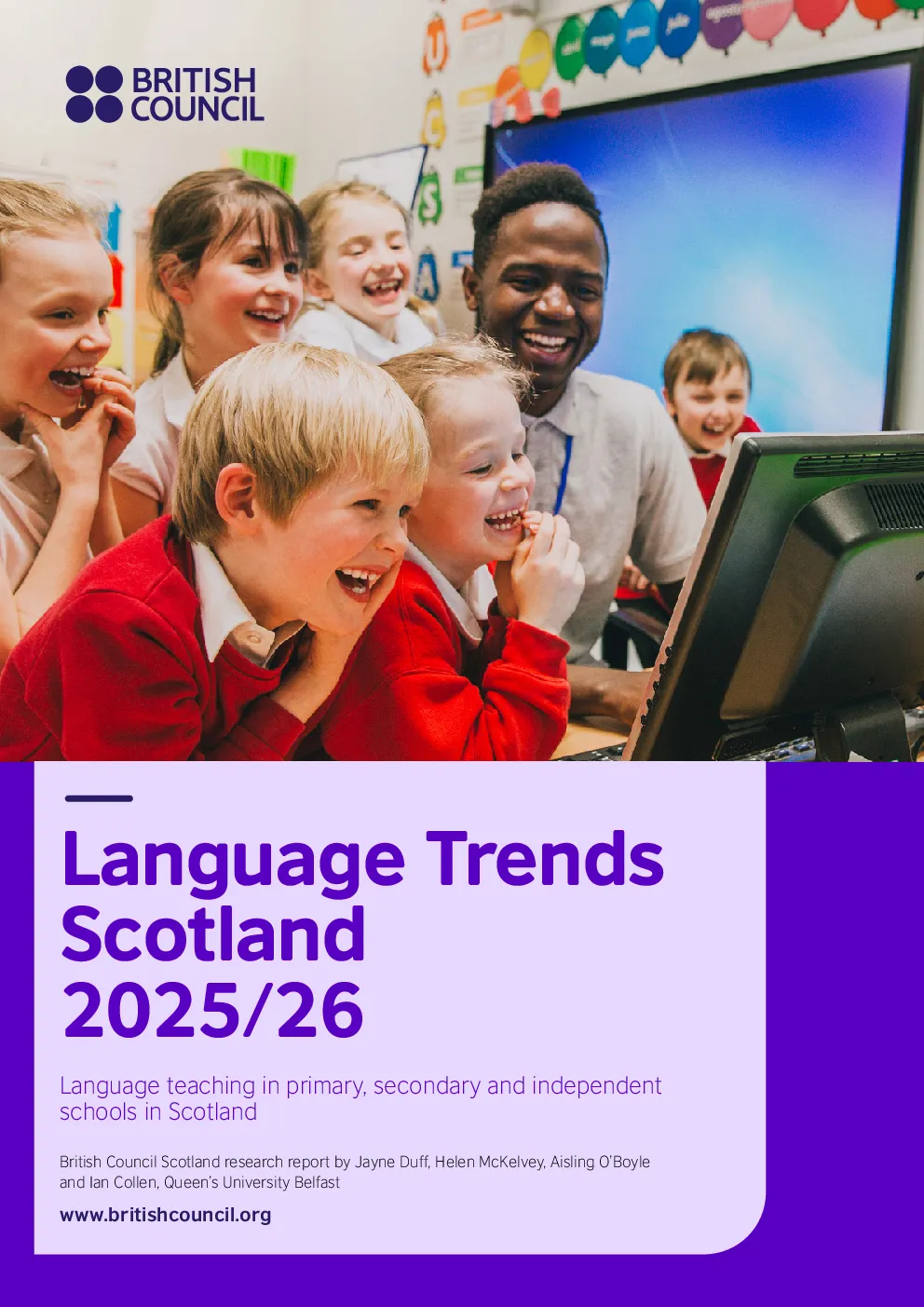
报告封面

Language teaching in primary, secondary and independent British Council Scotland research report by Jayne Duff, Helen McKelvey, Aisling O’Boyleand Ian Collen, Queen’s University Belfast www.britishcouncil.org Contents Foreword from British Council ScotlandIntroductionHeadline findings for 2025/26Policy context and backgroundResearch outlinePublic examination figuresFindings from local authority primary schools Foreword from BritishCouncil Scotland We in the British Council believe that languagelearning is a critical skill to prepare young people As someone who has lived and worked around theworld for much of my life, I know that languageskills can build personal and professionalconnections and open the world up in a whollyunique way. Whether it’s using French to chat to This is at the heart of our cultural relations workhere in Scotland. We aim to help the youngergeneration to learn about other languages and We are very pleased to share our Language TrendsScotland 2025/26 report. Although there are nodoubt current challenges, we note some positivetrends, strong commitment from teachers, and an Together with our partners across educationand the public sector, we look forward to usingthese insights to champion language learning and Claire de Braekeleer Director, British Council Scotland Introduction British Council Scotland is pleased to present thefindings ofLanguage Trends Scotland 2025/26. Headline findings for 2025/26 •Ninety-nine per cent of responding primaryschools are teaching languages in the 2025/26 Language Trends Scotlandis a survey of primaryand secondary schools in Scotland, designed incollaboration with an in-country expert panel to •One fifth of primary schools are embeddinglanguages in their daily routine and curriculum;•The two biggest challenges for primarylanguages are teacher confidence in language (i)to assess the impact of policy measures in •Sixty-three per cent of responding local authoritysecondary schools report that all their S1learners studymore than one language(up (ii)to analyse strengths and weaknesses inthe Scottish school system based both on •Over 60 per cent of schools run multi-levelclasses and 55 per cent run bi-level classes inS4; teachers commented on the challenges of The report is part of the wider Language Trendsseries, which began in 2002 with Language TrendsEngland; ever since, there have been annualsurveys of primary, secondary and independentschools in England. There has been an annualsurvey in Wales since 2015, a biennial survey inNorthern Ireland since 2019, and now annuallyin Scotland since 2024. An inaugural report fromIreland will be available later this year. All reports •Learners in local authority secondaries are takingEdinburgh College classes in 38 per cent of •Contrary to the UK-wide trend, German continuesto be well supported in Scottish Independentschools. On behalf of British Council Scotland and Queen’sUniversity Belfast, we would like to thank teachersfor participating in our research, without whom this Policy context and background The Curriculum for Excellence (CfE) is Scotland’s national curriculum, which outlines the educational rightsof all children and young people and is taught to learners aged 3–18 in Scottish schools from nursery tosecondary-school level. The CfE takes a learner-centric approach, enabling young people to be ‘successfullearners’, ‘confident individuals’, ‘responsible citizens’ and ‘effective contributors’ throughout and followingtheir educational journey (Education Scotland, 2025a). Integral to a learners’ educational journey in There are six curriculum levels in Scotland, encompassed by a Broad General Education (BGE) during theearly, first, second, third and fourth levels, and followed by a Senior Phase (Table 1). Primary education (P1–P7) covers education for 4–12-year-olds and secondary education (S1–S6) spans ages 11–18, with a focus Languages are listed as one of the eight core curriculum areas, ‘including English, Gàidhlig, Gaelic(Learners), modern languages and classical languages’ (Education Scotland, 2025a). The CfE is currently undergoing a systematic review called the Curriculum Improvement Cycle to ensurethe curriculum aligns with the current educational context for learners in Scotland (Education Scotland, Pupils from S4 upwards are presented for National Qualifications, including in ascending level of difficultyNational 5, Higher, and Advanced Higher. Broadly, National 5 courses are taken in secondary schools(S4–S6), Highers are taken in S5 and S6, and Advanced Highers in S6. Entrance to universities often doesnot require Advanced Highers; Highers direct from S5 can pave the way without the need to sit Advanced In 2012, Scottish Government launched anew language learning policy called the‘1+2Approach’, according to which learners starta first additional language (called L2) from P1,as well as a second additional language (calledL3) between P5 and P7 (Education Scotland,2025b)