您的浏览器禁用了JavaScript(一种计算机语言,用以实现您与网页的交互),请解除该禁用,或者联系我们。 [巴克莱银行]:Empowering AI: Gas turbines may decide the rise or fall of AI ambitions - 发现报告

Empowering AI: Gas turbines may decide the rise or fall of AI ambitions

信息技术 2026-01-21 - 巴克莱银行 有梦想的人不睡觉
报告封面

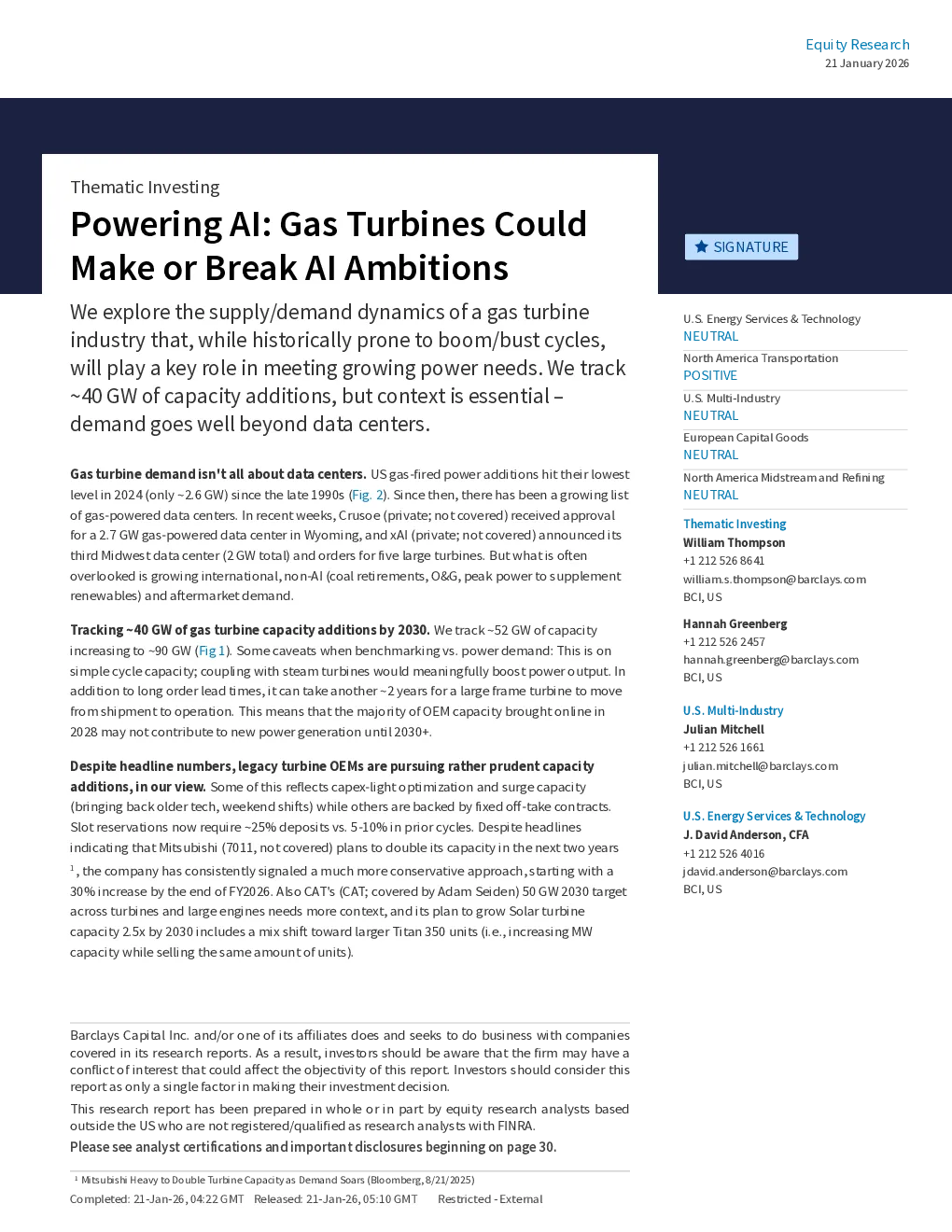
Powering AI: Gas Turbines CouldMake or Break AI Ambitions SIGNATURE We explore the supply/demand dynamics of a gas turbineindustry that, while historically prone to boom/bust cycles,will play a key role in meeting growing power needs. We track~40 GW of capacity additions, but context is essential – Gas turbine demand isn't all about data centers.US gas-fired power additions hit their lowestlevel in 2024 (only ~2.6 GW) since the late 1990s (Fig. 2). Since then, there has been a growing listof gas-powered data centers.In recent weeks, Crusoe (private; not covered) received approvalfor a 2.7 GW gas-powered data center in Wyoming, and xAI (private; not covered) announced its Thematic Investing William Thompson+1 212 526 8641william.s.thompson@barclays.com Hannah Greenberg+1 212 526 2457hannah.greenberg@barclays.com Tracking ~40 GW of gas turbine capacity additions by 2030.We track ~52 GW of capacityincreasing to ~90 GW (Fig 1). Some caveats when benchmarking vs. power demand: This is onsimple cycle capacity; coupling with steam turbines would meaningfully boost power output. Inaddition to long order lead times, it can take another ~2 years for a large frame turbine to move U.S. Multi-IndustryJulian Mitchell+1 212 526 1661julian.mitchell@barclays.com Despite headline numbers, legacy turbine OEMs are pursuing rather prudent capacityadditions, in our view.Some of this reflects capex-light optimization and surge capacity(bringing back older tech, weekendshifts)while others are backed by fixedoff-takecontracts.Slot reservations now require ~25% deposits vs. 5-10% in prior cycles. Despite headlines U.S. Energy Services & Technology J. David Anderson, CFA+1 212 526 4016jdavid.anderson@barclays.com , the company has consistently signaled a much more conservative approach, starting with a30% increase by the end of FY2026. Also CAT's (CAT; covered by Adam Seiden) 50 GW 2030 targetacross turbines and large engines needs more context, and its plan to grow Solar turbinecapacity 2.5x by 2030 includes a mixshifttoward larger Titan 350 units (i.e., increasing MW Barclays Capital Inc. and/or one of itsaffiliatesdoes and seeks to do business with companiescovered in its research reports. As a result, investors should be aware that the firm may have aconflict of interest that couldaffectthe objectivity of this report. Investors should consider this This research report has been prepared in whole or in part by equity research analysts basedoutside the US who are not registered/qualified as research analysts with FINRA. Please see analyst certifications and important disclosures beginning on page 30. That said, there are some new entrants with varying levels of development credibility. While the startup Boom Supersonic (private; not covered) targets 4 GW of aeroderivativecapacity by 2030, there is a reason why there are few aerospace/aeroderivative turbine OEMs.2It also took Doosan Enerbility (034020 KS; not covered) from 2017 to 2023 to move from design toan operational large-frame turbine, though it now has 12 orders to date, including 5 with xAI,and targets 12 units/yr by 2028 (~4.5 GW).3FTAI Aviation (FTAI; covered by Brandon Oglenski) and others seek to convert older jet engines into aeroderivative turbines with FTAI targeting Beggars can't be choosers: engines, boilers, fuel cells & SMRs.While data centers prefer gridpower, speed-to-power in the AI race is playing a greater factor than economics and emissions.This is fueling ashiftto bring-your-own-power (BYOP) using smaller aeroderivative andindustrial turbines, when available, and spilling over to gas engines, gas boilers, fuel cells and Gas turbine supply chain is complex.Blades and vanes subject to extreme temps/pressurerequire rare earths and specialized castings and coatings. This is further complicated by supplychain overlap with aerospace jet engines and the need to serve growingaftermarketdemand. FIGURE 1. Tracking turbine OEM capacity additions GEV and BKR only reflect heavy duty and industrial turbine capacity, respectively.Source: Company reports & Barclays research Gas Power Remains Critical to DC Needs US gas-fired power capacity additions comingoffnear-record lows.US gas-fired powerplant capacity additions hit their lowest level in 2024 (only ~2.6 GW) since the late 1990s, whichpreceded the gas power boom/bust in the early 2000s. US Energy Information Administration Source: US Energy Information Administration & Barclays research We also track a number of projects not listed in the EIA survey data.This is likely in part tomany being behind-the-meter and/or in early stages. We've listed many in our initial major USAI data center project tracker in late October (Powering AI: We Track 45+ GW in the US DataCenter Pipeline) and provide a number of new projects and updates below. While Europe lags Recent US data center-related project and awards: Crusoe developing a 2.7-GW DC project in Wyoming.Crusoe (private; not covered) andTallgrass E