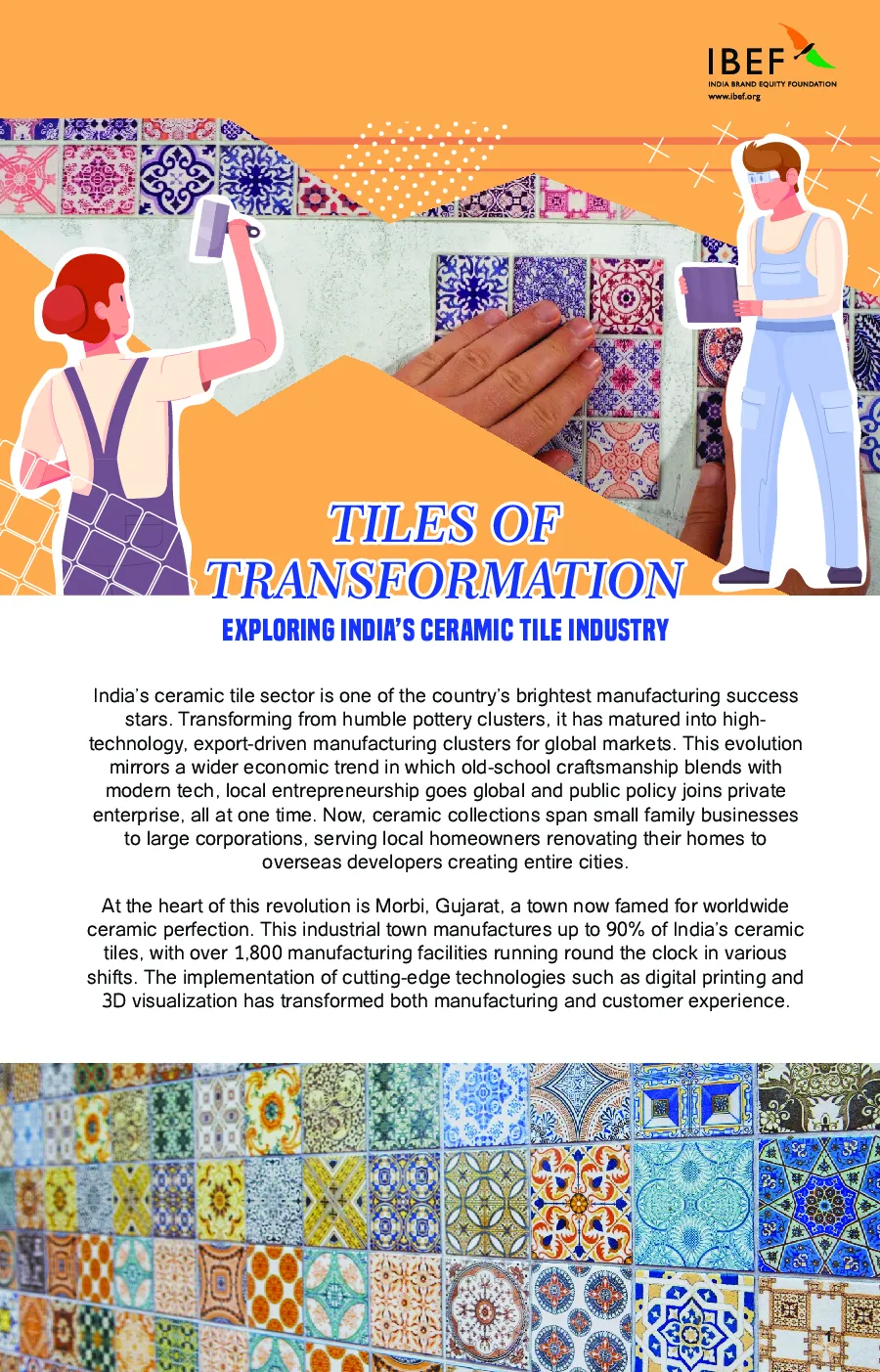
stars. Transforming from humble pottery clusters, it has matured into high-technology, export-driven manufacturing clusters for global markets. This evolutionmirrors a wider economic trend in which old-school craftsmanship blends withmodern tech, local entrepreneurship goes global and public policy joins private At the heart of this revolution is Morbi, Gujarat, a town now famed for worldwideceramic perfection. This industrial town manufactures up to 90% of India’s ceramictiles, with over 1,800 manufacturing facilities running round the clock in various Indiais the second-largest producer,consumer and exporter of ceramic tilesglobally as of 2024. India’s ceramic tileindustry reached a market value of Rs.62,000 crore (US$ 6.99 billion) in FY24,w i t hd o m e s t i c c o n s u m p t i o n o fapproximately2,000 million square places and cultures. Persian workers haddevelopedsophisticated decorativemethods by 900 AD, which defined theIslamic art throughout Syria, Turkey and India's modern ceramic revolution India's ceramic revolution started at theend of the 1980s, when the country wasl i b e r a l i s i n gi t s e c o n o m y a n drestructuringindustries.The state of A JOURNEY THROUGH TIME Ancient origins and global spread Athousand-year-old art form,ceramictilemaking has been practised formillennia.Research shows that clayroofingtiles were first made betweenseven and eight thousand years ago in the Thissuccess saga is a case of variousfactors coming together: supportive statepolicies, technological advancements at afast pace, visionary entrepreneurship andfavourable geography. What was a bunch This craftsmanship developed over many ports like Navlakhi (48 km), Kandla (139km)and Mundra(195 km)serve tofacilitate easy export logistics. The industry's evolution can be mapped •Pre-1980s:Traditional pottery andbasic ceramic production•1 9 8 0 s - 1 9 9 0 s :I nt r o d u c t io n ofmodern manufacturing techniques andinitial export development•2000s-2010s:Technology adoption, C o m p r e h e n s i v ep r o d u c t i o n TheMorbi cluster displays impressived i v e r s i t ya c r o s s t he p r o d u c t i o nspectrum.Based on detailed analysis,roughly479 ceramic units operate inspecialisedsegments:wall tiles(178units, 37% of capacity), seasonal roofingtiles (120 units, 25%), floor tiles (52 units, THE MORBI PHENOMENON Gujarat’s ceramic capital Morbi, often called the ‘Ceramic City ofIndia’,stands among the world’s topindustrialclusters.The city producesaround90%of India’s ceramic output This structured specialisation generatesmajor efficiencies. Shared infrastructure,askilled labour force and integratedsuppliernetworks allow companies to This scale is immense, and it is supportedbythe strategic factors of locationincluding the closeness to big ports, well-d e v e lo p e dt r a n s p o r t s y s te m a ndenhancedstructures of industry.Theindustrial cluster of Morbi is connected INFRASTRUCTUREDEVELOPMENT TheGujarat Industrial DevelopmentCorporationhas strengthened Morbi'sposition through the Integrated CeramicPark at Jambudiya-Paneli, spanning 425hectares.This state-of-the-art facility Thestate government has extendedsupportto the ceramics sector bydesignating it as a thrust industry underthe Aatmanirbhar Gujarat schemes. The p r o c u r e me nts u pp o r t ,a nd o t he r FORCES DRIVING GROWTH Robust domestic market foundation India’s ceramic tile industry stands on aremarkablystrong domestic base thatensures stability and sustained growth.Accordingto Chairman of the IndianC o u n c i lo f C e r a m i c T i l e a n dSanitaryware (ICCTAS), Mr. Rishi Kajaria,a sof 202 4 ,t he do me s t i c m a r k etcontributedroughly 64%of total infrastructuremodernisation.Together,theseprovide a vital buffer for theindustry, as it faces fluctuations in export E x p o r ts u c c e s s a n d s t r a t e g i c India has achieved remarkable success ontheglobal stage,exporting ceramicproducts to more than 140 countries. In2023, India overtook Spain to become theworld’ssecond-largest exporter,with D o m e s t i cc o n s u m p t i o n r e a c h e dapproximately2,000 million squaremetres in FY24, valued at Rs. 42,000 crore(US$4.73 billion).This demand is Technologyrevolution and digital Thesector is undergoing a massivetechnological change that is transformingeverythingincluding the productionprocess and customer experience. On theproductionfront,automation,digital (US$ 6.99 billion) in FY24, with domesticdemandof more than 2,000 millionsquare metres (Rs. 42,000 crore (US$ 4.73billion)in value terms)and exportscontributing 590 million square metres One such innovation is the digital printingtechnology,which is indeed a gamechanger. It allows makers to design tiles ofvery complex patterns, realistic textures Sanitarywaresegment also providedsturdy growth, with a market of aroundRs. 8,000 crore (US$ 901.80 million in2023-24and is further projected toachieve 10-12% CAGR in the subsequent Technological innovatio