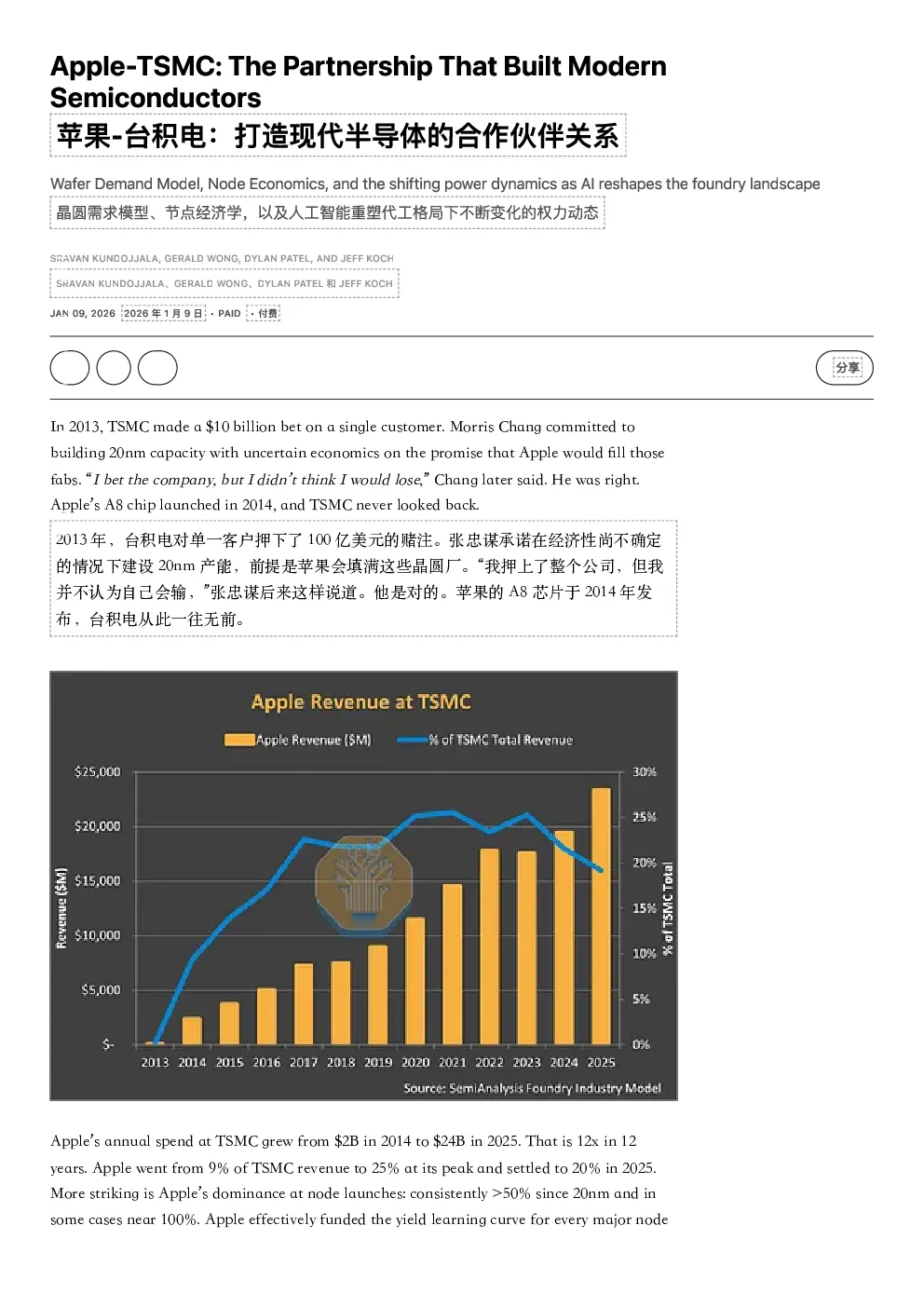
苹果-台积电:打造现代半导体的合作伙伴关系 WaferDemandModel,NodeEconomics,andtheshiftingpowerdynamicsasAIreshapesthefoundrylandscape 晶圆需求模型、节点经济学,以及⼈⼯智能重塑代⼯格局下不断变化的权⼒动态 SRAVAN KUNDOJJALA,GERALDWONG,DYLAN PATEL,AND JEFF KOCHSRAVAN KUNDOJJALA、GERALDWONG、DYLAN PATEL和JEFF KOCH JAN09,2026 2026年1⽉9⽇∙PAID∙付费 In 2013, TSMC made a $10 billion bet on a single customer. Morris Chang committed tobuilding 20nm capacity with uncertain economics on the promise that Apple wouldfill thosefabs. “I bet the company, but I didn’t think I would lose,” Chang later said. He was right.Apple’s A8 chip launched in 2014, and TSMC never looked back. 2013 年,台积电对单⼀客户押下了 100 亿美元的赌注。张忠谋承诺在经济性尚不确定的情况下建设 20nm 产能,前提是苹果会填满这些晶圆⼚。“我押上了整个公司,但我并不认为⾃⼰会输,”张忠谋后来这样说道。他是对的。苹果的 A8 芯⽚于 2014 年发布,台积电从此⼀往⽆前。 Apple’s annual spend at TSMC grew from $2B in 2014 to $24B in 2025. That is 12x in 12years. Apple went from 9% of TSMC revenue to 25% at its peak and settled to 20% in 2025.More striking is Apple’s dominance at node launches: consistently >50% since 20nm and insome cases near 100%. Apple effectively funded the yield learning curve for every major node transition since 20nm. 苹果在台积电的年度⽀出从 2014 年的 20 亿美元增长到 2025 年的 240 亿美元,12 年间增长了 12 倍。苹果在台积电营收中的占⽐从 9%提升⾄峰值 25%,并在 2025 年稳定在20%。更引⼈注⽬的是苹果在制程节点⾸发中的主导地位:⾃20nm 以来始终超过50%,在某些情况下甚⾄接近 100%。⾃20nm 起的每⼀次重⼤制程节点跃迁,苹果实际上都为良率学习曲线提供了资⾦⽀持。 The foundry model is dominant today. IDMs cannot support process development and fabcapex with what is effectively a single customer. But even foundries need a “first and best”customer with large demand and deep pockets to fund their continued advance. Apple hasbeen that customer for the last decade at TSMC. The juggernaut partnership has propelledboth companies to new heights, put competitors in the dust, and fueled the chipmakingindustry. 代⼯模式如今占据主导地位。IDM 在实际上只有单⼀客户的情况下,⽆法⽀撑制程开发和晶圆⼚资本开⽀。但即便是代⼯⼚,也需要⼀位需求庞⼤、资⾦雄厚的“⾸选且最优”客户,来为其持续推进技术发展提供资⾦。过去⼗年⾥,苹果⼀直是台积电的这位客户。这⼀势不可挡的合作关系将两家公司推向了新的⾼度,把竞争对⼿远远甩在⾝后,并为整个芯⽚制造⾏业注⼊了强劲动⼒。 This report traces the Apple-TSMC relationship from Intel’s 2010 rejection throughfivedistinct phases, examining how Apple built its chip empire through acquisitions and 8,000+engineers across 15 design centers. We analyze why competitors have failed to replicate thisvertical integration, map Apple’s manufacturing footprint across Fab 18 and advancedpackaging facilities, and assess the strategic questions facing both companies as Intel 18A andSamsung re-engagement become viable alternatives. We’ll also discuss the next phase of therelationship. It’s not just Apple at the leading edge anymore. All of this is quantified withspecifics from our proprietaryFoundry Industry ModelandApple Wafer Demand Model. 本报告从英特尔在 2010 年的拒绝开始,沿着五个不同阶段梳理了苹果与台积电之间的关系,探讨了苹果如何通过并购以及分布在 15 个设计中⼼的 8000 多名⼯程师打造起其芯⽚帝国。我们分析了竞争对⼿为何未能复制这种垂直整合模式,梳理了苹果在Fab 18 及先进封装设施上的制造布局,并评估了随着 Intel 18A 和三星重新参与竞争成为可⾏替代⽅案,双⽅所⾯临的战略问题。我们还将讨论这段关系的下⼀阶段。如今,处于技术前沿的已不再只有苹果⼀家。所有这些分析都基于我们专有的晶圆代⼯⾏业模型和苹果晶圆需求模型中的具体量化数据。 AnchorTenant锚定客户 You can see the Apple effect in TSMC’s capex trajectory. Pre-Apple (2005-2009), annualspending averaged $2.4B with no anchor tenant to de-risk investment. From 2019-2022, TSMCdeployed $98B, exceeding the cumulative spend of the prior 14 years. Apple’s manufacturingpurchase obligations scaled from $8.7B in 2010 to $71B in 2022. TSMC-specific payments grewfrom near-zero in 2013 to $23B+ in 2025. For over a decade, Apple was the only companycapable of pre-funding bleeding-edge capacity at scale. That changed with Nvidia’s AI-driven cash generation. Today, two companies can fund TSMC’s roadmap. 从台积电的资本开⽀轨迹中可以清楚地看到“苹果效应”。在苹果之前(2005–2009年),由于缺乏能够为投资去风险的锚定客户,年度⽀出平均仅为 24 亿美元。2019–2022 年间,台积电投⼊了 980 亿美元,超过此前 14 年的累计⽀出。苹果的制造采购承诺从 2010 年的 87 亿美元扩⼤到 2022 年的 710 亿美元。⾯向台积电的专项付款从 2013年⼏乎为零增长到 2025 年的 230 亿美元以上。⼗多年来,苹果⼀直是唯⼀有能⼒以规模化⽅式为最前沿产能预先出资的公司。随着英伟达由 AI 驱动的现⾦创造能⼒崛起,这⼀局⾯发⽣了改变。如今,有两家公司可以为台积电的技术路线图提供资⾦⽀持。 The platform shift has already happened. HPC revenue at TSMC grew from 36% in 2020 to58% in 2025. Smartphone revenue shrunk to 29% from 46%. Our model shows Nvidia willconsume more N3 wafers than Apple by 4Q27. Apple’s share of N2 drops to 48%, thefirsttime in a decade Apple is not the dominant customer on a new node. 平台转移已经发⽣。台积电的 HPC 收⼊占⽐从 2020 年的 36% 增长到 2025 年的 58%。智能⼿机收⼊占⽐则从 46% 萎缩⾄29%。我们的模型显⽰,到 2027 年第四季度,英伟达对 N3 晶圆的消耗量将超过苹果。苹果在 N2 上的份额降⾄48%,这是⼗年来苹果⾸次未成为新制程节点上的主导客户。 Consensus sees this as permanent displacement. Our model says otherwise. 市场共识认为这是永久性的取代。我们的模型则给出了不同的结论。 TSMC’s A16 is architected for HPC. Backside power delivery, gate-all-around transistors, andthermal envelopes are optimized for HPC and smartphones will skip this node. Nvidiabenefits disproportionately. Apple’s N2 (N2 + A16) share drops not because Apple lostleverage, but because the node was built for a different customer. A14 (1.4nm) rebalances theequation. TSMC is designing A14 for both mobile and HPC from the start, with a separatebackside power (TSMC’s trade name is Super Power Rail) variant for HPC. Our model showsApple reclaims 67% node share on