中国:被严重忽视的中欧贸易紧张风险
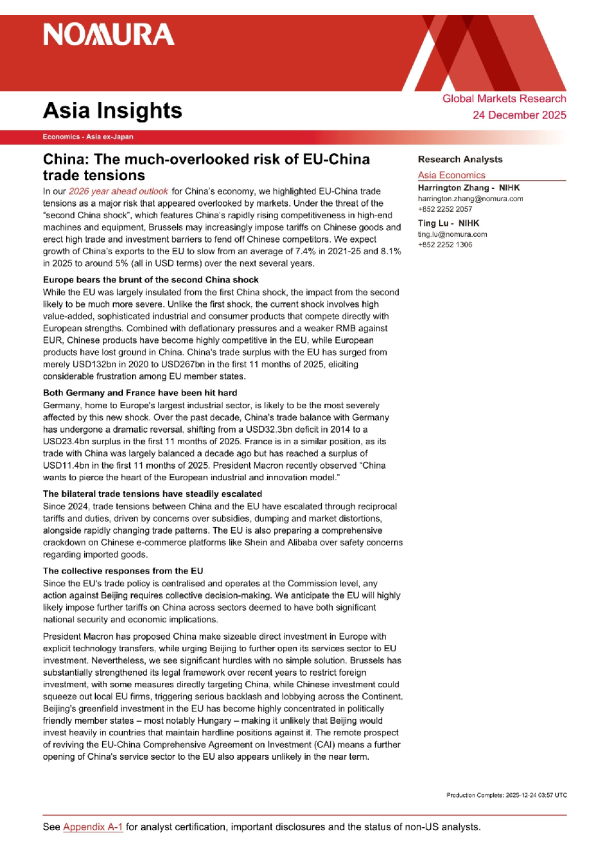
China: The much-overlooked risk of EU-Chinatrade tensions Research Analysts Asia Economics Harrington Zhang - NIHKharrington.zheng@romurg.com+852 2252 2057 tensions as a major risk that appeared overlookod by markets. Under the threat of the"second China shock", vhich features China's rapicly rising competitiveness in high-endmachines and equipment, Brussels may increasingly impose tariffs on Chinese goods anderect high trade and investment barriers to fend off Chinese competitors. We expectgrowth of China's exports to the EU to slow frorn an average of 7.4% in 2021-25 and 8.1%in 2025 to arounc 5% (all in USD terms) over tne next several years. Ting Lu - NIHKting.lugnomura.com+852 2252 1306 Europe bears the brunt of the second China shock While the EU was largely insulated from the first China shock, the impact from the secondlikely to be rmuch more severe. Unlike the first shock, tne current shock involves highvalue-added, sophisticated industrial and consumer products that compete dlirectly withEuropean strengths. Combined with deflationary pressures and a weaker RMB againstEUR, Chinese products have becorne highly competitive in the EU, while Europeanproducts nave lost ground in China, China's trade surplus with the EU has surged frommerely USD132bn in 2020 to USD267bn in the first 11 months of 2025, elicitingconsiderable frustration arnong EU member states. Both Germany and France have been hit hard Germany, home to Europe's largest indlustrial soctor, is likely to be the most severelyaffected by this new shock. Over the past cecade, China's trade balance with GermanyUSD23.4bn surplus in the first 11 months of 2025. France is in a similar position, as itstrade with China was largely balsnced a decsce ago but has reached al surplus ofUSD11.4bn in the first 11 months of 2025. President Macron recently observed 'Chinawants to pierce the heart of the European industrial and innovation model.* The bilateral trade tensions have steadily escalated Since 2024, trade tensions between China and the EU have escalated through reciprocaltariffs and duties, driven by concerns over subsicies, dumging and market distortions,alongside rapicly changing trade patterns. The EU is also preparing α cormprehensivecrackdown on Chinese e-commerce platforms like Shein and Alibaba over safety concemsregarding imgortod goods. The collective responses from the EU Since the EU's trade policy is centralised and operates at the Commission level, anyaction against Bejing requires collective decision-making. We anticipate the EU will highlylikely impose further tarifs on China across sectors deemed to have both significantnational security and economic implications. President Macron has proposed China make sizeable direct investment in Europe withexplicit technology transfers, while urging Beijing to further open its services sector to EUinvestment. Nevertheless, we see significant hurdles with no simple solution. Brussels hassubstantially strengthened its legal framework over recent years to restrict foreigninvestment, with some measures directly targoting China, while Chinese investment couldsqueeze out local EU firns, triggering serious backlash and lobbying across the ContinentBejing's grecnfield investment in the EU has bocome highly concentrated in politicallyfriendly member states most notably Hungary making it unlikely that Beijing wouldinvest heavily in countries that maintain hardlline positions against it. The remote prospectof reviving the EU-China Comprehensive Agreement on Investment (CAl) means a furtheroening of China's service sector to the EU also appears unlikely in the near temm. Frmod.rlon Corrplslx: 2325-12-24 cG 57 UTC The EU is at the forefront of the second China shock French President Macron recently completed his fourth state visit to China, receiving anigh-level reception. In our view, frequent visits such as this may misguicedly echo formerChina-Germany relationship of that decade, and may give the (wrong) impression thst animproving Franco-Chinese relationship could be emerging. However, shorty afterdeparting China, Mr Macron spoke harshly about the EU-China trade imbalaince,describing it as *becoming unbesraible"” and waming that *Europeans will be forced to takestrong measures in the coming months.' One French official even cautioned thst "we areat the last stop before a crisis. In our view, trade tensions between China and the EU most notably Germany andUSD1trn over the first 11 months of 2025, has clearly capturec the market's attention.What is now deemed the 'second China shock' is a principal driver behind these risingtensions, and represents s: dramatic reversal of fortunes for Europe. The first China shockon basic manufacturing skils, with the EU largely insulated or even benefiting from thisfirst shock, due to competitive advantages in machines, equipment and luxury goods. Incontrast, the current second China shock is characterised by high value-added,sophisticated industrial and