《快速领导者杂志》,2020年4月,作者:彼得·菲斯克
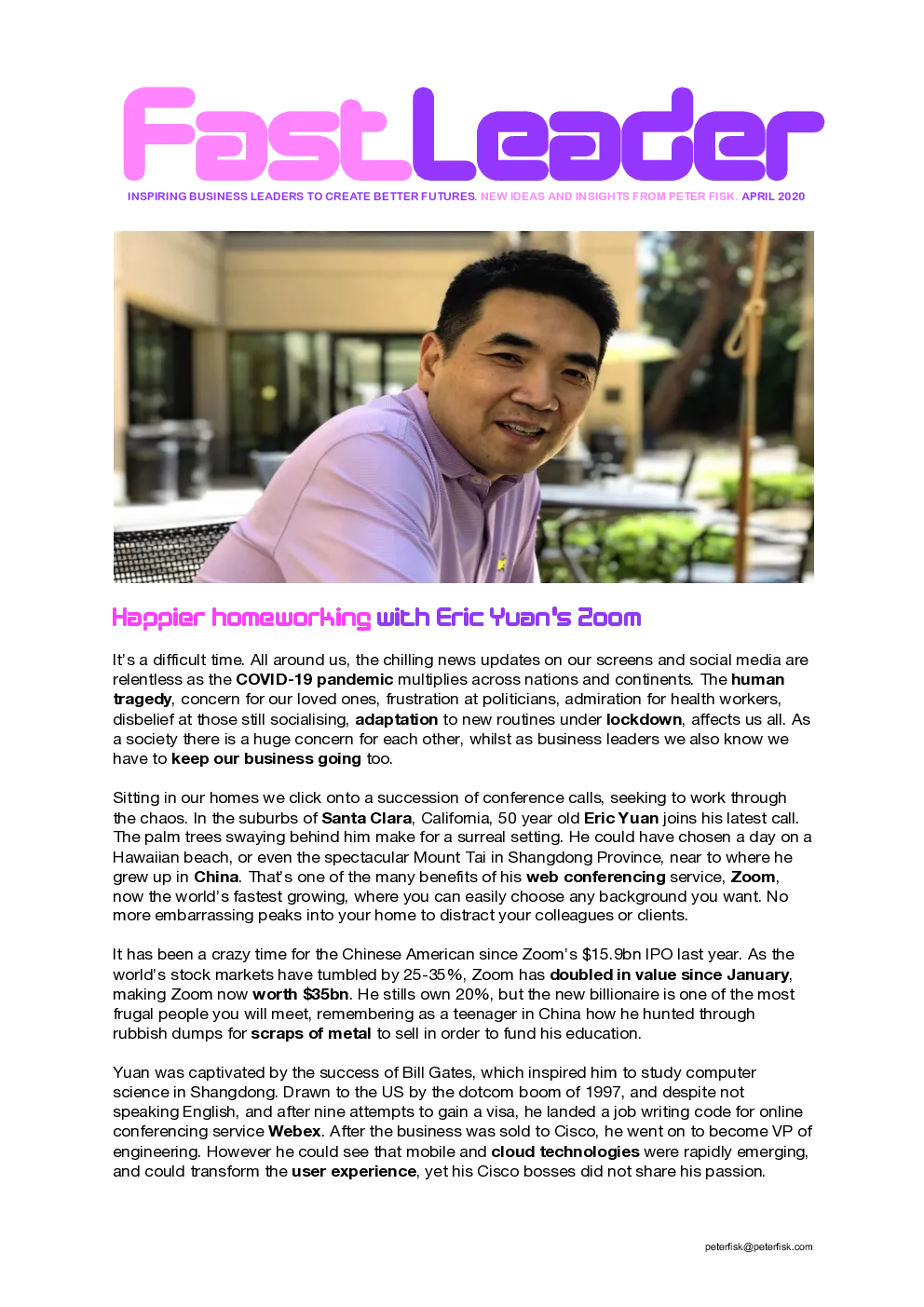
INSPIRING BUSINESS LEADERS TO CREATE BETTER FUTURES.NEW IDEAS AND INSIGHTS FROM PETER FISK.APRIL2020 Happier homeworkingwithEric Yuan’sZoom It’s a difficult time. All around us, thechillingnews updates onourscreens andsocial mediaarerelentless astheCOVID-19pandemicmultiplies acrossnations andcontinents. Thehumantragedy, concern for our loved ones, frustration at politicians, admiration for health workers,disbelief at those still socialising,adaptationto new routines underlockdown, affects us all. Asa society there is a huge concern for each other, whilst as business leaders wealsoknow wehave tokeep our businessgoingtoo. Sitting inour homeswe click onto a succession ofconference calls,seeking to work throughthe chaos.In the suburbs ofSanta Clara,California,50 year oldEric Yuanjoinshislatest call.The palm trees swaying behind him make for a surreal setting. He could have chosen a dayon aHawaiianbeach, or even the spectacular Mount Tai in Shangdong Province, near to where hegrew upinChina. That’s one of themanybenefits ofhisweb conferencingservice,Zoom,nowthe world’s fastest growing,whereyou caneasilychoose any background you want. Nomore embarrassing peaks into your home to distract yourcolleagues or clients. It has been acrazy time fortheChinese American since Zoom’s$15.9bnIPO last year. As theworld’s stock markets have tumbledby 25-35%, Zoom hasdoubled in valuesince January,making Zoom nowworth$35bn.Hestills own 20%, but thenew billionaireis one of the mostfrugal people you will meet,rememberingas a teenagerin Chinahow hehuntedthroughrubbishdumpsforscraps ofmetalto sellin order to fund his education. Yuanwascaptivated by thesuccess of Bill Gates,which inspired him tostudycomputerscience in Shangdong.Drawn to the US by the dotcom boom of1997, and despite notspeaking English, andafternineattempts to gain a visa, he landed a job writing code for onlineconferencing serviceWebex.After the business was sold toCisco,he went on to become VP ofengineering. However he could see that mobile andcloud technologieswere rapidly emerging,and could transform theuser experience, yet his Cisco bosses did not share his passion. He left in 2011 to start his own company from the ground up–asimpler, moreintuitive, app-based experience to meet the rapidly evolving world of remote and collaborative working.Initially calling isSaasbe, heturned to former colleaguesto help him fund a team of 30engineers back in China work on his new idea. He worked tirelessly fortwo yearson the newapp, a lightweight web client that would work on any device, even with slow or patchy internetconnection. He also added morehuman features, like the choice of virtual backgrounds. Zoomlaunched in 2013, initially targetingthe corporate market, and creating networkingsolutions like Zoom Rooms with partners such as Logitech. Within a year he had 40 millionsubscribers, including 65,000 organisations. In 2017, after subsequent rounds of funding, Zoombecame a $1 billion valued“unicorn”,now with around 2000 employees (a third still based inChina),andstarted exploring new areas such as virtual reality.Zoom evolved intoa “freemium”business modelbased on subscriptions, with the first 40 minutes of any callfree and able toaccomodateup to 100 participants, although the platform caters for anything to 1000 people. Since Januarythis year, Yuan has seenhuge growthin Zoom, becoming indispensable to theworld’s schools, businesses and governments,asCOVID-19shut downthe physical world.Yuan offeredfree accessto all schools,and now seesaround1million app downloadseveryday.He’s been surprised too bythe innovative social applications that have emerged–fromvirtual fitness programstovirtualcocktailsparties(the “Quarantino”cocktail is a big hit). Remote working, though,is nothing unusual for Yuan. He typically only makes two businesstrips a year, aware of thetimeinefficienciesandenvironmentalimpactsof travel,when you cansimplyclick onto Zoom.Yet he is a big fan of human engagement, defining Zoom’s missionas“delivering happiness”and measuringbusinessperformancebasedonhappiness,trust andgratitude,as equalstomore usualfinancial results. Survivingandthrivingin crazy times Andy Grove, former CEO of Intel, once said“Badcompaniesaredestroyedbycrisis,goodcompaniessurvivethem,greatcompaniesareimprovedbythem.” Change drivesnew attitudes and behaviours, new ideas and solutions. If wesee innovationstake off rapidly in good times, when there is no need to change, imagine how the right ideas cangrow when there really is a burning platform. Look at ourchanging behavioursrightnow–not only is everyone remote working, but thereare massive shifts in the way in which we access everything from education to food, healthcareand entertainment. After the closure of schools, kidshavequicklylearnt to learn online,withlessons shiftingto more convenient times, and arapid growth in peer-to-peer learning groups. Home deliveries of foodhave soared, withshopping appInstacart, for example, seekingto re