AI智能总结
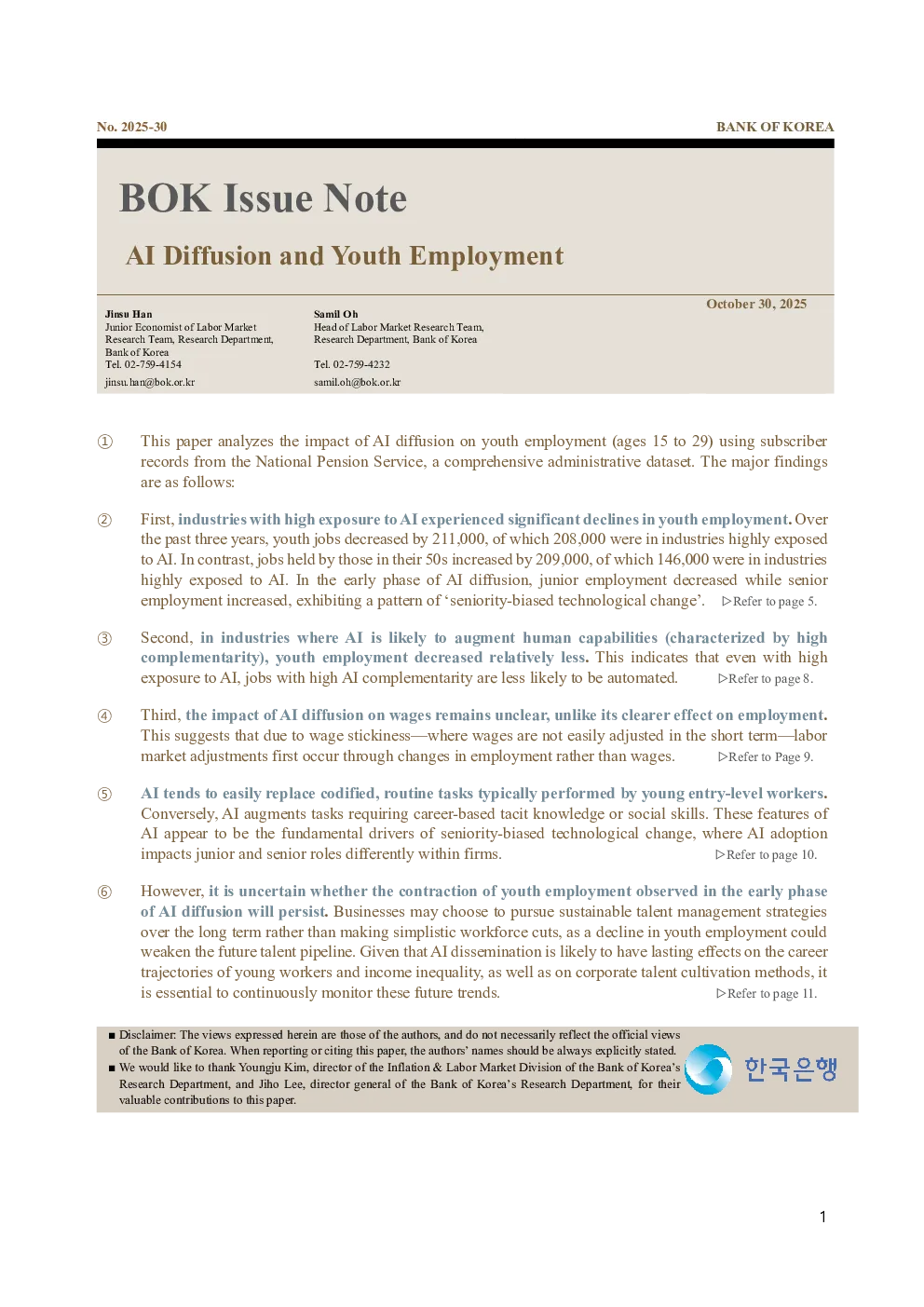
AI Diffusion and Youth Employment October 30, 2025 Jinsu HanJunior EconomistofLabor MarketResearch Team, Research Department,Bank of KoreaTel. 02-759-4154jinsu.han@bok.or.kr Samil OhHead of Labor Market Research Team,Research Department, Bank of KoreaTel. 02-759-4232samil.oh@bok.or.kr ①This paper analyzes the impact of AI diffusion on youth employment (ages 15 to 29) using subscriberrecords from the National Pension Service, a comprehensive administrative dataset. The major findings ②First,industries with high exposure to AI experienced significant declines in youth employment.Overthe past three years, youth jobs decreased by 211,000, of which 208,000 were in industries highly exposedto AI. In contrast, jobs held by those in their 50s increased by 209,000, of which 146,000 were in industrieshighly exposed to AI. In the early phase of AI diffusion, junior employment decreased while senior ③Second,in industries where AI is likely to augment human capabilities (characterized by highcomplementarity), youth employment decreased relatively less.This indicates that even with highexposure to AI, jobs with high AI complementarity are less likely to be automated.▷Refer to page 8. ④Third,the impact of AI diffusion on wages remains unclear, unlike its clearer effect on employment.This suggests that due to wage stickiness—where wages are not easily adjusted in the short term—labormarket adjustments first occur through changes in employment rather than wages.▷Refer to Page 9. ⑤AI tends to easily replace codified, routine tasks typically performed by young entry-level workers.Conversely, AI augments tasks requiring career-based tacit knowledge or social skills. These features ofAI appear to be the fundamental drivers of seniority-biased technological change, where AI adoption impacts junior and senior roles differently within firms. ⑥However,it is uncertain whether the contraction of youth employment observed in the early phaseof AI diffusion will persist.Businesses may choose to pursue sustainable talent management strategies over the long term rather than making simplistic workforce cuts, as a decline in youth employment couldweaken the future talent pipeline. Given that AI dissemination is likely to have lasting effects on the careertrajectories of young workers and income inequality, as well as on corporate talent cultivation methods, it ■Disclaimer: The views expressed herein are those of the authors, and do not necessarily reflect the official viewsof the Bank of Korea. When reporting or citing this paper, the authors’ names should be always explicitly stated.■We would like to thank Youngju Kim, director of the Inflation & Labor Market Division of the Bank of Korea’s Ⅰ. Introduction Since the launch of ChatGPT in November 2022, numerous generative AI services have rapidly emerged in a highlycompetitive landscape, accelerating the pace of AI performance advancements. These improvements span a broadspectrum of applications, from back-office tasks like coding, document drafting, and data analysis to sophisticated Moreover, AI technology is spreading at an unparalleled speed. According to Suh et al. (2025), as of May and June2025, 63.5% of Korean workers reported using AI technologies, with 51.8% using AI specifically for businesspurposes.1 Compared to the early phase of Internet adoption, AI is spreading at a rate eight times faster (Figure 1).Moreover, the share of heavy users—those engaging with AI for more than one hour per day—reached 78.6%, Note:1) Based on AI use specifically for businesspurposes.Source: cited again from Suh et al. (2025) With the fast pace of performance development and diffusion, the potential impact of AI on the labor market is diverse,ranging from optimism based on increased productivity to fear of massive job displacement and skepticism that actualeffects will not be significant as expected. However, based on historical experience with technological change, it is Recently, there has been growing concern that the rapid adoption of AI is disproportionately replacing jobs held byyoung workers, particularly those in entry-level positions. While earlier research relied mainly on anecdotal mediareports, Brynjolfsson et al. (2025a) and Hosseini & Lichtinger (2025) provide rigorous empirical evidence from large This paper investigates whether AI adoption has a more pronounced negative impact on youth employment—inparticular, whether there is evidence of seniority-biased technological change in the Korean labor market—using Pension Service subscribers by age group and industry with AI exposure by industry, tracking these variables in a timeseries framework to detect shifts related to AI diffusion. The key findings are as follows: First, youth employment declined significantly in industries highly exposed to AI.Over the past three years, 211,000 youth jobs (aged 15 to 29) disappeared, with 208,000 of these losses occurring inindustries within the top 50% AI exposure quartile—accou