您的浏览器禁用了JavaScript(一种计算机语言,用以实现您与网页的交互),请解除该禁用,或者联系我们。[伍德麦肯兹]:2025亚太地区碳捕集与封存(CCS)市场演进 - 发现报告

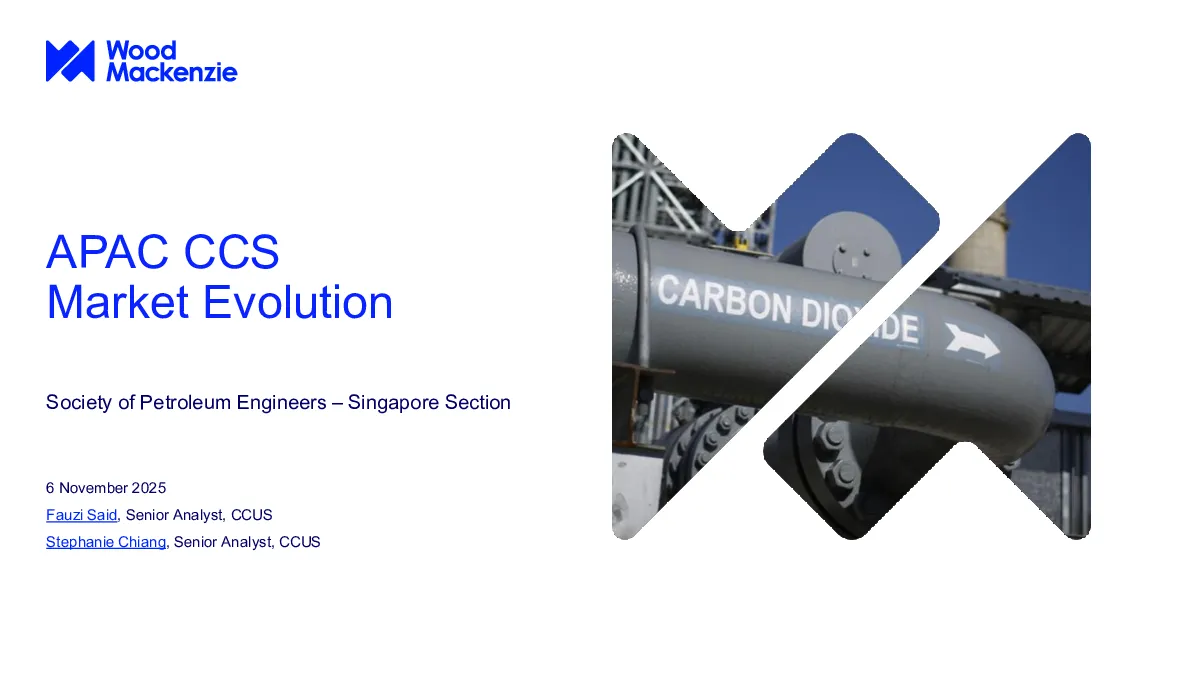
2025亚太地区碳捕集与封存(CCS)市场演进

AI智能总结
查看更多
2025亚太地区碳捕集与封存(CCS)市场演进

Society of Petroleum Engineers–Singapore Section 6 November 2025Fauzi Said, Senior Analyst, CCUS CCUS:The emerging technology integral to a smooth energy transition •Carbon capture,utilisationand storage(CCUS) and engineered carbon removals,such as Direct Air Capture (DAC) and •Responsible producers of carbon intensive materialsincludingcement, steel, chemicals and energy-relatedsectors, and the governments and investors who back Current global carbon capture capacity is around 64 milliontonnesper year •Toconstrain global warming to 1.5 degrees above pre-industrial levels, wouldneedto reach7,750 Mtpa(around 15% of current global CO2 CCS market evolution in APACPolicy and regulatory influence CCSMarketEvolution Capture capacity driven by projects under construction Industrial point source capacity will rise to over 15% by 2035 from less than 5% today, CCUS to attract US$250 billion of investments between 2025 and 2035 North America to dominate, Asia Pacific to follow while hydrogen and power make up half of capture investments APAC to reach120Mtpa capture capacity by 2035 China, India and Thailand expected to announce new projects while hydrogen and natural gas lead growth Geology determines total potential storage capacity, but policy drives accessibility Onshore storage sites have lower storage cost, lowers the barrier to wide-scale deployment NOCs and SOEs cross paths to link emission sources to storage sites NOCs carry country & company targets while IOCs to participate in CCUS projects Policy andRegulatory Next three years are crucial with many projects seeking FID 60 Mtpa across 40 projects lined up in APAC over 3 years–some are at higher risk Various hubs are being proposed for in Southeast Asia and Australia… Hubs with domestic anchor emitters could help lower risk and enable economies of scale …but a more concerted and consistent effort from governments are required to scale Incentives, regulations, standards and bilateral agreement are equally important in enabling cross-border CCS Policy momentum builds around regulation and partnerships, while incentives lag All eyes on Japan, Singapore, and South Korea to lead incentive support for cross-border CCS Carbon price is the main driver of project returns in APAC Cost varies significantly depending on scope, location, source of capture Cross-border CCS Asia Pacific: Southeast Asia and Australia are projected to be storage hotspots Top five largest networks offer 65 Mtpa of nominal capacity to serve the Asia Pacific emitters Cross-border projects could be competitive with domestic projects Opportunity to lower shipping cost with larger ships at low pressure/temperature Best storage sites exhibit high injection rates, large connected capacity Large-scale projects need to sustain high injection rates for a long project lifecycle FIDs, policy and agreements define APAC’s low-carbon future The Critical 2030 Investment Threshold̵FIDs by 2030 will shape the market by 2035 Policy: From Ambition to Regulation̵Emitter incentives Cross-Border Trade: The Connecting Linchpin̵Liability and monitoring ̵Emissions accounting (avoiding double counting) Thank you for listening! Carbon Management at Wood Mackenzie Connect with Stephanie Connect with Fauzi Fauzi.Said@woodmac.comwww.linkedin.com/in/fauzisaid/ Q&A Fauzi Said Senior Research Analyst, Subsurface/ Carbon Management Connect with Fauzi Fauzi is a Senior Research Analyst focused on providing integrated research and dataanalytics to project developers, investors, regulators and authorities oncarbon managementand storage in Asia Pacific. His insights on storage projects, industry activities, policies andregulations in the region enable customers to make quality, informed decisions on their Fauzi.Said@woodmac.com Before joining Wood Mackenzie, Fauzi worked at Shell for as a JV representative, subsurfaceteam lead, geoscientist and drilling engineer responsible for subsurface development plans, www.linkedin.com/in/fauzisaid/ Fauzi graduated with a BSc. (Hons) in Geology with Geophysics from the University ofLeicester, United Kingdom. He is a keen golfer, and a social tennis and badminton player. Stephanie Chiang Senior Research Analyst, CCUS Biography Connect with Stephanie Stephanie is a senior analyst in Wood Mackenzie’s CCUS research team based in Singapore. Sheprovides insight and strategic analysis on the CCUS landscape to project developers, technologyproviders, investors, and governments. Her work involves tracking andanalysingprojects, building Prior to joining Wood Mackenzie, Stephanie spent four years at the Singapore EconomicDevelopment Board focused on driving industrydecarbonisationin Singapore. She engaged keyindustry players in the energy and chemicals sectors, influenced government policies, and developedthe business case for the government to support new technologies such as CCUS and chemical stephanie.chiang@woodmac.com +65 6433 0138 https