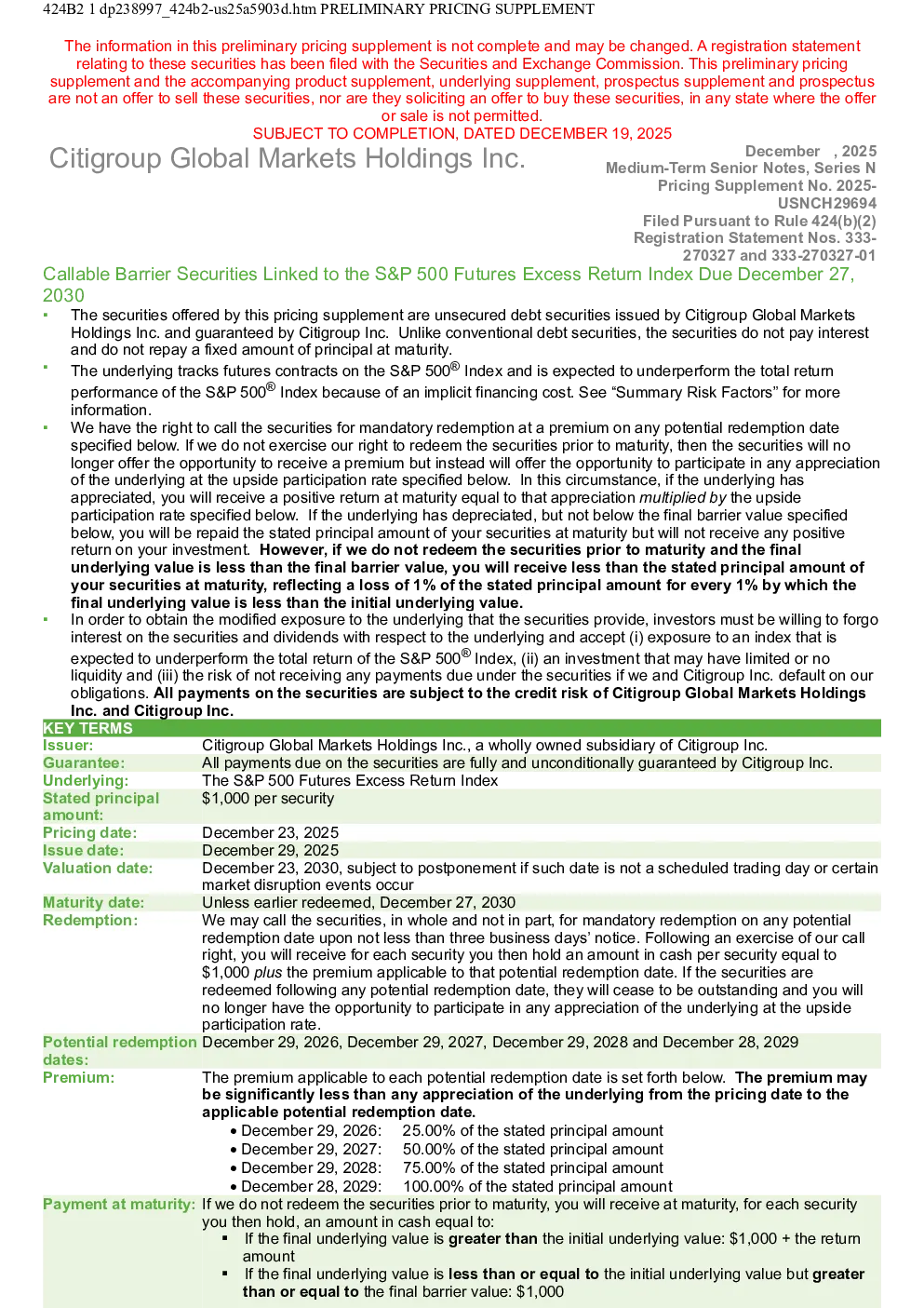
Callable Barrier Securities Linked to the S&P 500 Futures Excess Return Index Due December 27,2030 ▪The securities offered by this pricing supplement are unsecured debt securities issued by Citigroup Global MarketsHoldings Inc. and guaranteed by Citigroup Inc.Unlike conventional debt securities, the securities do not pay interestand do not repay a fixed amount of principal at maturity. The underlying tracks futures contracts on the S&P 500® performance of the S&P 500®Index because of an implicit financing cost. See “Summary Risk Factors” for more information.We have the right to call the securities for mandatory redemption at a premium on any potential redemption datespecified below. If we do not exercise our right to redeem the securities prior to maturity, then the securities will nolonger offer the opportunity to receive a premium but instead will offer the opportunity to participate in any appreciationof the underlying at the upside participation rate specified below.In this circumstance, if the underlying has appreciated, you will receive a positive return at maturity equal to that appreciationmultiplied bythe upsideparticipation rate specified below.If the underlying has depreciated, but not below the final barrier value specified below, you will be repaid the stated principal amount of your securities at maturity but will not receive any positivereturn on your investment.However, if we do not redeem the securities prior to maturity and the finalunderlying value is less than the final barrier value, you will receive less than the stated principal amount ofyour securities at maturity, reflecting a loss of 1% of the stated principal amount for every 1% by which the amountIf the final underlying value isless than or equal tothe initial underlying value butgreater Investing in the securities involves risks not associated with an investment in conventionaldebt securities. See “Summary Risk Factors” beginning on page PS-5. Additional Information The terms of the securities are set forth in the accompanying product supplement, prospectus supplement andprospectus, as supplemented by this pricing supplement. The accompanying product supplement, prospectus supplementand prospectus contain important disclosures that are not repeated in this pricing supplement. For example, theaccompanying product supplement contains important information about how the closing value of the underlying will bedetermined and about adjustments that may be made to the terms of the securities upon the occurrence of market Hypothetical Payment Upon Early Redemption The following table illustrates how the amount payable per security upon early redemption will be calculated if we chooseto exercise our call right on a potential redemption date. Payout Diagram The diagram below illustrates the payment at maturity of the securities, assuming the securities have not previously beenredeemed, for a range of hypothetical underlying returns. Investors in the securities will not receive any dividends with respect to the underlying. The diagram andexamples below do not show any effect of lost dividend yield over the term of the securities.See “Summary RiskFactors—You will not receive dividends or have any other rights with respect to the underlying” below. Hypothetical Examples of the Payment at Maturity The examples below illustrate how to determine the payment at maturity on the securities, assuming the securities are notredeemed prior to maturity. The examples are solely for illustrative purposes, do not show all possible outcomes and arenot a prediction of any payment that may be made on the securities. The examples below are based on a hypothetical initial underlying value of 100 and a hypothetical final barrier value of 50and do not reflect the actual initial underlying value or final barrier value. For the actual initial underlying value and finalbarrier value, see the cover page of this pricing supplement. We have used these hypothetical values, rather than the The examples below are intended to illustrate how, if the securities are not redeemed prior to maturity, your payment atmaturity will depend on the final underlying value. Your actual payment at maturity per security will depend on the actualinitial underlying value and the actual final underlying value. Example 1—Upside Scenario.The final underlying value is 110, resulting in a 10% underlying return. In this example,the final underlying value isgreater thanthe initial underlying value. Payment at maturity per security = $1,000 + the return amount = $1,000 + ($1,000 × the underlying return × the upside participation rate) = $1,000 + ($1,000 × 10% × 157.50%) = $1,000 + $157.50 = $1,157.50 In this scenario, the underlying has appreciated from the initial underlying value to the final underlying value, and your totalreturn at maturity would equal the underlying returnmultiplied bythe upside participation rate. Example 2—Par Scenario.The final underlying valu