AI智能总结
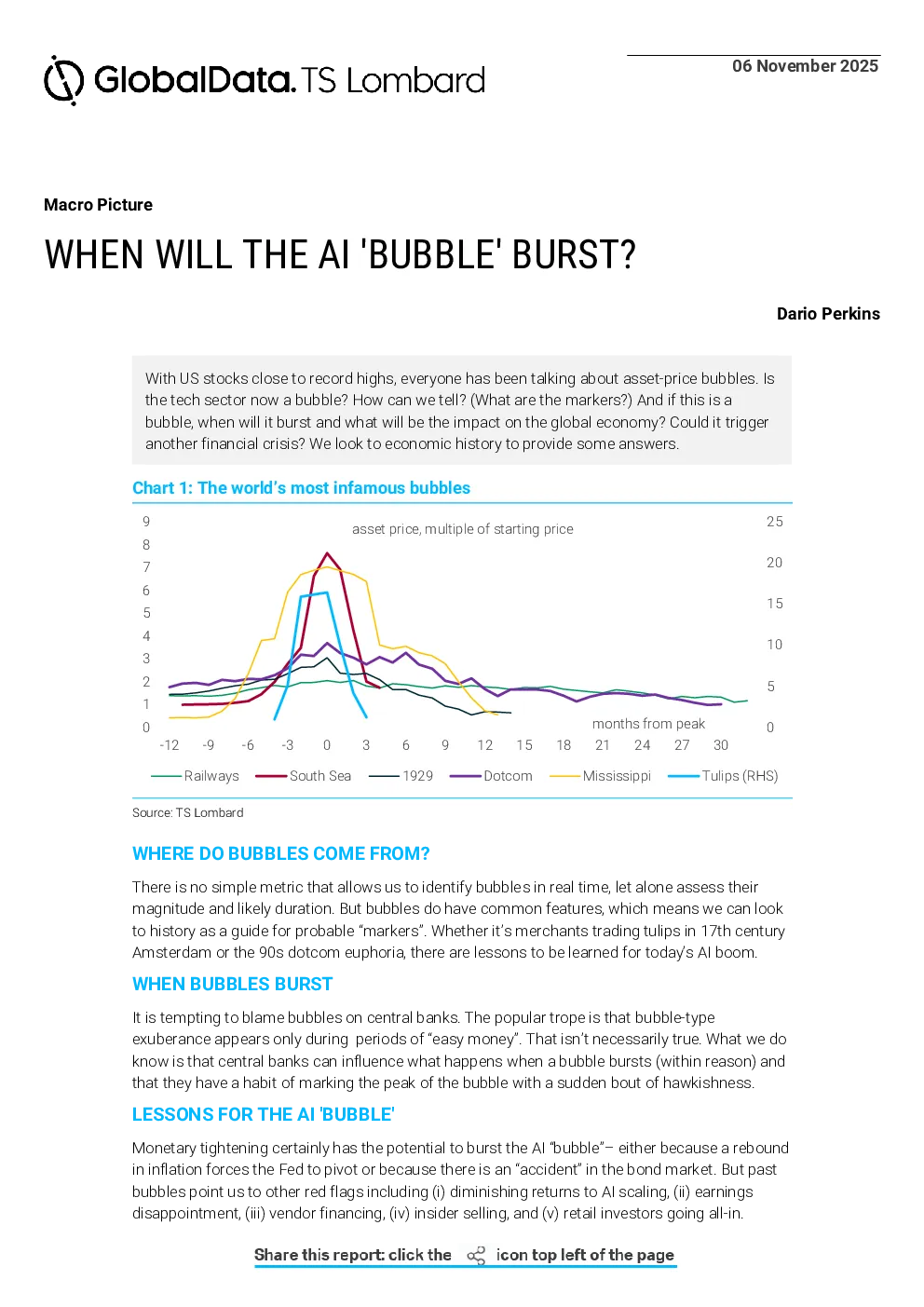
Macro Picture WHEN WILL THE AI 'BUBBLE' BURST? With US stocksclose to recordhighs, everyonehas beentalking about asset-price bubbles. Isthe tech sector nowa bubble? How can we tell?(What are the markers?)And ifthisis abubble, when will it burst and whatwill be theimpact on the global economy?Could it trigger WHERE DO BUBBLES COME FROM? There is no simple metric that allows us to identify bubblesin real time, let alone assesstheirmagnitude andlikelyduration. But bubblesdohave common features, which means we can lookto history as a guide for probable “markers”. Whether it’smerchants trading tulips in17thcentury WHEN BUBBLES BURST It is tempting to blame bubbles on central banks. The popular trope is thatbubble-typeexuberanceappearsonly duringperiods of “easy money”.That isn’t necessarily true. What we doknow is that central banks caninfluence what happens when a bubble bursts (within reason) and LESSONS FOR THE AI 'BUBBLE' Monetary tighteningcertainly has the potential to burst theAI “bubble”–either because a reboundin inflation forces the Fed to pivot or becausethere is an“accident” in the bond market. Butpastbubblespoint us toother red flags including(i)diminishing returns to AI scaling, (ii) earnings WHENWILLTHEAI'BUBBLE' BURST? History is littered withfinancialbubbles–that is,big increases inthepricesof assets, such asstocks and real estate, that become detached fromfundamentals andsuffermassivereversals.In the 1630s, it wasmerchantstrading tulipsin the taverns of Haarlem and Amsterdam. In the1720s, it was companies in France and Britain that promisedaccess tothe riches of the NewWorld. In the 1800s,it was railwaymania. And, of course,themoderneragaveus the RoaringTwenties, Japan’sproperty crashin the 1990s,dotcomand thesubprime bust(youmightremember that one…).Whileallbubbles areobvious in retrospect, identifying them in real time is Punterslike to blame central banks for asset bubbles. Surely bubbles can happenonlyduringtimes of“easy money”and if the authorities had raised rates earlier, theeventual crashcould havebeen avoided. But the link between asset prices and monetary policy has always beenratherfuzzy. And in the modern collateralized financial system, where “liquidity” is endogenous to riskappetite, it doesn’treallymake sense to focus on interest rates or the money supply.Whilewecan’t always blame central banks for the formation of assetpricebubbles, they do have a ratherunfortunate track record when it comes to burstingthem (or at leastmarking theirpeak). In 1845, History suggests that AI is the perfect candidate for a new bubble. There is massive uncertaintyabout its impact on the world, and it is the type of technology thatinevitablycomes withalotofhype.Unlike the so-called “Everything Bubble” of the 2010s, this is something investors cangenuinely get excited about (bubbles always need a simple narrative). Although there is no simplemetric that allowsusto predict the magnitude/duration of this current bout of euphoria, the pastcan offer clues about what mighteventually deliverthebigreversal. These markersor red flagsinclude (i) monetary tightening (the new Trump-appointed Fed chair will want to accommodateAI, but will the inflationbackdropallow that?Macro conditions are certainly more challenging 1.WHERE DO BUBBLES COME FROM? What is an assetprice bubble? The definition of afinancialbubble isratherobvious–a sharp rise in the price of an assetthatisn’t justified by fundamentals. And because it isn’t justified by fundamentals, theremusteventually bea big reversal. Chart 1(seefront page) showssome of themost infamous bubblesin history, including the Dutchtulipmaniaofthe 1630s, the Mississippi and South Sea bubbles of1720 (two separate instancesinFrance and Britain thatwerelinked by asingle,common idea–to exploit trade with the New World.), therailway mania of the 1840s (Britain, in fact,had threerailway bubbles in the 1800sand the US joined inafter theCivil War)and the Roaring Twenties. Source:McClure andThomas (2017)andDavid Chandler Thomas Source:Google, TS Lombard Identifying bubbles–what are the best metrics? While identifying bubbles is easy after the fact (although economists still manage to disagree andoften find themselves arguing about whether it was “rational” for prices to rise so sharply), it ismuch harder to spot them in real time. Thatisbecause,underour definition ofabubble, thephrase “notjustified bythefundamentals” is doing a lot of the work. The “fundamentals” arealwayshighly uncertain;andatthe centre of most bubbles there is usuallyadebate about howthe fundamentals aresetto evolve in the future. How muchwould the railways changeVictorianBritish societyand what would that mean for the companies operating the new lines?Would the distil the bubble question down into simple numerical metrics. Some of the morepopularof those 1Z-scores:Adjust the asset price for its mean and divide by its standard deviation. Thiswill tell you how far out of historical “norms” the