税收、支出与公平:国际模式与发展中国家的经验教训
 AI智能总结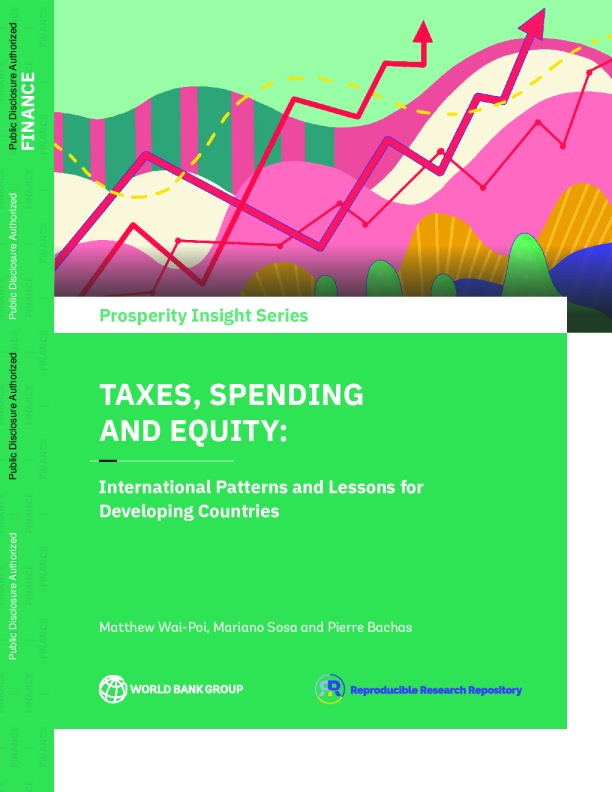
International Patterns and Lessons forPublic Disclosure Authorized Matthew Wai-Poi, Mariano Sosa and Pierre Bachas TAXES, SPENDING International Patterns and Lessons for Matthew Wai-Poi, Mariano Sosa and Pierre Bachas A verified reproducibility package for this paper is available athttp://reproducibility.workdbank.org, clickherefor direct access. This work is a product of the staff of The World Bank with external contributions. The findings,interpretations, and conclusions expressed in this work do not necessarily reflect the views of The The World Bank does not guarantee the accuracy, completeness, or currency of the data includedin this work and does not assume responsibility for any errors, omissions, or discrepancies in theinformation, or liability with respect to the use of or failure to use the information, methods, processes,or conclusions set forth. The boundaries, colors, denominations, links/footnotes and other information Nothing herein shall constitute or be construed or considered to be a limitation upon or waiver of theprivileges and immunities of The World Bank, all of which are specifically reserved. Rights and Permissions The material in this work is subject to copyright. Because The World Bank encourages dissemination ofits knowledge, this work may be reproduced, in whole or in part, for noncommercial purposes as long Any queries on rights and licenses, including subsidiary rights, should be addressed to World BankPublications, The World Bank Group, 1818 H Street NW, Washington, DC 20433, USA; fax: 202-522- TABLE Executive Summary01 1. Introduction: Fiscal Incidence, Data and Methodology 1.1 Data on taxes and spending and their distributional impacts1.2 Fiscal incidence and the Commitment to Equity Framework (CEQ)1.3 Focus of the paper and its contributions) 2. Taxes and Spending Reduce Inequality in all Countries to Differing Degrees 3. Tax and Equity20 3.1 Richer countries collect more tax revenue with direct taxes comprising an increasingshare3.2 Direct taxes are significantly more progressive than indirect taxes...3.3 ...although indirect taxes are not as regressive as commonly thought 4. Spending and Equity 4.1 Higher revenues in richer countries finance higher education, health and social protection364.2 Spending on energy, agriculture and other subsidies is widespread374.3 Direct transfers are highly progressive; subsidies provide some poor income support, 5.1 Progressive taxes and spending are possible at all income levels5.2 VAT and Direct Transfers Play a Central Role 6. References47 ES. EXECUTIVE SUMMARY Taxes and public spending underpin the basic administration of government and finance the human capital andinfrastructure investments needed for economic growth. They can also have a significant and immediate impacton poverty and inequality. The question of how public finance can support longer-term growth objectives whilepromoting equity has become even more important in recent years, given the high fiscal deficits and debt levels This paper examines the global evidence concerning which households pay which taxes and who benefits fromwhat spending – and critically, what the net effect is for different households across the income distribution.The aim is to determine what patterns and lessons emerge for designing progressive fiscal policies. A global Inequality is reduced by the taxes and spending covered in the CEQ framework in all countries studied to date.While richer countries reduce inequality to a greater degree on average, there is more variation within incomelevels than between them, thus highlighting the fact that progressive taxes and spending can be achieved at all Richer countries collect more tax. They also make greater use of direct taxes, such as taxes on personal income,that are progressive and generally paid at a higher rate by richer households. However, personal income taxesrequire formal employment and income levels above reasonable taxable thresholds. Thus, while direct taxescomprise three-quarters of tax revenues in Organization for Economic Co-operation and Development (OECD) However, they are usually not regressive. Exemptions on staple items and higher rates of informal consumptionmean that poorer households can face lower indirect tax rates relative to their income than richer ones, while Higher revenues mean higher public expenditures.Importantly,from low-income to high-incomecountry levels, expenditures other than on health,education and social protection — for example,publicadministration,security and economicaffairs — are generally constant (relative to grossdomestic product [GDP]), suggesting a mostly fixedcost to running a government. Consequently, eachextra dollar of tax revenue roughly means an extradollar for social spending. Thus, richer countries each income level means that progressive fiscalpolicy is possible at all levels of development andadministrative capacity. Thus, this paper includes Central to any pro