摩根士丹利美股招股说明书(2025-11-19版)
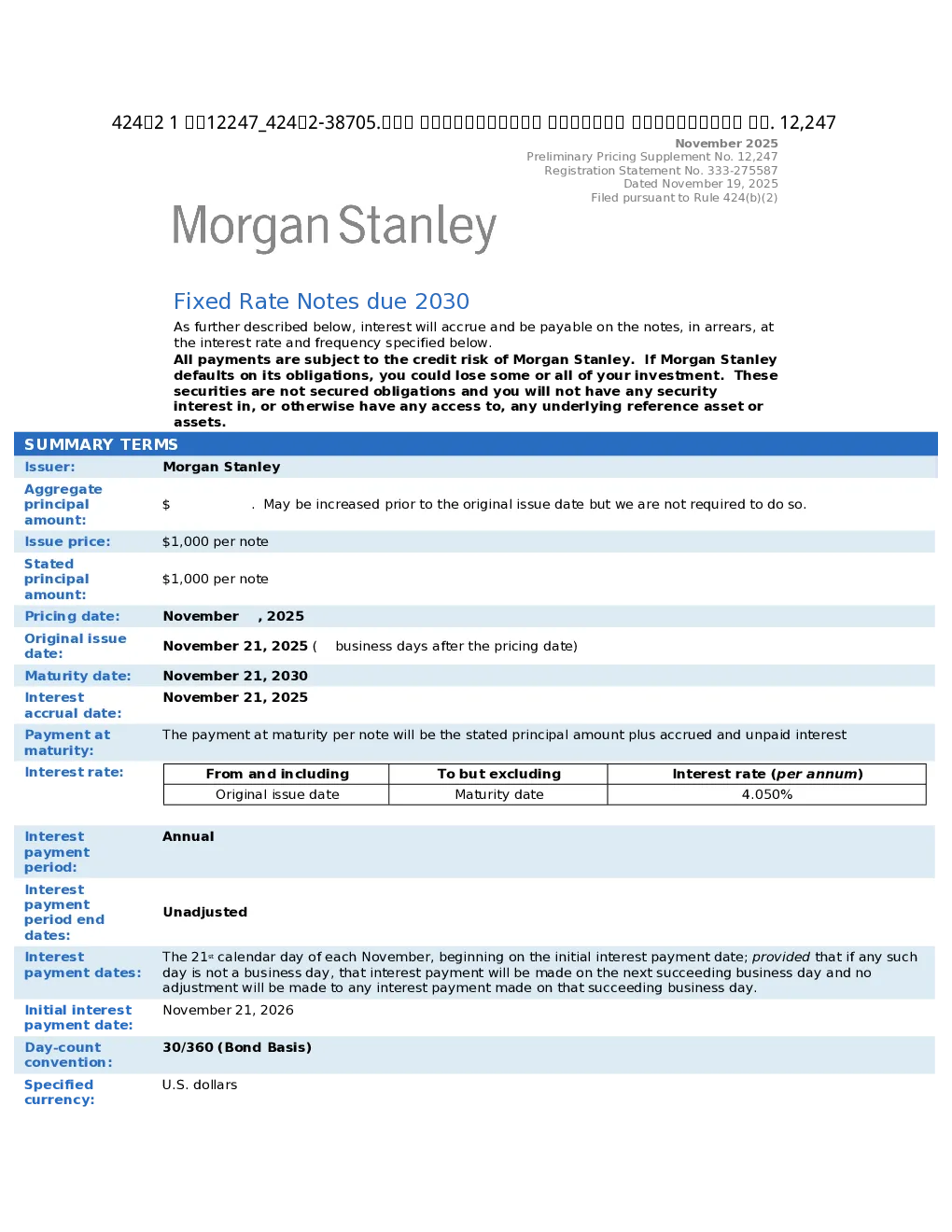
FixedRate Notes due 2030 As further described below, interest will accrue and be payable on the notes, in arrears, at the interest rate and frequency specifiedbelow. All payments are subject to the credit risk of Morgan Stanley. If Morgan Stanley defaults on its obligations, you could losesome or all of your investment. These securities are not secured obligations and you will not have any security interest in, orotherwise have any access to, any underlying reference asset or assets. You should read this document together with the related prospectus supplement and prospectus,each of which can be accessed via the hyperlinks below. When you read the accompanying prospectus supplement, please note that all references insuch supplement to the prospectus dated November 16, 2023, or to any sections therein, should refer instead to the accompanying prospectus dated April12, 2024 or to the corresponding sections of such prospectus, as applicable. Fixed Rate Notes The Notes The notes are debt securities of Morgan Stanley. We describe the basic features of these notes in the sections of theaccompanying prospectus called “Description of Debt Securities—Fixed Rate Debt Securities” and prospectus supplement called The stated principal amount and issue price of each note is $1,000. This price includes costs associated with issuing, selling,structuring and hedging the notes, which are borne by you, and, consequently, the estimated value of the notes on the pricingdate will be less than the issue price. We estimate that the value of each note on the pricing date will be approximately$985.80 What goes into the estimated value on the pricing date? In valuing the notes on the pricing date, we take into account that the notes comprise both a debt component and a performance-based component linked to interest rates. The estimated value of the notes is determined using our own pricing and valuationmodels, market inputs and assumptions relating to volatility and other factors including current and expected interest rates, as What determines the economic terms of the notes? In determining the economic terms of the notes, including the interest rate applicable to each interest payment period, we use aninternal funding rate, which is likely to be lower than our secondary market credit spreads and therefore advantageous to us. Ifthe issuing, selling, structuring and hedging costs borne by you were lower or if the internal funding rate were higher, one or more What is the relationship between the estimated value on the pricing date and the secondary market price of the notes? The price at which MS & Co. purchases the notes in the secondary market, absent changes in market conditions, including thoserelated to interest rates, may vary from, and be lower than, the estimated value on the pricing date, because the secondarymarket price takes into account our secondary market credit spread as well as the bid-offer spread that MS & Co. would charge MS & Co. may, but is not obligated to, make a market in the notes and, if it once chooses to make a market, may cease doing soat any time. Fixed Rate Notes Risk Factors The notes involve risks not associated with an investment in ordinary fixed rate notes. This section describes the material risksrelating to the notes. For a complete list of risk factors, please see the accompanying prospectus supplement and prospectus. Risks Relating to an Investment in the Notes ■Investors are subject to our credit risk, and any actual or anticipated changes to our credit ratings or credit spreadsmay adversely affect the market value of the notes.Investors are dependent on our ability to pay all amounts due on thenotes on interest payment dates and at maturity and therefore investors are subject to our credit risk and to changes in themarket’s view of our creditworthiness. The notes are not guaranteed by any other entity. If we default on our obligationsunder the notes, your investment would be at risk and you could lose some or all of your investment. As a result, the market ■The price at which the notes may be sold prior to maturity will depend on a number of factors and may besubstantially less than the amount for which they were originally purchased.Some of these factors include, but arenot limited to: (i) actual or anticipated changes in interest and yield rates, (ii) any actual or anticipated changes in our creditratings or credit spreads and (iii) time remaining to maturity.Generally, the longer the time remaining to maturity and the ■The rate we are willing to pay for securities of this type, maturity and issuance size is likely to be lower than therate implied by our secondary market credit spreads and advantageous to us. Both the lower rate and theinclusion of costs associated with issuing, selling, structuring and hedging the notes in the original issue pricereduce the economic terms of the notes, cause the estimated value of the notes to be less than the original issueprice and