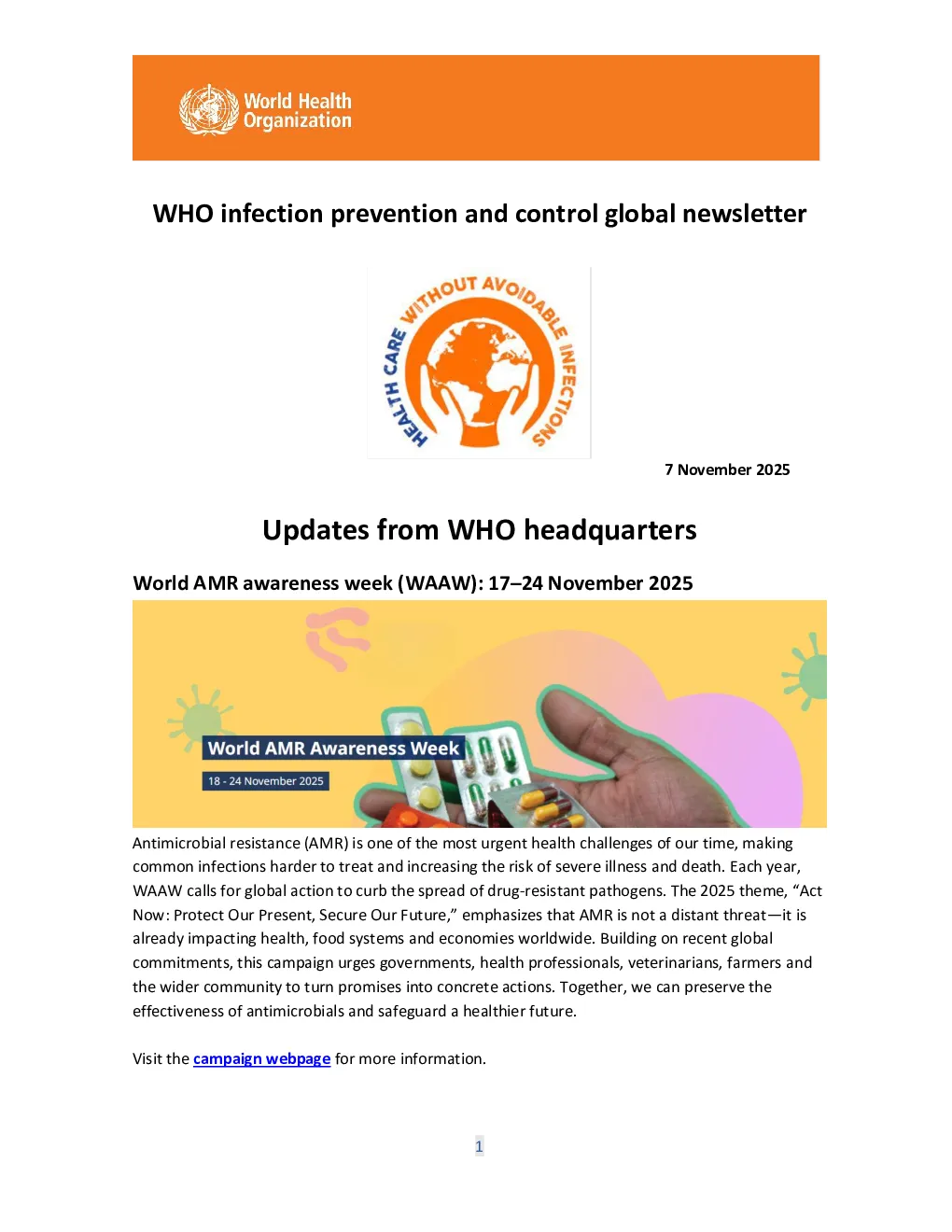
7November2025 Updates from WHOheadquarters World AMRawareness week(WAAW): 17–24 November 2025 Antimicrobialresistance (AMR) is one of the most urgent healthchallenges of our time, makingcommon infections harder to treat and increasing the risk of severe illness and death. Each year,WAAWcalls for global action to curb the spread of drug-resistant pathogens. The 2025 theme, “ActNow: Protect Our Present, Secure Our Future,” emphasizes that AMR is not a distant threat—it isalready impacting health, food systems and economies worldwide. Building on recent global In keeping with this theme,WHO will host a global webinar titledFromdata toimpact:advancingHAIsurveillance forsafercare and ahealthierfuture,on24 November 2025, 13:30–15:00 CET.Health care-associated infections (HAIs) remain a major challenge worldwide, yet most arepreventable through strong infection prevention and control (IPC) practices. This session will Register hereto join leading experts to explore how robust surveillance systems can drivemeasurable improvements in patient safety and support the WHO Global Action Plan on IPC. Updates from theWHO Health Emergencies (WHE) IPC & WASHteam: New guidance and response activities TheGuidance on safe and supportive care in community care centres for individuals with mildmpox in camps for internally displaced persons or refugeeshas been published.This guidanceoutlines practical approaches for providing safe and supportive care to individuals with mild anduncomplicated mpox in community care centres established within camps for internally displacedpersons (IDPs)and refugees, as well as other overcrowded or resource-limited settings where WHO Supports DRC’s IPCresponse to the Ebolaoutbreak in Bulape Health Zone National Ebola response authorities, in collaboration with WHO and partners, have implementedthe IPC ring approach, including rapid IPC and WASH assessments in priority healthcare facilities tocontain the Ebola outbreak inBulape Health Zone, DRC. As part of this support, WHO deployed IPC Key actions included cleaning and disinfection of high-risk health facilities, training of healthcareworkers on Ebola IPC practices, provision of essential IPC supplies, and the development ofimprovement plans to address identified gaps and needs, followed by supportive supervision and Ongoing efforts continue to focus on strengthening IPC capacityacross the health zone to ensuresafe and resilient healthcare services. These interventions are critical to protecting both patientsand health workers,while preventing further transmission of Ebola virus disease. Watch highlights of IPC activities here:Facebook video link For more information, visit the Health Emergencies IPC andWASHwebpage. Guidelines on hand hygiene in community settings During a joint webinar (now available here on demand) on Global HandwashingDay 2025 (15 October), WHO and UNICEF launched the first-everGlobalGuidelines on Hand Hygiene in Community Settings—a landmark effort tosupport governments in strengthening hand hygiene across homes, schools, This global webinar featured an overview of the new Guidelines, country leadership perspectivesfrom Mali, Bangladesh, Ghana, and Zambia, insights from GIZ, IFRC, and WaterAid on Updates fromWHOregions How prepared are Latin Americanhealthcarefacilities to detect and containcarbapenem-resistant and carbapenemase-producing organisms? Healthcare-associated infections (HAIs) caused by carbapenem-resistant organisms (CROs) andcarbapenemase-producing organisms (CP-CROs) are one of the mainpublic healthproblems in LatinAmerica. Therefore, understanding and monitoringthecapacity ofhealthcare facilities to detect, Successful detection, containment and response to antimicrobial-resistant organisms in healthcarefacilities rely primarily on two key pillars:infectionprevention andcontrol and laboratory capacity.To better understand current readiness and gaps in these areas, a joint assessment was conductedby the Pan American Health Organization and the national authorities ofa number of ministries of Among the 26 HCFs assessed, 21 had an IPCprogrammein place. However, only eight had adedicated IPC budget. All facilities had at least one professional responsible for implementing the Regarding laboratory capacity, 26 HCFs had an on-site bacteriology laboratory, all included at leastone carbapenem antibiotic as part of routine antibiotic susceptibility testing for Gram-negativeorganisms, and all used at least one method for carbapenemase detection. While it is not possible to generalize due tothe smallsample size, the findings allow fortheprovision ofrecommendations to the healthcare facilities and thenational IPCprogrammes to Development of the Nationalstrategicplan forinfectionprevention and Infectionprevention andcontrol is a global public health priority. In the Republic of Congo,preliminary assessments atthenational level and in 15 pilot health facilities using WHO tools,revealed inadequate perform