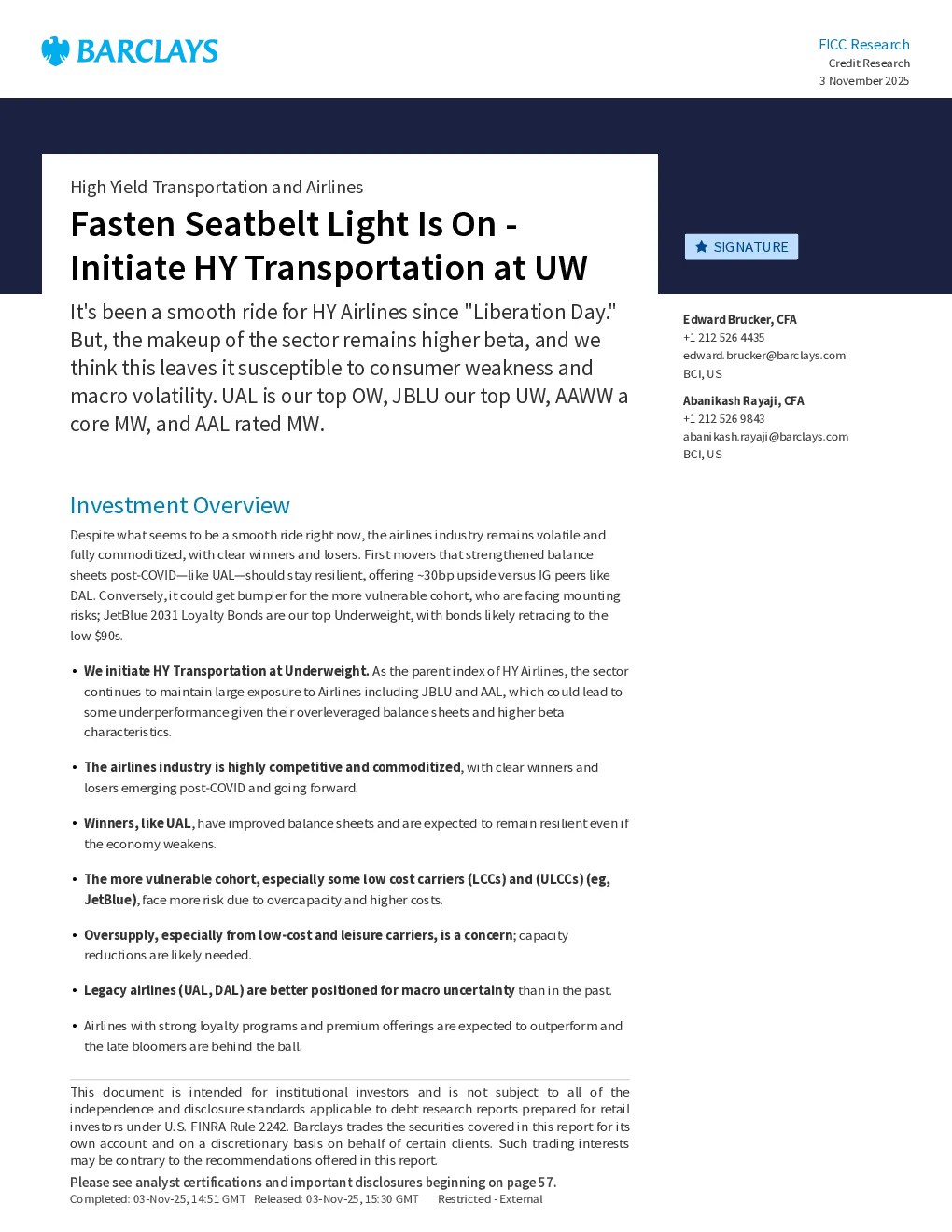
投资概览
- HY 交通运输板块:由于航空公司占比较高,且航空公司本身具有高贝塔特性,该板块在当前市场高位下较为脆弱,存在违约风险。我们给予 HY 交通运输板块“跑输”评级。
- 航空公司行业:行业竞争激烈且高度商品化,存在明显的赢家和输家。例如,UAL 等拥有更强财务状况的公司预计将保持弹性,而一些低成本航空公司(如 JetBlue)则面临更多风险。
- HY 航空公司:我们给予 HY 航空公司“跑输”评级,因为该板块对航空公司(包括 JBLU 和 AAL)的敞口较大,而这些航空公司的资产负债表杠杆率较高,贝塔特性也更高。
行业观点和相对价值
- HY 航空指数:该指数贝塔系数较高,在市场波动和利率收紧时期表现不佳。目前,该指数溢价与 HY 指数持平,考虑到航空公司成分股的风险,我们认为其利差可能扩大。
- 指数成分变化:近年来,指数成分股发生了重大变化,例如 Delta 升级为投资级,Hawaiian Airlines 被 Alaska 收购,SAVE 陷入破产等。这些变化导致指数的评级结构发生变化,目前不再包含 CCC 级公司。
- 私人航空:VistaJet 和 FlexJet 等私人航空公司过去一年波动较大,但需求应该在整个周期中保持弹性。
EETC
- EETC 定义:EETC 是航空公司用作低成本融资选择的担保债务,通常通过特殊目的实体 (SPV) 构建,该实体在法律上持有飞机。
- EETC 评级:由于结构性优势,大多数 EETC 为投资级,但通常存在流动性溢价。
- EETC 估值:我们认为 EETC 的估值有利,因为其抵押品基础得到了波音/空客供应链问题带来的飞机短缺的支撑。
航空公司行业概述
- 竞争格局:美国航空业竞争激烈,主要由四大航空公司(Delta、United、Southwest 和 American)主导,低成本航空公司(LCC)和超低成本航空公司(ULCC)占据剩余市场份额。
- 需求驱动因素:国内航空市场需求受消费者健康和信心驱动,但经济周期和收入水平在不同经济群体之间存在差异。
- 行业面临的挑战:空中交通管制 (ATC) 问题、供应链问题(尤其是飞机和零部件 OEM)以及劳动力成本上升是整个行业的挑战。
- 航空公司采取的策略:航空公司正采取多种策略来应对成本上升,例如精品化、忠诚度计划、国际旅行、机队升级和燃油成本管理。
过度竞争问题
- 产能过剩:COVID-19 疫情后,许多航空公司扩大了产能,导致国内市场(尤其是 LCC/ULCC 市场)出现产能过剩。
- 竞争加剧:低成本航空公司过度依赖低收入消费者,而经济不确定性和通货膨胀对该群体造成了压力。同时,传统航空公司通过推出基础经济舱与 LCC/ULCC 竞争,进一步加剧了竞争。
- SAVE 破产的影响:SAVE 的破产可能导致国内市场产能减少约 28%,从而支持相关航线的收益率。
经济衰退期间的影响
- 历史表现:历史上,航空公司在经济衰退期间表现不佳,主要原因是系统内杠杆率过高。
- 当前状况:尽管经历了整合和财务状况有所改善,但航空公司仍然存在分化,一些杠杆率较高的低成本航空公司可能面临困境。
航空货运概述
- 市场概况:航空货运通常用于运输高价值、时间敏感的商品,占全球贸易价值的 35%,但仅占全球贸易吨位的 1%。
- 需求驱动因素:国际贸易扩张、电子商务的兴起以及供应链对快速运输的需求是航空货运增长的主要驱动力。
- 供应限制:波音和空客的供应链问题导致宽体货机供应紧张,预计未来几年宽体货机产能增长有限。
- 行业龙头:AAWW 作为最大的宽体货运运营商,受益于供需失衡,预计将获得更高的收益率。
JetBlue Airways (JBLU)
- 投资概览:我们给予 JetBlue 9.875% 2031 忠诚度债券“跑输”评级。我们认为 JetBlue 的盈利能力将在短期内到中期内持续疲软,自由现金流将在 2025 年和 2026 年为负,导致流动性紧张。
- 关键信用要点:
- 行业产能过剩和竞争压力:航空业(尤其是休闲市场)受到产能过剩的困扰,导致 JetBlue 的盈利能力下降。
- 低票价模式的问题:低成本航空公司缺乏定价权,而成本上升对其造成了巨大压力。
- 行业动态带来的不利影响:空中交通管制短缺、Pratt & Whitney 发动机检查供应链限制以及飓风 Melissa 等因素都对 JetBlue 造成负面影响。
- 未来现金消耗:我们预计 JetBlue 将在 2025 年和 2026 年消耗 14 亿美元现金,可能需要更多债务发行。
- 资产覆盖率良好:JetBlue 使用 TrueBlue 忠诚度计划作为抵押品,这对其债券构成支撑。
United Airlines Inc (UAL)
- 投资概览:我们给予 UAL 3.1% 2028 债券“跑赢”评级。我们认为 UAL 拥有强劲的财务状况和良好的业务组合,并致力于去杠杆化,目标是将杠杆率降至 2 倍以下。
- 关键信用要点:
- 资产负债表重点关注:UAL 管理层致力于去杠杆化,目标是在 2025 年底将杠杆率降至 2 倍以下。
- 投资级升级催化剂:UAL 表达了成为完全投资级公司的目标,并努力实现投资级信用指标。
- 市场领先地位:UAL 位于航空市场的最佳细分市场,拥有行业领先的利润率,并专注于高收益率业务。
- 竞争对手的市场份额:UAL 将从 Spirit 破产中受益,并有可能从竞争对手那里获得市场份额。
American Airlines Group (AAL)
- 投资概览:我们给予 AAL 7.25% 2028 债券和 AAL 8.5% 2029 债券“市场权重”评级,并给予 AAL 5.75% 2029 和 AAL 5.5% 2026 AAdvantage 忠诚度债券“市场权重”评级。
- 关键信用要点:
- 对国内市场的敞口:与 UAL 和 DAL 相比,AAL 对国内市场的敞口更大,因此其表现更容易受到经济疲软的影响。
- 企业市场份额复苏和新的联名信用卡交易:AAL 正在努力夺回企业旅客市场份额,并推出了新的联名信用卡交易,预计将提高收益率。
- 杠杆率将保持高位:由于自由现金流有限,我们预计 AAL 的杠杆率将在未来几个季度保持高位。
- 在关键市场和产品中的有限足迹:AAL 在东北部地区的足迹有限,其高端产品供应也弱于 DAL 和 UAL,导致其盈利能力落后于同行。
Atlas Air (AAWW)
- 投资概览:我们给予 AAWW 8.5% 2030 债券“市场权重”评级。
- 关键信用要点:
- 有利的长期供需动态:宽体货机产能增长有限,而航空货运需求预计将保持强劲增长。
- 关税政策带来的短期冲击:贸易政策的不确定性导致航空货运需求疲软,但 AAWW 的合同结构和战略定位有助于缓解影响。
- 有价值的抵押品组合:AAWW 债券和期限贷款设施均以第一顺位抵押品为基础,为其提供了安全保障。
- 赞助商的激进股息政策:AAWW 的股息政策激进,但仍然可控,预计自由现金流将在 2025 年为负,导致杠杆率将保持高位。