您的浏览器禁用了JavaScript(一种计算机语言,用以实现您与网页的交互),请解除该禁用,或者联系我们。[华尔街日报]:一连串相互循环的人工智能交易是双赢局面——还是泡沫的迹象? - 发现报告

一连串相互循环的人工智能交易是双赢局面——还是泡沫的迹象?

2025-10-22华尔街日报匡***
AI智能总结
查看更多
一连串相互循环的人工智能交易是双赢局面——还是泡沫的迹象?

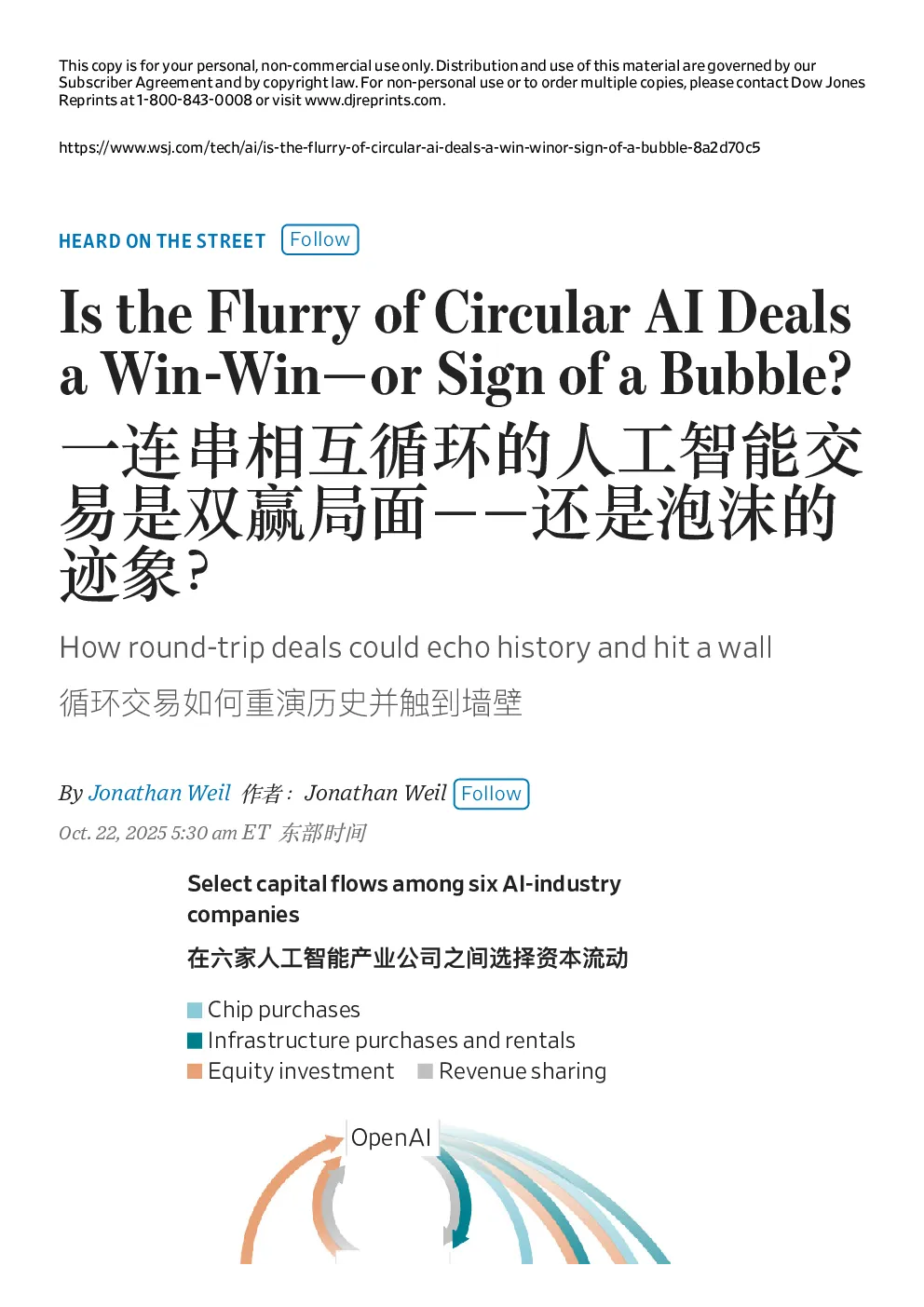
https://www.wsj.com/tech/ai/is-the-flurry-of-circular-ai-deals-a-win-winor-sign-of-a-bubble-8a2d70c5 HEARD ON THE STREETFollow Is the Flurry of Circular AI Dealsa Win-Win—or Sign of a Bubble?⼀连串相互循环的⼈⼯智能交易是双赢局⾯——还是泡沫的迹象? How round-trip deals could echo history and hit a wall 循环交易如何重演历史并触到墙壁 ByJonathan Weil作者:Jonathan WeilFollow Oct. 22, 2025 5:30 amET东部时间 Select capital flows among six AI-industrycompanies 在六家⼈⼯智能产业公司之间选择资本流动 Chip purchasesInfrastructure purchases and rentalsEquity investmentRevenue sharing Note: Some chip purchases are through intermediaries. Someinvestments and other arrangements subject to conditions. 注:部分芯⽚购买通过中间商进⾏。部分投资及其他安排受条件约束。 Sources: staff reports; Morgan Stanley 来源:员⼯报告;摩根⼠丹利 Nate Rattner/WSJNate Rattner/华尔街⽇报 “Circularity” has become a buzzword in artificial-intelligence deals.Some investors have drawn comparisons between the megadeals oftoday and some excesses of the original dot-com bubble. “循环性”已成为⼈⼯智能交易中的⼀个流⾏词。⼀些投资者将今⽇的巨额交易与最初的互联⽹泡沫时期的⼀些过度⾏为相提并论。 Today the dollars at stake are exponentially bigger, the deals are morecomplex, and the money trail is often harder to follow. But somesimilarities are real. One risk: If enthusiasm forspending money on datacenterswanes, companies such asNvidiaandMicrosoftcould be hit twice—with less revenue coming in anddeclining values for their equity investments in customers.NVDA-0.81%MSFT0.17% 如今涉及的资⾦规模呈指数级增长,交易更为复杂,资⾦流向也往往更难追踪。但有些相似之处确实存在。⼀个风险是:如果对在数据中⼼上花钱的热情减退,像英伟达(Nvidia NVDA-0.81%)和微软(MicrosoftMSFT0.17%)这样的公司可能会遭受双重打击——收⼊减少,同时对客户的股权投资价值下跌。 Broadly speaking, circularfinancing often goes something like this: Onecompany pays money to another as part of a transaction, and then theother company turns around and buys thefirst company’s products orservices. Without the initial transaction, the other company might notbe able to make the purchase. The funding mechanism could take theform of an investment, a loan, a lease or something else. ⼀般⽽⾔,循环融资通常⼤致如下:⼀家企业在⼀笔交易中向另⼀家企业⽀付资⾦,然后那家企业又转⽽购买⾸家公司的产品或服务。若没有最初的交易,另⼀家公司可能⽆法进⾏该购买。资助机制可以采取投资、贷款、租赁或其他形式。 During the late 1990s and early 2000s, such dependency loops mainlyconsisted of telecom-equipment makerslending money or extendingcreditto customers so the customers could afford to buy their gear. In those days, this was widely referred to as vendorfinancing. 在20世纪90年代末和21世纪初,这类相互依赖的循环主要表现为电信设备制造商向客户放贷或延长信⽤额度,以便客户能够买得起他们的设备。那时,这种做法被⼴泛称为供应商融资。 The poster child forvendorfinancing run amokwas LucentTechnologies. It lent billions of dollars to upstart telecom providersbuilding out their infrastructure and networks. In the boom years, theirpurchases helped fuel Lucent’s rapid sales growth. When thosecustomers went bust—because they ran out of cash and couldn’t raisefresh capital—Lucent had to write offtheir bad debts and book hugelosses. 供应商融资失控的典型案例是朗讯科技(Lucent Technologies)。它向新兴电信服务提供商借出了数⼗亿美元,以帮助他们建设基础设施和⽹络。在繁荣时期,这些客户的采购推动了朗讯销售的快速增长。当这些客户破产——因为他们资⾦耗尽且⽆法筹集新资本——朗讯不得不核销这些坏账并记巨额亏损。 Some of Lucent’s biggest troubled customers, including telecom startupWinstar Communications, were publicly traded. As it turned out,investors sometimes could learn more about Lucent’sdoomed vendor-financing dealsfrom reading Winstar’s disclosures than they could fromLucent’s. 朗讯⼀些最⼤的问题客户,包括电信初创公司WinstarCommunications,都是上市公司。事实证明,投资者有时通过阅读Winstar的披露,⽐从朗讯的披露中更能了解朗讯那些注定失败的供应商融资交易。 Nvidia CEO Jensen Huang, Microsoft CEO Satya Nadella and OpenAI CEO SamAltman.GETTY IMAGES (2), ZUMA PRESS 英伟达⾸席执⾏官⻩仁勋、微软⾸席执⾏官萨提亚·纳德拉和OpenAI⾸席执⾏官⼭姆·奥特曼。GETTY IMAGES(2),ZUMA PRESS Vendorfinancing still exists. But it isn’t how the bulk of the latestattention-grabbing, circular deals are structured. ⼚商融资仍然存在。但这不是⼤多数最新引⼈注⽬的循环交易的结构⽅式。 Take, for example, the strategic partnership announced in Septemberby Nvidia and OpenAI, the company behind ChatGPT. The companiessaid Nvidia wouldinvest as much as $100 billionin OpenAI, and thatOpenAI is looking to buy millions of Nvidia’s specialized chips. That isn’tvendorfinancing, because it doesn’t involve a loan tofinance a specific purchase. But it does look circular. 举例来说,像英伟达与打造ChatGPT的OpenAI在九⽉宣布的战略合作就是如此。两家公司表⽰,英伟达将最多对OpenAI投资1000亿美元,且OpenAI正寻求购买数以百万计的英伟达专⽤芯⽚。这并不是供应商融资,因为它不涉及为特定采购提供贷款。但这确实看起来像是循环往复。 OpenAI isn’t publicly traded, so it doesn’t disclosefinancial reports. Butit is known to be losing money, notwithstanding a recent secondaryshare sale that implieda $500 billion valuation. Nvidia’s investment willhelp OpenAI pay for its infrastructure build-out. Nvidia also stands toget money back from OpenAI through chip sales, boosting its revenue. OpenAI不是上市公司,因此不公开财务报告。但据悉它在亏损,尽管最近⼀次⼆级股权出售暗⽰了5000亿美元的估值。英伟达的投资将有助于OpenAI为其基础设施建设提供资⾦。英伟达也有望通过向OpenAI出售芯⽚收回资⾦,从⽽提升其收⼊。 To bullish investors that might look like a win-win. It also providesfodder for skeptics who suspect the AI ecosystem is in a bubble andcan’t expand without the companies subsidizing and leaning on eachother. The actual deal terms weren’t disclosed, either, because Nvidiaand OpenAI said they weren’tfinalized. In a vendor-finance