AI智能总结
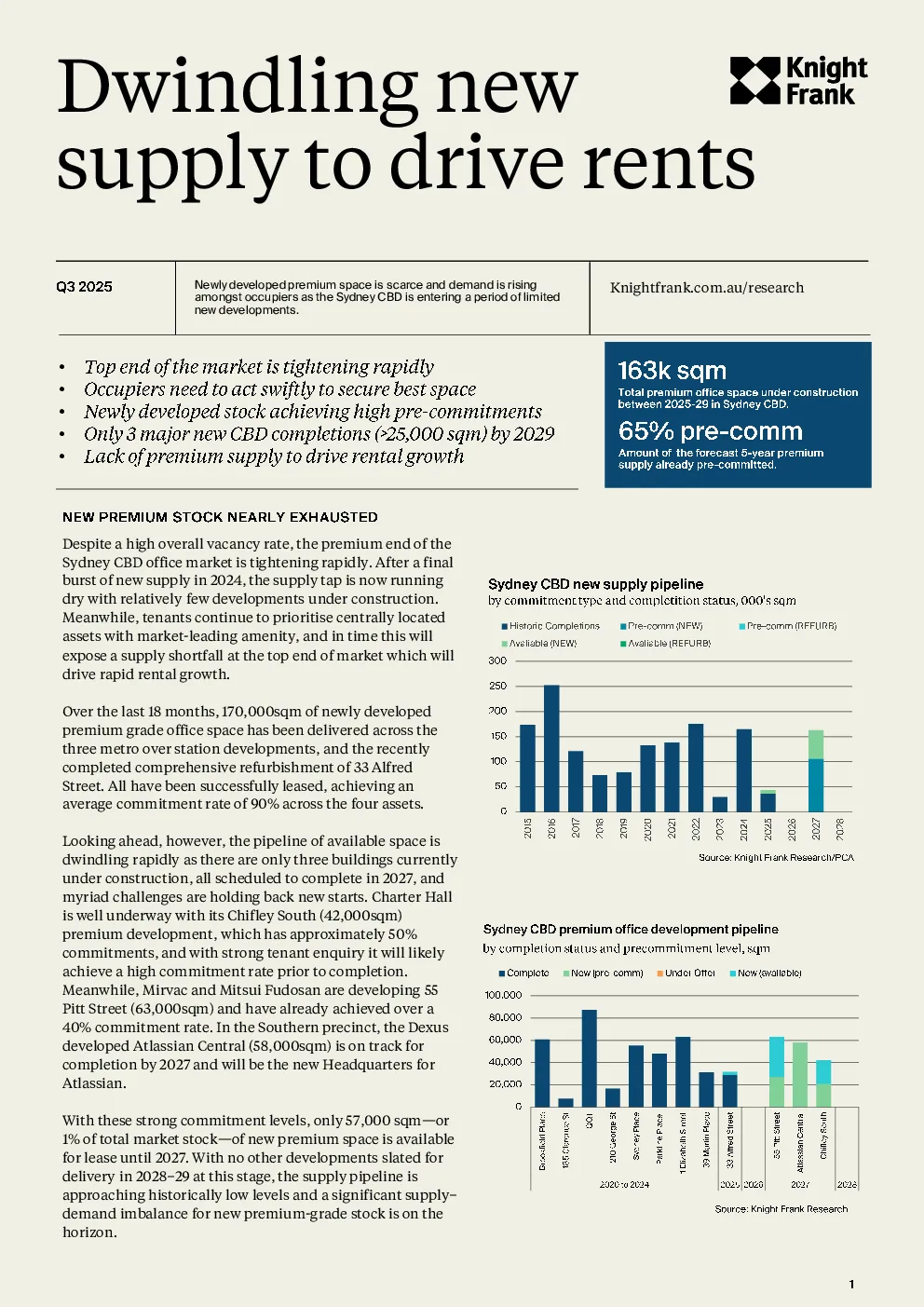
Knightfrank.com.au/research ••••• Despite a high overall vacancy rate, the premium end of theSydney CBD office market is tightening rapidly. After a finalburst of new supply in 2024, the supply tap is now runningdry with relatively few developments under construction.Meanwhile, tenants continue to prioritise centrally locatedassets with market-leading amenity, and in time this willexpose a supply shortfall at the top end of market which willdrive rapid rental growth. Over the last 18 months, 170,000sqm of newly developedpremium grade office space has been delivered across thethree metro over station developments, and the recentlycompleted comprehensive refurbishment of 33 AlfredStreet. All have been successfully leased, achieving anaverage commitment rate of 90% across the four assets. Looking ahead, however, the pipeline of available space isdwindling rapidly as there are only three buildings currentlyunder construction, all scheduled to complete in 2027, andmyriad challenges are holding back new starts. Charter Hallis well underway with its Chifley South (42,000sqm)premium development, which has approximately 50%commitments, and with strong tenant enquiry it will likelyachieve a high commitment rate prior to completion.Meanwhile, Mirvac and Mitsui Fudosan are developing 55Pitt Street (63,000sqm) and have already achieved over a40% commitment rate. In the Southern precinct, the Dexusdeveloped Atlassian Central (58,000sqm) is on track forcompletion by 2027 and will be the new Headquarters forAtlassian. With these strong commitment levels, only 57,000 sqm—or1% of total market stock—of new premium space is availablefor lease until 2027. With no other developments slated fordelivery in 2028–29 at this stage, the supply pipeline isapproaching historically low levels and a significant supply–demand imbalance for new premium-grade stock is on thehorizon. The performance of Sydney’s newest premium towershighlights the strength of demand for well-located, high-quality stock and offers a lower risk profile for developers.But despite strong leasing fundamentals, multiplefeasibility challenges and resulting high economic rentsrequired to develop these towers have made it difficult fordevelopers to progress the next wave of schemes. Strong demand for new premium stock and successfulleasing of these assets is nothing new to the market. Since2018 there has been an average pre-practical completioncommitment rate of 87% across all new developments,which have totalled 481,000 sqm across 13 schemes. If welook further at occupancy rates 12 months post completionthis rises to over 91%. Construction cost inflation peaked at an all-time high of17% in 2022, with specific materials increasing by over 50%.Coupled with a higher interest rate environment driving upcap rates and rising incentives, this has had a profoundimpact on economic rents (which we will address andquantify in a forthcoming report) and directly led to theforthcoming period of limited new supply. We are nowseeing this clearly with the level of supply additions overthe next three years as a percentage of total stock at itslowest level on record and forecast to trend towards zero ifno schemes progress in 2028 and 2029. Looking at specific schemes, the largest development QuayQuarter Tower (87,201sqm) opened in 2022 with acommitment rate of over 95%. In the same year SydneyPlace (55,000sqm) opened with a commitment rate of 87%.More recently, the three over station developments whichcompleted all over the last 12 months had an averagecommitment rate of over 90% prior to completion. This strong take-up of new stock has come during a periodwhen some corporates have chosen to contract their overalloccupational footprint, and their experience bearstestament to a persistent flight to quality. Occupiers havegravitated to their modern design, cutting-edge technology,strong ESG credentials, connectivity to multiple transportnodes and close alignment with evolving workplaceexpectations. These trends will continue to drive robustdemand for best-in-class office stock into the future. As a result of the looming supply shortfall, occupiers seeingpremium space within the 2026-28 window need to actswiftly to secure their preferred option. Delaying a decisioncould easily mean missing out on optimal floorplates, topamenities, and the most desirable locations. Aggregate absorption levels by grade reflect the cleardisparity between premium stock and the rest of the market.Since 2020 premium grade net absorption has totalled279,858sqm, whilst all other grades have experiencednegative absorption levels. This bodes well for owners of top-tier assets, as the balanceof power in lease negotiations is likely to shift to landlords.Rents will continue to be pushed for these premium assetswith strong growth above 5% per annum likely to beachieved in coming years and incentive levels also likely toshift down to be significantly lower than the wider market. Diving deeper into take-up