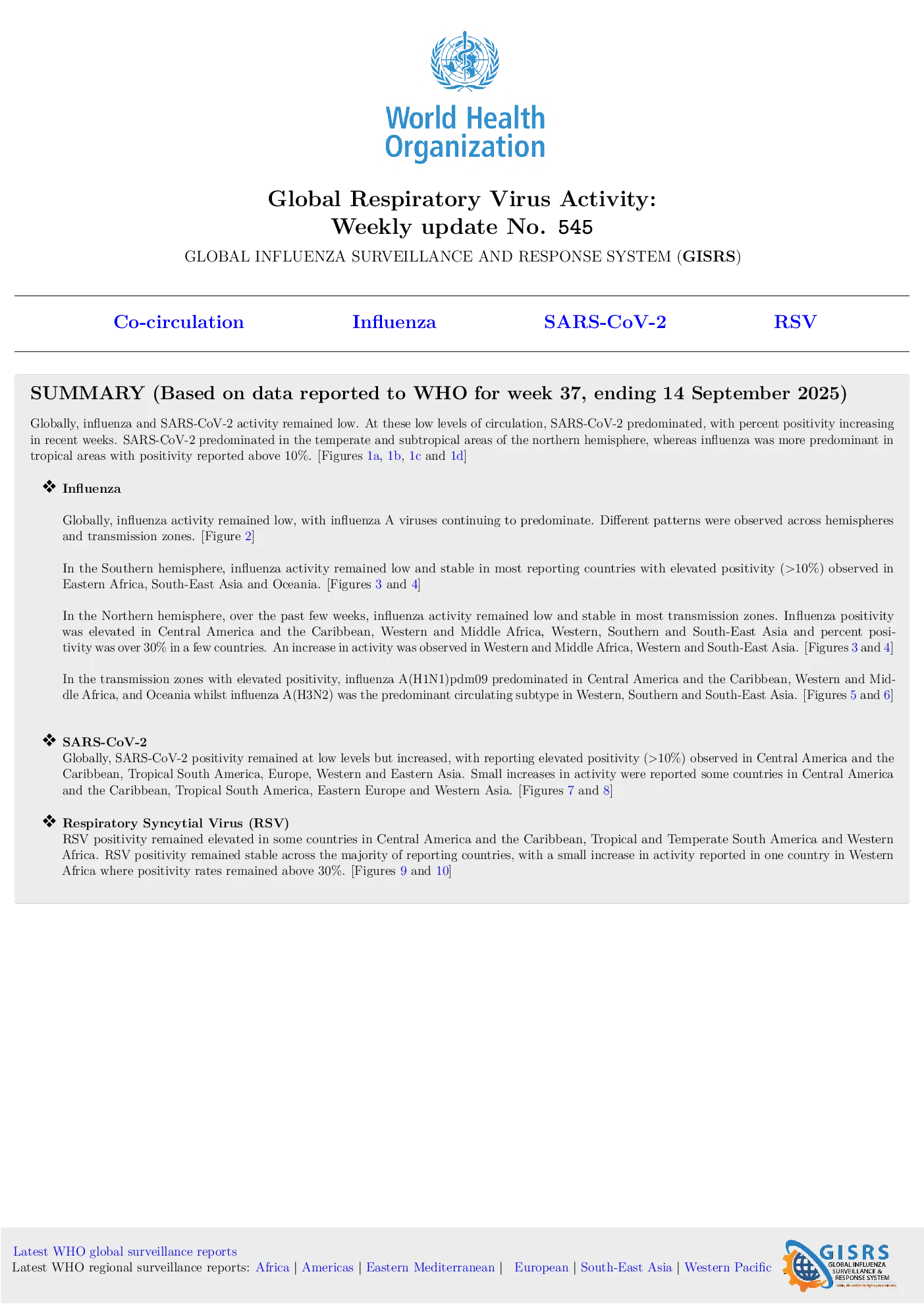
GLOBAL INFLUENZA SURVEILLANCE AND RESPONSE SYSTEM (GISRS) RSV SARS-CoV-2 Influenza Co-circulation SUMMARY (Based on data reported to WHO for week 37, ending 14 September 2025) Globally, influenza and SARS-CoV-2 activity remained low. At these low levels of circulation, SARS-CoV-2 predominated, with percent positivity increasingin recent weeks. SARS-CoV-2 predominated in the temperate and subtropical areas of the northern hemisphere, whereas influenza was more predominant intropical areas with positivity reported above 10%. [Figures 1a, 1b, 1c and 1d] qInfluenza Globally, influenza activity remained low, with influenza A viruses continuing to predominate. Different patterns were observed across hemispheres In the Southern hemisphere, influenza activity remained low and stable in most reporting countries with elevated positivity (>10%) observed inEastern Africa, South-East Asia and Oceania. [Figures 3 and 4] In the Northern hemisphere, over the past few weeks, influenza activity remained low and stable in most transmission zones. Influenza positivitywas elevated in Central America and the Caribbean, Western and Middle Africa, Western, Southern and South-East Asia and percent posi-tivity was over 30% in a few countries. An increase in activity was observed in Western and Middle Africa, Western and South-East Asia. [Figures 3 and 4] In the transmission zones with elevated positivity, influenza A(H1N1)pdm09 predominated in Central America and the Caribbean, Western and Mid-dle Africa, and Oceania whilst influenza A(H3N2) was the predominant circulating subtype in Western, Southern and South-East Asia. [Figures 5 and 6] qSARS-CoV-2Globally, SARS-CoV-2 positivity remained at low levels but increased, with reporting elevated positivity (>10%) observed in Central America and the Caribbean, Tropical South America, Europe, Western and Eastern Asia. Small increases in activity were reported some countries in Central Americaand the Caribbean, Tropical South America, Eastern Europe and Western Asia. [Figures 7 and 8] qRespiratory Syncytial Virus (RSV)RSV positivity remained elevated in some countries in Central America and the Caribbean, Tropical and Temperate South America and Western Africa. RSV positivity remained stable across the majority of reporting countries, with a small increase in activity reported in one country in WesternAfrica where positivity rates remained above 30%. [Figures 9 and 10] Co-circulation of influenza and SARS-CoV-2 1a) Weekly numbers of influenza and SARS-CoV-2 virus specimens tested and percent positivity at the global level(last 12 months) 1c) Weekly numbers of influenza andSARS-CoV-2 virus specimens tested andpercent positivity in Tropical areas 1b) Weekly numbers of influenza andSARS-CoV-2 virus specimens tested andpercent positivity in Northern hemispheretemperate and subtropical areas 1d) Weekly numbers of influenza andSARS-CoV-2 virus specimens tested andpercent positivity in Southern hemispheretemperate and subtropical areas Influenza 2) Weekly numbers of influenza virus positive specimens by type and subtype and percent positivity at the globallevel (last 12 months) 4) Change in proportions of specimens that testedpositive for influenza (year-week:2025-37) 3) Proportions of specimens that tested positive forinfluenza (year-week:2025-37) 6) Weekly distribution of influenza virus types andsubtypes by geographic zone (last 12 months) 5) Proportions of influenza virus types and subtypes byinfluenza transmission zones (year-week:2025-37) SARS-CoV-2 8) Change in proportions of specimens that testedpositive for SARS-CoV-2 (year-week:2025-37) 7) Proportions of specimens that tested positive forSARS-CoV-2 (year-week:2025-37) Respiratory syncytial virus 10) Change in proportions of specimens that testedpositive for RSV (year-week:2025-37) 9) Proportions of specimens that tested positive for RSV(year-week:2025-37) Additional information Data and methods The data presented in this report originates from virologic surveillance conducted by countries, areas, and territories (CATs) andsubmitted to WHO FluNet through participation or collaboration with the Global Influenza Surveillance and Response System(GISRS). These CATs employ diverse methodologies to monitor respiratory virus activity, which may result in variations betweenthis report and other surveillance summaries published elsewhere. This report includes virologic data from bothsentinel surveillance and other systematically conducted surveillance. Dueto differences in surveillance strategies, direct comparisons of percent positivity between CATs should be interpreted with caution.The data source used for each CAT was decided jointly corresponding with WHO Regional Offices and the respective reporting entity. To assess trends, the proportion of specimens tested positive for influenza or SARS-CoV-2 was smoothed over a 3-weeks period. Thisanalysis includes only countries that tested 10 or more specimens in