您的浏览器禁用了JavaScript(一种计算机语言,用以实现您与网页的交互),请解除该禁用,或者联系我们。[国际能源署]:与汽车集成光伏(VIPV)市场进入相关的挑战 - 发现报告

与汽车集成光伏(VIPV)市场进入相关的挑战

AI智能总结
查看更多
与汽车集成光伏(VIPV)市场进入相关的挑战

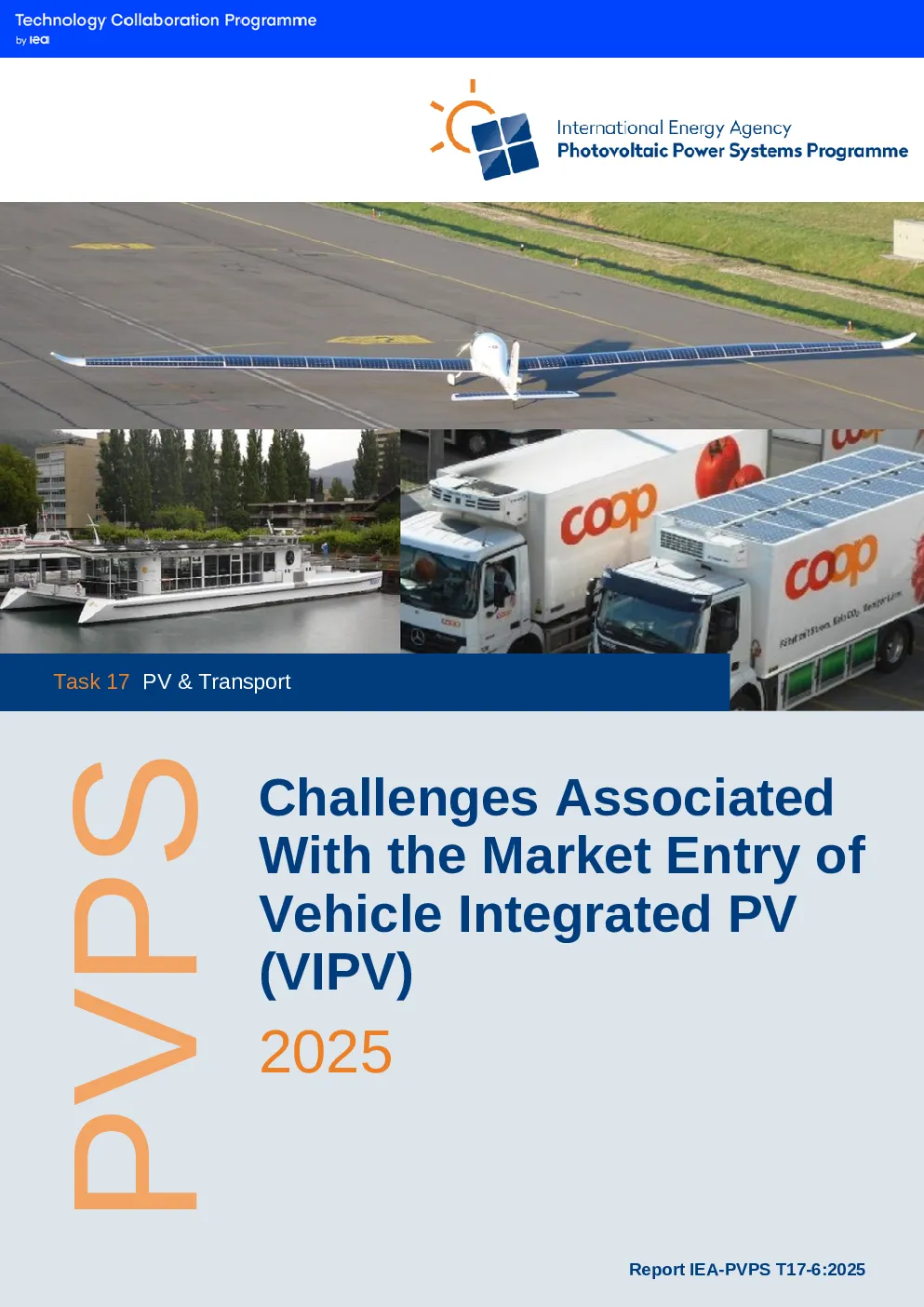
What is IEA PVPS TCP? The International Energy Agency (IEA), founded in 1974, is an autonomous body within the framework of the Organizationfor Economic Cooperation and Development (OECD).The Technology Collaboration Programme(TCP)was created witha belief that the future of energy security and sustainability starts with global collaboration. The programme is made up of6.000experts across government, academia, and industry dedicated to advancing common research and the applicationof specific energy technologies. One of the IEA TCPs is the “Photovoltaic Power Systems Programme”(IEATCPPVPS). It wasestablished in 1993, andits missionis to “enhance the international collaborative efforts which facilitate the role of photovoltaic solar energy as acornerstone in the transition to sustainable energy systems.”To achieve this, the Programme’s participants haveundertaken a variety of joint research projects in PV power systems applications. The overall programme is headed by anExecutive Committee, comprised of onedelegate from each country or organisation member, which designates distinct‘Tasks’ that may be research projects or activity areas. The 27 IEA PVPS participating countries are Australia, Austria, Belgium, Canada, China, Denmark, Finland, France,Germany, India, Israel, Italy, Japan, Korea, Malaysia, Morocco, the Netherlands, Norway, Portugal, South Africa, Spain,Sweden,Switzerland,Thailand,Turkiye, the United Kingdom and the United States of America.The EuropeanCommission, Solar Power Europe and the Solar Energy Research Institute of Singapore are also members. Visit us at:www.iea-pvps.org What is IEA PVPSTask17? The objective of Task 17 of the IEA Photovoltaic Power Systems Programme is to deploy PV in the transport sector, whichwill contribute to reducing CO2emissions of the sector and enhance PV market expansions. The results contribute toclarifying the potential of utilization of PV in transport and to proposeon how to proceed toward realizing the concepts. Task 17’s scope includes PV-powered vehicles such as PLDVs (passenger light duty vehicles), LCVs (light commercialvehicles),HDVs(heavy duty vehicles) and other vehicles, as well as PV applications for electric systems andinfrastructures, such as charging infrastructure with PV, battery and other power management systems. DISCLAIMER TheIEAPVPSTCPisorganisedundertheauspicesoftheInternationalEnergyAgency(IEA)butisfunctionallyandlegallyautonomous.Views, findings and publications of the IEA PVPS TCP do not necessarily represent the views or policies of the IEA Secretariat or itsindividualmembercountries. COPYRIGHT STATEMENT Thiscontent may be freely used, copied and redistributed, providedappropriate credit is given(pleaserefer tothe ‘Suggested Citation’).The exception is that some licensed images may not becopied, as specified in theindividualimage captions. SUGGESTEDCITATION MuntwylerU., Schüpbach E. (2025).Challenges associated with the market entry of Vehicle Integrated PV (VIPV)(Report No. T17-6:2025). IEA PVPS Task 17.https://iea-pvps.org/key-topics/t17-challenges-market-entry-vipv-2025 COVER PICTURE SOLARSTRATOSexperimental solar planedesigned bysolar pioneer Raphaël Domjan and his crew,constructed for a flight into thestratosphere in Payerne(Switzerland)at the “PV in MotionConference”in2024(Photo: Muntwyler). Challenges associated with the marketentry of Vehicle Integrated PV (VIPV) IEA PVPSTask 17PV and Transport Report IEA-PVPS T17-6:2025September–2025 ISBN:978-1-7642902-1-0DOI:https://doi.org/10.69766/FDNG7873 Main Authors Urs W. Muntwyler,SwitzerlandEvaSchüpbach,Switzerland Acknowledgements...........................................................................................................4List of abbreviations..........................................................................................................5Executive summary...........................................................................................................61Introduction............................................................................................................92Underlying Rationale..............................................................................................103Diffusion of Innovation, Mass Market and Customer Segments.............................113.1Diffusionof Innovation:Customer Segments and Target-OrientedMarketing...............................................................................................................113.2The Process of Accepting a Novelty...........................................................123.3Entering the Mass Market by Crossing the Chasm.....................................133.4Customer Benefit is Fundamental for Success or Failure...........................144Solar Cars, Planes and Boats: A Historical Perspective.........................................164.1IR Solar Car 1960.......................................................................................164.2Sol