您的浏览器禁用了JavaScript(一种计算机语言,用以实现您与网页的交互),请解除该禁用,或者联系我们。[世界银行]:赞比亚学校性别暴力预防干预的经验教训(英)2025 - 发现报告

赞比亚学校性别暴力预防干预的经验教训(英)2025

赞比亚学校性别暴力预防干预的经验教训(英)2025

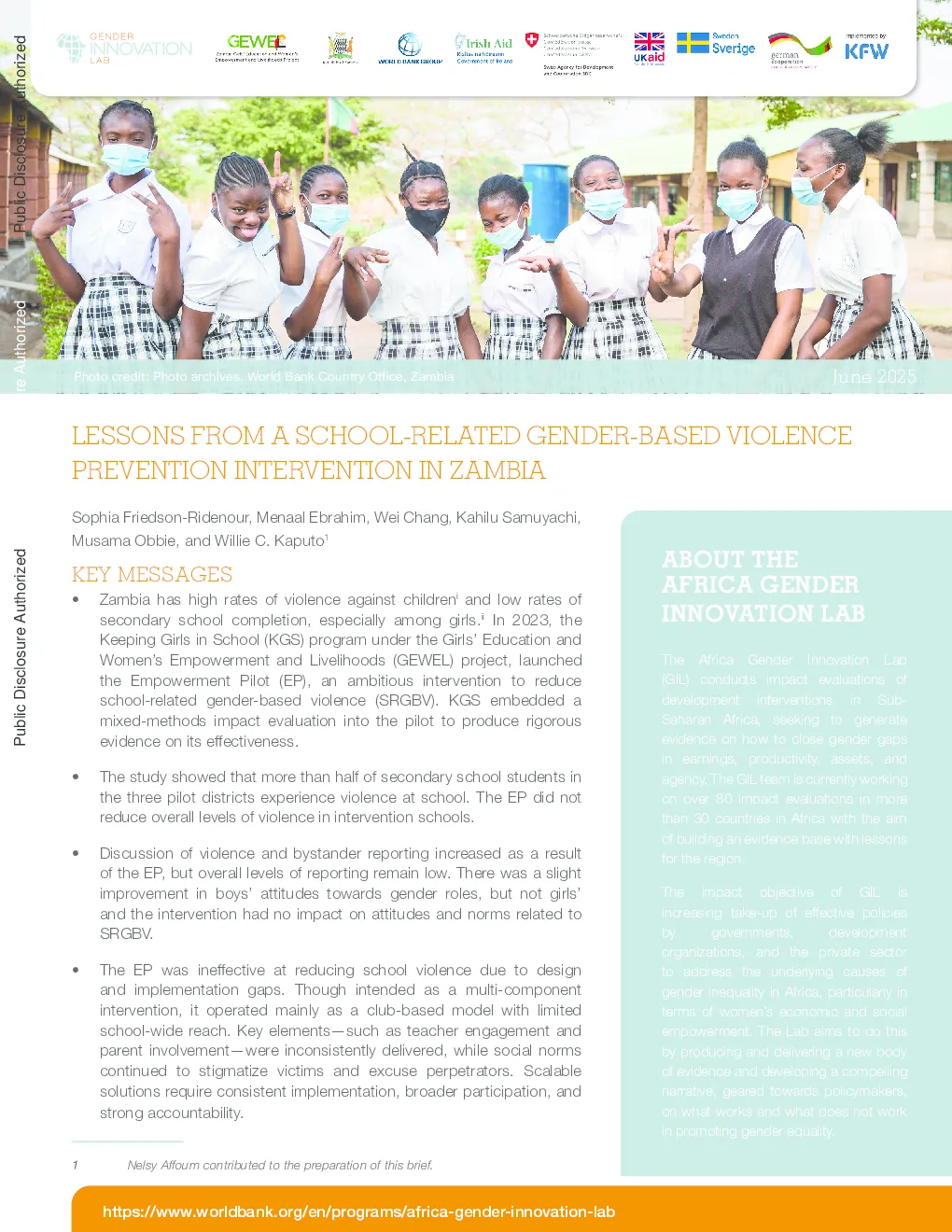
Photo credit: Photo archives, World Bank Country Office, Zambia LESSONS FROM A SCHOOL-RELATED GENDER-BASED VIOLENCEPREVENTION INTERVENTION IN ZAMBIAPublic Disclosure Authorized Sophia Friedson-Ridenour, Menaal Ebrahim, Wei Chang, Kahilu Samuyachi,Musama Obbie, and Willie C. Kaputo1 ABOUT THEAFRICA GENDERINNOVATION LAB KEY MESSAGES •Zambia has high rates of violence against childreniand low rates ofsecondary school completion, especially among girls.ii In 2023, theKeeping Girls in School (KGS) program under the Girls’ Education andWomen’s Empowerment and Livelihoods (GEWEL) project, launchedtheEmpowerment Pilot(EP),an ambitious intervention to reduceschool-relatedgender-based violence(SRGBV).KGS embedded amixed-methods impact evaluation into the pilot to produce rigorousevidence on its effectiveness.Public Disclosure Authorized TheAfrica Gender Innovation Lab(GIL)conducts impact evaluations ofdevelopmentinterventionsinSub-SaharanAfrica,seeking to generateevidence on how to close gender gapsinearnings,productivity,assets,andagency. The GIL team is currently workingon over 80 impact evaluations in morethan 30 countries in Africa with the aimof building an evidence base with lessonsfor the region. •The study showed that more than half of secondary school students inthe three pilot districts experience violence at school. The EP did notreduce overall levels of violence in intervention schools. •Discussion of violence and bystander reporting increased as a resultof the EP, but overall levels of reporting remain low. There was a slightimprovement in boys’ attitudes towards gender roles, but not girls’and the intervention had no impact on attitudes and norms related toSRGBV. TheimpactobjectiveofGILisincreasing take-up of effective policiesbygovernments,developmentorganizations,and the private sectortoaddress the underlying causes ofgender inequality in Africa, particularly interms of women’s economic and socialempowerment. The Lab aims to do thisby producing and delivering a new bodyof evidence and developing a compellingnarrative, geared towards policymakers,on what works and what does not workin promoting gender equality. •The EP was ineffective at reducing school violence due to designand implementation gaps. Though intended as a multi-componentintervention, it operated mainly as a club-based model with limitedschool-wide reach. Key elements—such as teacher engagement andparent involvement—were inconsistently delivered, while social normscontinued to stigmatize victims and excuse perpetrators. Scalablesolutions require consistent implementation, broader participation, andstrong accountability.Public Disclosure Authorized https://www.worldbank.org/en/programs/africa-gender-innovation-lab WHAT WE DID KGS partnered with GIL to conduct a mixed-methodsimpact evaluation of the EP to understand whether theprogramdecreases SRGBV,improves attitudes andnormsaround gender roles and SRGBV,enhancesschool climate, and increases socio-emotional skills andwell-being. The impact evaluation was designed as acluster randomized controlled trial with the interventionrandomizedat the school level.Administrative datacollectedat the beginning of the 2023 school yearwas used to identify all schools located in the threestudy districts. A total of 90 eligible schools were thenrandomized into two groups: those receiving the EPintervention(treatment)and those not receiving theintervention(control)(see Figure 1).Data collectionincluded a school survey and the listing of all students atthe beginning of the study, two rounds of qualitative datacollection during implementation, followed by one roundof quantitative surveys four months after the interventionconcluded, which collected data from adolescents andteachers in study schools.2Twenty-five boys and 25 girlswere randomly selected per school to form the students’sample and were not necessarily participants in the safespace clubs. KGS girls were also sampled. The goal wasto measure violence at the school-wide level to assesswhether the program was effective at reducing overalllevels of violence amongst the general student body, aswell as to look specifically at KGS girls who tend to be morevulnerable and were also more likely to participate directlyin safe space clubs. Qualitative data were collected fromeight intervention schools and included 72 interviews and28 focus group discussions with boys and girls in andout of the clubs, and mentor and non-mentor teachers,and 14 observations of safe space club sessions. Thequalitative data provide more detailed information aboutthe experiences of those who did and did not participatein the clubs. CONTEXT Recognizingthe challenges to girls’education,theGovernment of the Republic of Zambia launched KGS in2016 under the GEWEL Project. KGS aims to increaseaccessto secondary education for disadvantagedadolescentgirls in extremely poor households inselecteddistricts.KGS beneficiaries are adolescentgirls from extremely poor households that pa