dgp:一种用于图像增强大语言模型欺诈检测的双粒度提示框架
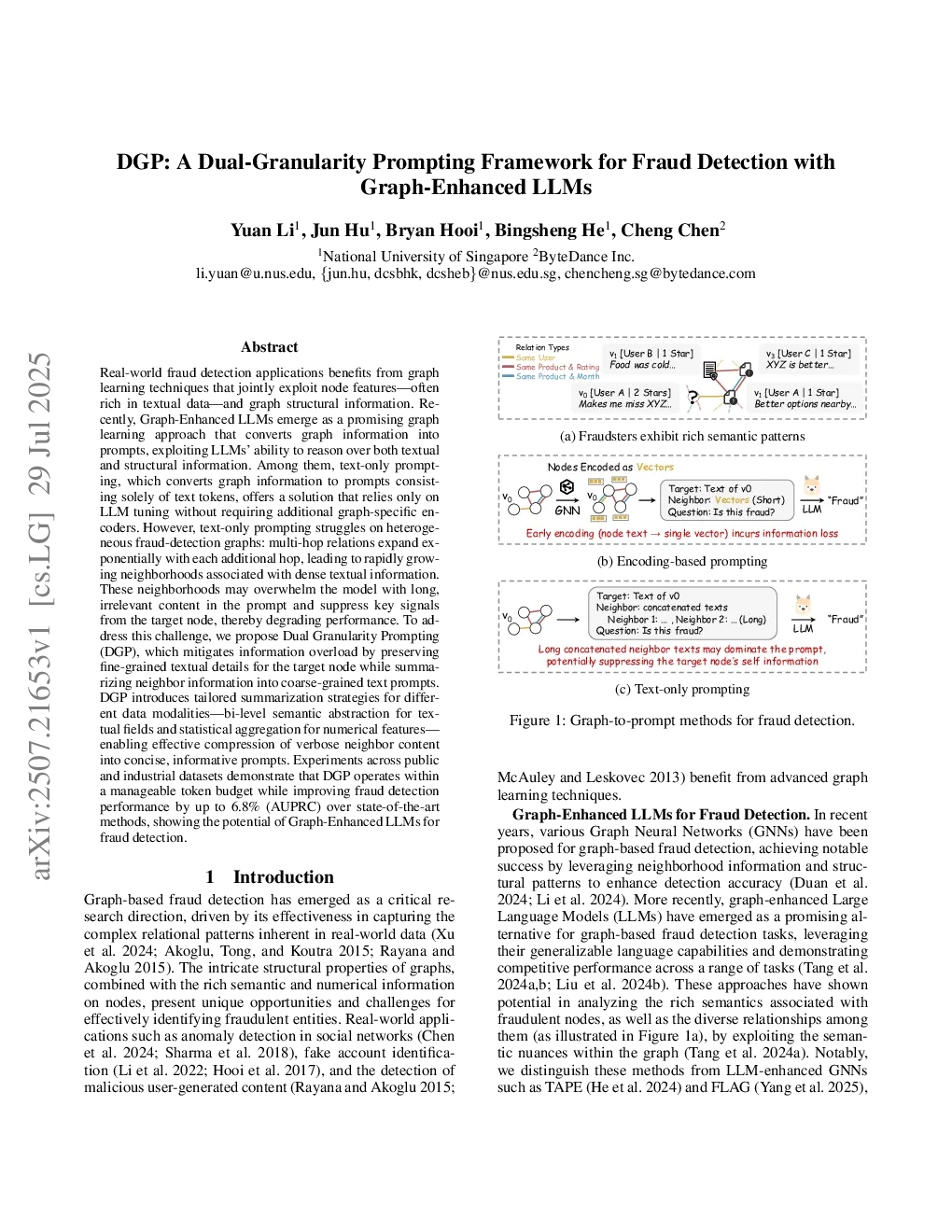
Yuan Li1, Jun Hu1, Bryan Hooi1, Bingsheng He1, Cheng Chen2 1National University of Singapore2ByteDance Inc.li.yuan@u.nus.edu,{jun.hu, dcsbhk, dcsheb}@nus.edu.sg, chencheng.sg@bytedance.com Abstract Real-world fraud detection applications benefits from graphlearning techniques that jointly exploit node features—oftenrich in textual data—and graph structural information. Re-cently, Graph-Enhanced LLMs emerge as a promising graphlearningapproach that converts graph information intoprompts, exploiting LLMs’ ability to reason over both textualand structural information. Among them, text-only prompt-ing, which converts graph information to prompts consist-ing solely of text tokens, offers a solution that relies only onLLM tuning without requiring additional graph-specific en-coders. However, text-only prompting struggles on heteroge-neous fraud-detection graphs: multi-hop relations expand ex-ponentially with each additional hop, leading to rapidly grow-ing neighborhoods associated with dense textual information.These neighborhoods may overwhelm the model with long,irrelevant content in the prompt and suppress key signalsfrom the target node, thereby degrading performance. To ad-dress this challenge, we propose Dual Granularity Prompting(DGP), which mitigates information overload by preservingfine-grained textual details for the target node while summa-rizing neighbor information into coarse-grained text prompts.DGP introduces tailored summarization strategies for differ-ent data modalities—bi-level semantic abstraction for tex-tual fields and statistical aggregation for numerical features—enabling effective compression of verbose neighbor contentinto concise, informative prompts. Experiments across publicand industrial datasets demonstrate that DGP operates withina manageable token budget while improving fraud detectionperformance by up to 6.8% (AUPRC) over state-of-the-artmethods, showing the potential of Graph-Enhanced LLMs forfraud detection. McAuley and Leskovec 2013) benefit from advanced graphlearning techniques.Graph-Enhanced LLMs for Fraud Detection.In recent years, various Graph Neural Networks (GNNs) have beenproposed for graph-based fraud detection, achieving notablesuccess by leveraging neighborhood information and struc-tural patterns to enhance detection accuracy (Duan et al.2024; Li et al. 2024). More recently, graph-enhanced LargeLanguage Models (LLMs) have emerged as a promising al-ternative for graph-based fraud detection tasks, leveragingtheir generalizable language capabilities and demonstratingcompetitive performance across a range of tasks (Tang et al.2024a,b; Liu et al. 2024b). These approaches have shownpotential in analyzing the rich semantics associated withfraudulent nodes, as well as the diverse relationships amongthem (as illustrated in Figure 1a), by exploiting the seman-tic nuances within the graph (Tang et al. 2024a). Notably,we distinguish these methods from LLM-enhanced GNNssuch as TAPE (He et al. 2024) and FLAG (Yang et al. 2025),arXiv:2507.21653v1 [cs.LG] 29 Jul 2025 1Introduction Graph-based fraud detection has emerged as a critical re-search direction, driven by its effectiveness in capturing thecomplex relational patterns inherent in real-world data (Xuet al. 2024; Akoglu, Tong, and Koutra 2015; Rayana andAkoglu 2015). The intricate structural properties of graphs,combined with the rich semantic and numerical informationon nodes, present unique opportunities and challenges foreffectively identifying fraudulent entities. Real-world appli-cations such as anomaly detection in social networks (Chenet al. 2024; Sharma et al. 2018), fake account identifica-tion (Li et al. 2022; Hooi et al. 2017), and the detection ofmalicious user-generated content (Rayana and Akoglu 2015; to 6.8% (AUPRC), demonstrating the effectiveness of ourdual-granularity design with reasonable token budgets.The key contribution of this work is three-fold: • We propose DGP, a novel graph prompting frameworkthat integrates fine-grained textual details for target nodeswith coarse-grained semantic summaries for their neigh-bors, thereby overcoming limitations faced by existinggraph-to-prompt methods.• We introduce specialized summarization strategies forcompressing neighborhoods associated with textual andnumerical features into concise, semantically meaningfulprompts tailored for LLM processing.• Extensive experiments on public and industry datasetsdemonstrate the superior empirical performance of DGP,achieving manageable prompt lengths while improvingfraud detection performance by up to 6.8% in AUPRCcompared to state-of-the-art approaches. which incorporate LLM-encoded features and rely heavilyon the classification capabilities of GNNs. In this work, wefocus on leveraging graph-enhanced LLMs as standaloneclassifiers to fully explore their potential in graph-basedfraud detection.To bridge the gap between graph-structured data and 2Related Work LLMs, graph-enhanced LLMs transform graph data into tex-