CCS监控:利用负合成信用利差
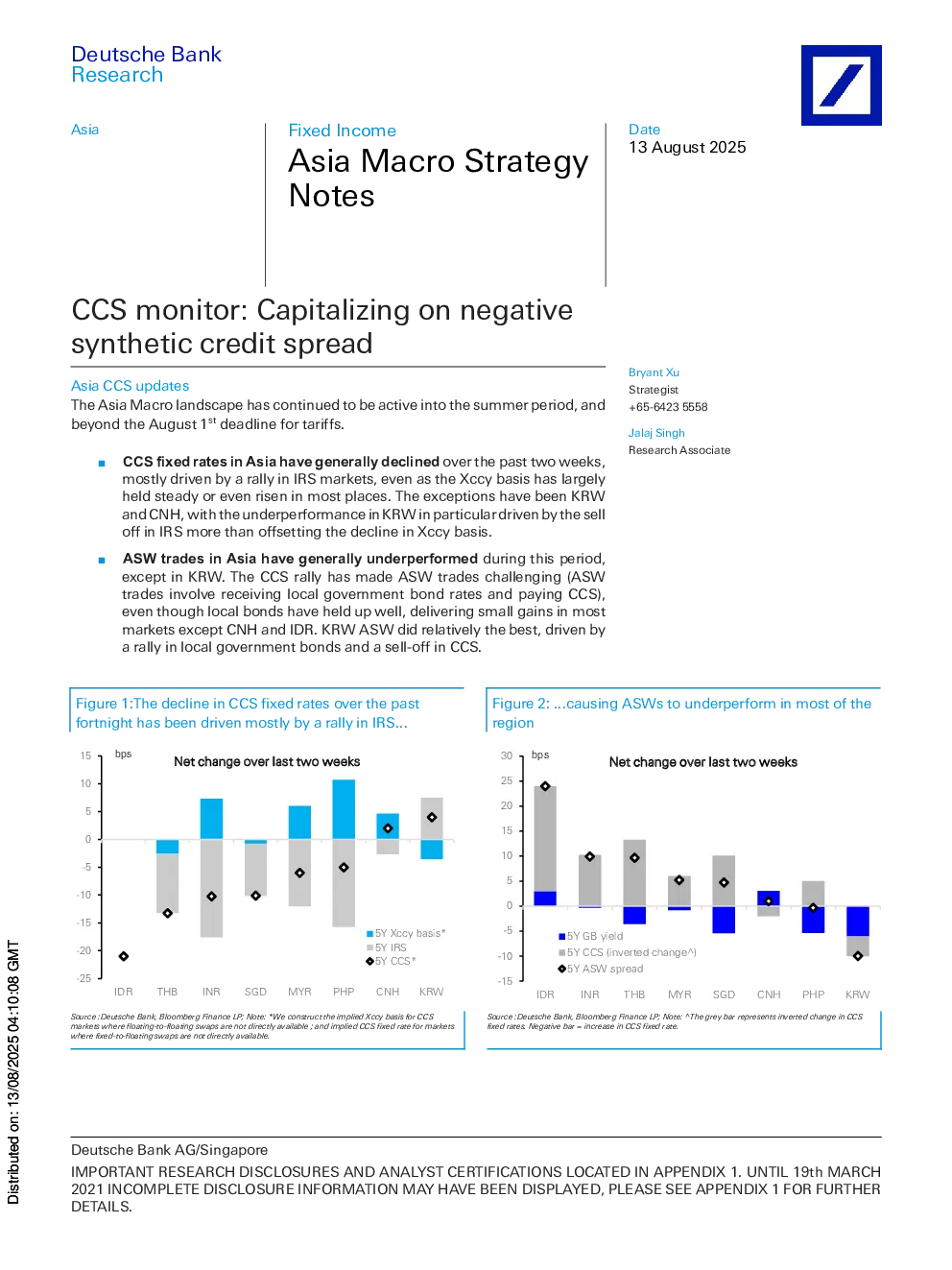
Asia 13 August 2025Date Asia Macro StrategyNotes CCS monitor: Capitalizing on negativesynthetic credit spread Bryant Xu Asia CCS updates Strategist+65-6423 5558 The Asia Macro landscape has continued to be active into the summer period, andbeyond the August 1stdeadline for tariffs. Jalaj SinghResearch Associate nCCS fixed rates in Asia have generally declinedover the past two weeks,mostly driven by a rally in IRS markets, even as the Xccy basis has largelyheld steady or even risen in most places. The exceptions have been KRWand CNH, with the underperformance in KRW in particular driven by the selloff in IRS more than offsetting the decline in Xccy basis. nASW trades in Asia have generally underperformedduring this period,except in KRW. The CCS rally has made ASW trades challenging (ASWtrades involve receiving local government bond rates and paying CCS),even though local bonds have held up well, delivering small gains in mostmarkets except CNH and IDR. KRW ASW did relatively the best, driven bya rally in local government bonds and a sell-off in CCS. Introducing the CCS carry monitor We are enhancing our CCS analytics offering with a carry monitor. This new monitorquantifies the carry and rolldown per month of receiving forward CCS trades. Itincludes fixed-to-floating cross currency swaps for CNH, INR, and KRW, andfloating-to-floating cross currency swaps for SGD, THB, MYR, EUR, AUD, and JPY. Receiving 5Y CCS in CNH, INR, and KRW is for the moment yielding positive carry,while receiving Xccy basis swaps in SGD and THB is yielding negative carry. Thiscarry varies across different tenors and forward starting periods. Capitalizing on negative synthetic credit spread (or ASWpickup over UST) in Asia There has been increased discussion of late around the possibility of Asia USDcredit spreads tightening into negative territory, i.e., Asia USD bond yields tradingbelow the theoretical risk-free UST yields. Local market investors are more familiarwith the idea of spreads tightening to inside of UST yields. TheASW pickup overUST, i.e., the difference between ASW all-in rates in USD and corresponding USTyields, which we will subsequently refer to as thesynthetic credit spread1,hasalready been negative in several Asian markets. This is mostly due to theremarkable rally of Asia ASW trades (versus UST). A few observations about the same; The average 10Y Asia ASW pickup over UST has tightened significantlysince 2020 and has flipped into negative since early 2024. Currently, amongthe major Asian markets, only Korea and Malaysia offer positive ASWpickups over UST ( Figure 6). 1The AsiaASW pickup over USTis referred to as thesynthetic credit spreaddue to its conceptualsimilarity to the traditional Asia USD credit spread. By using CCS, an ASW trade can effectivelytransform local currency government bonds into synthetic USD bonds. Consequently, the yielddifferential between these synthetic USD bonds and corresponding UST yields represents thesynthetic credit spread, a value that is equivalent to theASW pickup over UST. nThe Asia ASW rally (versus UST) initially mirrored a similar trend in DM ASWfrom 2020 to mid 2022. However, while DM ASW pickup over USTsubsequently widened sharply, the Asia spread has continued to tighten,suggesting unique regional dynamics at play. To understand the drivers behind this continued rally in Asia ASWs (versus UST), wecan decompose the Asia ASW pickup over UST into its component parts: bond-swap spreads and cross-currency (Xccy) basis. ASW pickup over UST= Local GB yield – Asia CCS + USD IRS – UST yield = Local GB yield – Asia IRS – Asia Xccy basis + USD IRS – UST yield= (Local GB yield – Asia IRS) – (UST – USD IRS) – Asia Xccy basis=(Asia bond swap spread) - (US bond swap spread) – Asia Xccy basis Since 2022, the 82 bps tightening in the Asia ASW pickup over UST has beenprimarily driven by two factors: nContrasting performance of bond-swap spreads in US and Asia.In theUS, bonds have underperformed swaps by 32 bps since 2022, likelyreflecting concerns about the large fiscal deficit and a higher risk premiumfor holding USTs. Conversely, the average Asia bond-swap spread hastightened by 19 bps, supported by gradual fiscal consolidation effortsacross the region following the pandemic. This dichotomy in bond-swapspread movements (Figure 7) has contributed approximately 51 bps totightening in the Asia ASW spread (versus UST). nIncreased Asia Xccy Basis.Cross-currency swap basis has been wideningalmost everywhere, likely because of availability of ample USD funding.Specifically in Asia, the proportion of FX deposits relative to total depositshas risen rapidly since 2022 (Figure 9), coinciding with an average increaseof 31 bps in the Asia Xccy basis (Figure 8). Ultimately, the tightening in Asian ASWs versus UST reflects a shift in global riskappetite and a growing preference for diversification away from US assets. The opportunities The negativesynthetic credit spread(orASW pic