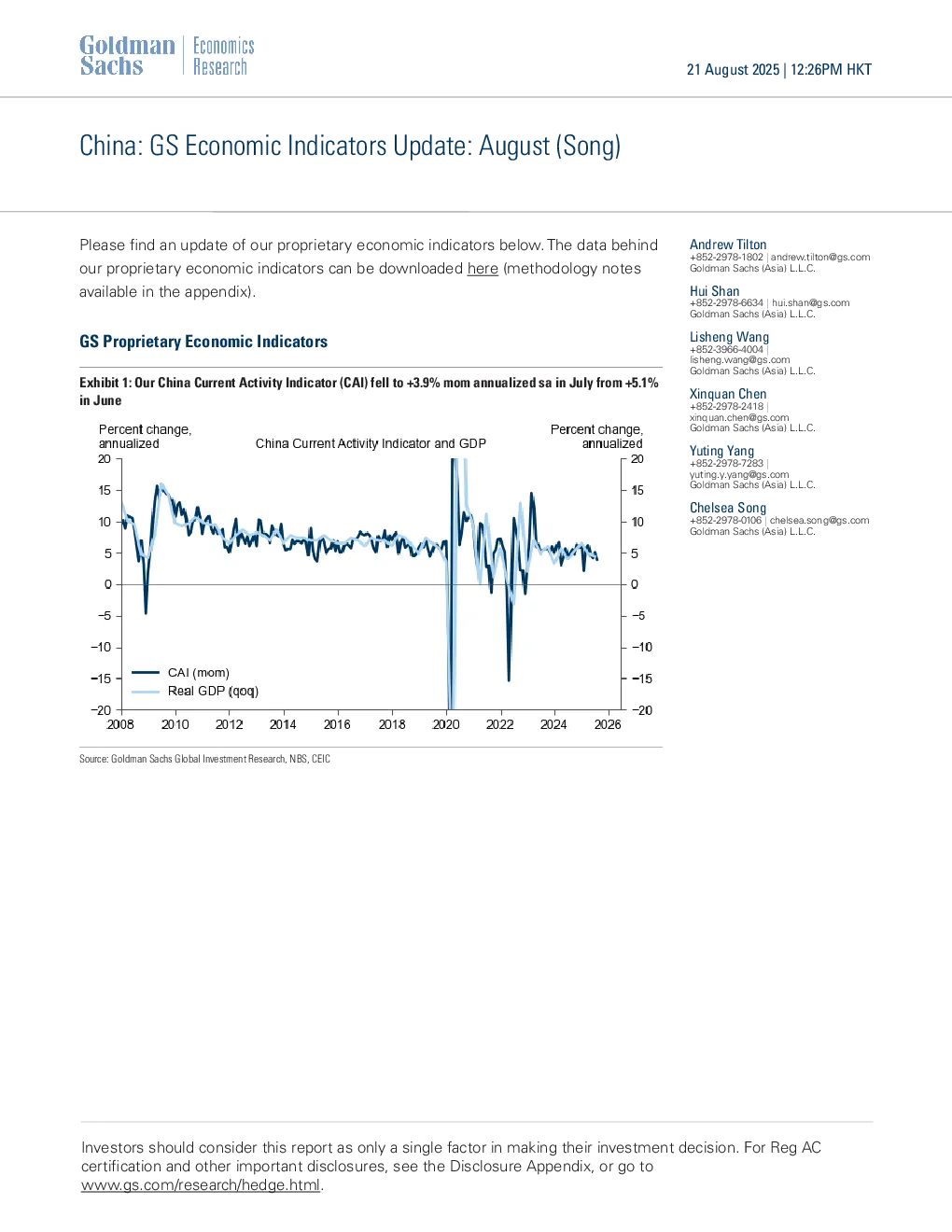
GS proprietary economic indicators update, including:
- China Current Activity Indicator (GSCNCAI): First principal component of real activity indicators (industrial production, electricity consumption, PMIs), expressed in GDP-equivalent units, recategorized for manufacturing, consumption, and other areas.
- Import-Implied Real Domestic Demand: Infers domestic demand by assigning Chinese imports to final demand sources using input-output tables, cross-checked with national accounts data.
- ChinaMAP Surprise Index: Summarizes importance and strength of economic indicators relative to consensus expectations.
- Construction and Manufacturing Growth Proxies: Median year-on-year growth of housing starts, steel, cement, glass (construction), and metal cutting machine, auto, power generating equipment, microcomputer (manufacturing).
- Revised Inventory Tracker: Based on commodities, PMI sub-indices, industrial enterprises finished goods inventory, and auto inventory, mapped into percentage of GDP terms.
- Revised "Outside-In" Trade Measures: Estimates export and import growth using mirror statistics from major trading partners, based on country-specific lead-lag relationships.
- Revised China Financial Conditions (FCI) Index: Tracks liquidity conditions via funding index (AA MTN yield, 3m SHIBOR, M2, TSF flows), equity market P/E ratio, and RMB on a trade-weighted basis.
- Estimated Growth Impact of FCI Impulse: Measures impact of FCI changes on GDP growth.
- Preferred Gauge of FX Flows: Tracks SAFE monthly net FX sales/settlement and net cross-border flows of RMB.
- China Domestic Macro Policy Proxy: Summarizes domestic macro policy stance from fiscal, monetary, credit, and housing policy aspects.
- Augmented Fiscal Deficit: Sum of effective on-budget fiscal deficit and off-budget fiscal deficit, estimated by major channels financing quasi-fiscal activities.
- Government Bond Financing Tracker: Measures monthly pace of government bond net issuance by bond type (CGGB, CGSB, LGGB, LGSB) and provides projections for the remainder of the year.
- Property Policy Relative Tightness Index: Tracks relative tightness of property policies in over 100 cities from demand (purchase restrictions, credit restrictions, sales restrictions), supply (price caps, presales restrictions, land transaction tax), and others (property speculation, land supply) aspects.
Methodology notes provided in the appendix detail the construction and calculation of each indicator, with data sourced from various providers including Goldman Sachs Global Investment Research, NBS, CEIC, Haver Analytics, Bloomberg, SAFE, Wind, and local governments.