您的浏览器禁用了JavaScript(一种计算机语言,用以实现您与网页的交互),请解除该禁用,或者联系我们。[世界卫生组织]:公共卫生形势分析-柬埔寨-泰国边境冲突 - 发现报告

公共卫生形势分析-柬埔寨-泰国边境冲突

公共卫生形势分析-柬埔寨-泰国边境冲突

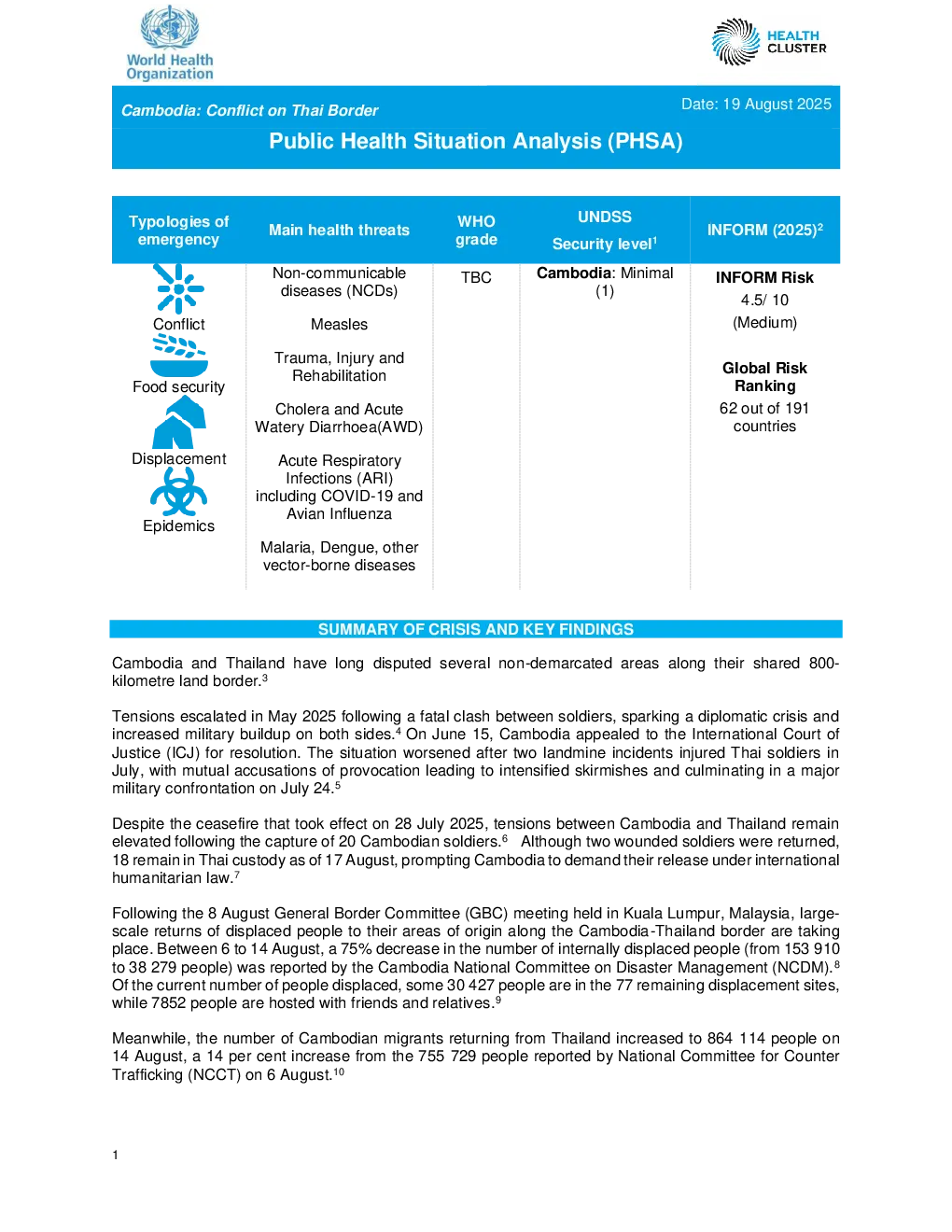
Cambodia: Conflict on Thai Border Public Health Situation Analysis (PHSA) SUMMARY OF CRISIS AND KEY FINDINGS Cambodia and Thailand have long disputed several non-demarcated areas along their shared 800-kilometre land border.3 Tensions escalated in May 2025 following a fatal clash between soldiers, sparking a diplomatic crisis andincreased military buildup on both sides.4On June 15, Cambodia appealed to the International Court ofJustice (ICJ) for resolution. The situation worsened after two landmine incidents injured Thai soldiers inJuly, with mutual accusations of provocation leading to intensified skirmishes and culminating in a majormilitary confrontation on July 24.5 Despite the ceasefire that took effect on 28 July 2025, tensions between Cambodia and Thailand remainelevated following the capture of 20 Cambodian soldiers.6 Although two wounded soldiers were returned,18 remain in Thai custodyas of17 August,prompting Cambodia to demand their release under internationalhumanitarian law.7 Following the 8 August General Border Committee (GBC) meeting held in Kuala Lumpur, Malaysia,large-scale returns of displaced people to their areas of origin along the Cambodia-Thailand border are takingplace. Between 6 to 14 August, a 75%decrease in the number of internally displaced people (from 153910to 38279 people) was reported by the Cambodia National Committee on Disaster Management (NCDM).8Of the current number of people displaced, some 30427 people are in the 77 remaining displacement sites,while 7852 people are hosted with friends and relatives.9 Meanwhile, the number of Cambodian migrants returning from Thailand increased to 864114 people on14 August, a 14 per cent increase from the 755729 people reported by National Committee for CounterTrafficking (NCCT) on 6 August.10 The escalation of armed conflict along the Thailand–Cambodia border since late May, culminating inairstrikes andmass displacement by late July,severely disrupted access to essential services.11The IDPsare facing urgent needs in shelter, health, food, education, protection, nutrition, and WASH. While somedisplaced populations are in planned shelters, many are staying in overcrowded schools, pagodas, or inthe open, with only plastic sheets or makeshift materials for cover. These conditions expose them to theelements and increase their vulnerability. Key gaps include overwhelmed hospitals, closed schools, lack ofclean water and sanitation, and heightened protection risks for vulnerable groups.12 As of31July 2025, Ministry of Defence of Cambodia report there were 13 deaths (five military; eightcivilians)and 71 injuries.13 HUMANITARIAN PROFILE DISPLACEMENT HEALTH NEEDS FOOD SECURITY PEOPLE IN NEED (PiN) Between 6 to 14August, a75%decreasein thenumber of internallydisplaced people(from 153910 to38279 people)wasreported.16 Displacement sitesface common illnessoutbreaks, includingscabies, exacerbatedby heat, poor shelter,and overcrowding.15 There is limited informationavailable on those in need,however there are currently118 796people stayingin120 evacuation centresas of6 August 2025.14 A substantial portionof the population facesfood insecurity,poverty and shocks.17 Humanitarian Response to Date The uncertainty of the situation is leading humanitarian partners to focus on a two-pronged approach,continued assistance and service provision to people in the remaining displacement sites and a shift toearly recovery assistance to vulnerable families returning, whose homes or livelihood assets were damagedor destroyed during the hostilities.18Some damage and needs assessments have taken place in areas ofreturn, with other assessments planned in the coming days to identify those households most affected andtheir level of vulnerability.19 On July 25, Cambodia's Ministry of Health activated an Emergency Health Response Committee withsecretariat andthree sub-committees: 1) emergency care and referral; 2) prevention, health education, andmental health andpsychosocial support; 3) logistics, equipment and supplies. At the provincial level, health departments launched a preparedness plan across with three levels ofemergency medical teams (EMT)and patients pathway, which consist of EMT 1 focusing on onsiteprimaryhealthcare servicesat temporary centers in collaboration with local authorities, EMT 2 focusing onintermediate careatdistrict hospital and selected healthcenters, and EMT 3for more advancedcare andtreatment. Under the coordination of Humanitarian Country Team (HCT),the Humanitarian Response Forum(HRF)wasactivatedto support the Governmenthumanitarianresponseto internally displaced population (IDPs)under leadership of National Committee for Disaster Management(NCDM) and Provincial CommitteeforDisaster Management (PCDM). Displacement Having reached a peak of 172 000 displaced people on 30 July, therewere153 910 displaced people asof 6 August. Of these, some 35 000 peoplewerewith friends and relatives, with the rest staying in 120displaceme